What is Tajweed and Why Does It Matter?
Tajweed (تجويد) comes from the Arabic root j-w-d, meaning “to make excellent.” In practice, tajweed is the science of reciting the Quran the way it was revealed, giving every letter its right and its due.
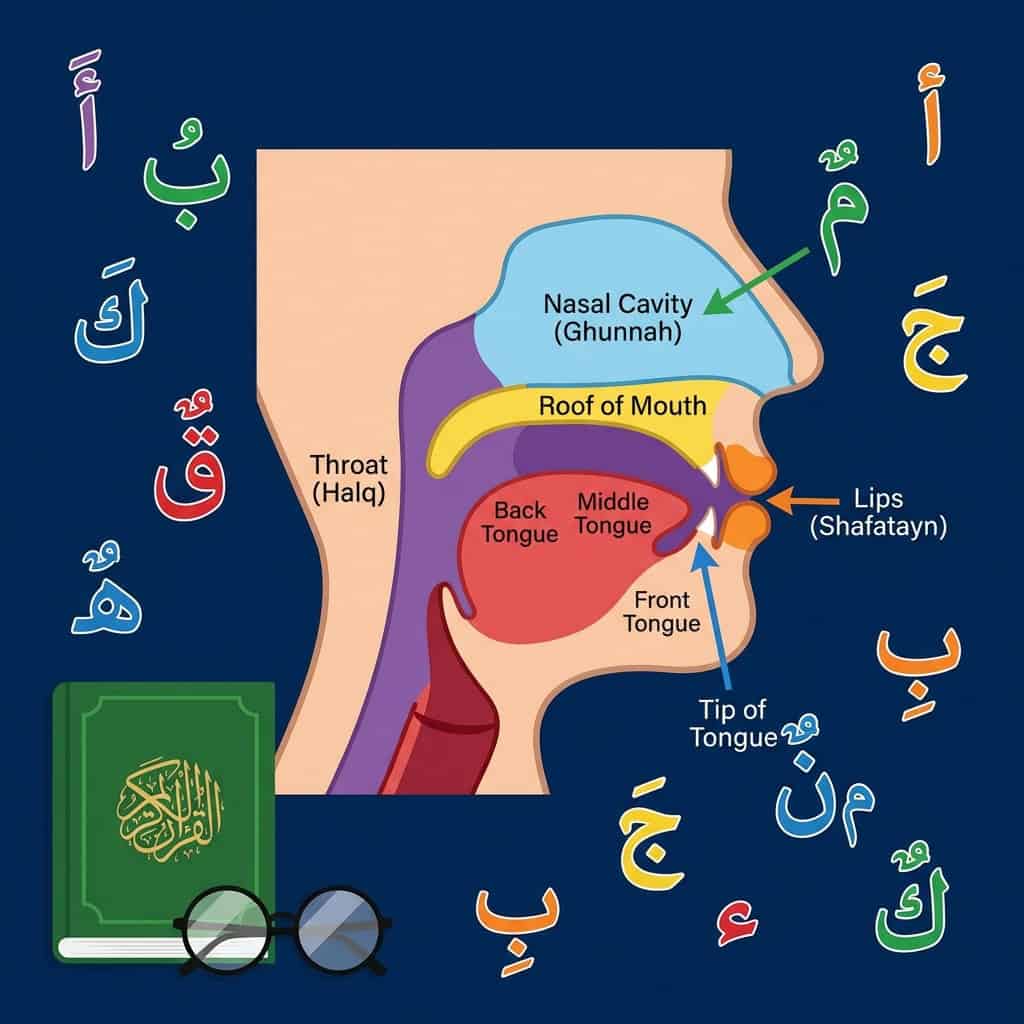
This isn’t just about sounding good. When you change how a letter is pronounced, you can accidentally change the meaning of an entire ayah. The word qalb (قَلْب, heart) becomes kalb (كَلْب, dog) with just a slight shift in where your tongue touches. That’s why scholars consider learning basic tajweed rules an individual obligation (fard al-‘ayn) for every Muslim who recites the Quran in prayer.
Allah says in the Quran: “…and recite the Quran with measured recitation (tartilan)” (Surah Al-Muzzammil, 73:4). This command is what tajweed fulfills.
Whether you’re new to the subject or you’ve been reciting for years, this guide breaks down every major tajweed rule with real Quranic examples. If you’re completely new, our introduction to what tajweed is covers the what and why before you dive into the rules.
The 4 Noon Sakinah and Tanween Rules (أحكام النون الساكنة والتنوين)
These are usually the first rules students learn, and for good reason. You’ll run into noon sakinah (نْ) or tanween (ً ٍ ٌ) on almost every line of the Quran. How you handle them depends entirely on which letter comes next.
1. Izhar (الإظهار) — Clear Pronunciation
When noon sakinah or tanween is followed by one of the six throat letters (ء هـ ع ح غ خ), you pronounce the noon clearly and fully. No hiding, no merging.
Example: In Surah Al-Fatihah (1:7), “أَنْعَمْتَ” (an’amta), the noon is clear before the ‘ayn (ع). You can hear the full noon sound before the ‘ayn.
2. Idgham (الإدغام) — Merging
When noon sakinah or tanween is followed by one of six letters (ي ر م ل و ن, remembered as يَرْمَلُونَ), the noon merges into the next letter. It’s like the noon disappears and gets absorbed.
There are two types here:
-
- Idgham with ghunnah (before ي ن م و): You merge the noon but keep a nasal humming sound for 2 counts. In Surah An-Nisa (4:123), “مِنْ يَعْمَلْ” sounds like “miyyahmal.”
-
- Idgham without ghunnah (before ل ر): Complete merging with no nasal sound at all. In Surah Al-Baqarah (2:5), “مِنْ رَبِّهِمْ” becomes “mirabbihim.”
Important exception: Idgham never happens when the noon sakinah and the next letter are in the same word. So in “الدُّنْيا” (ad-dunya), you do NOT merge, even though ya (ي) is an idgham letter.
3. Iqlab (الإقلاب) — Conversion
This is the simplest tajweed rule because it only involves one letter. When noon sakinah or tanween comes before ب (ba), you convert the noon into a meem (م) sound, held with a nasal hum for 2 counts.
Example: In Surah Al-Baqarah (2:27), “مِنْ بَعْدِ” is pronounced as “mimbahdi.” The noon becomes a meem before the ba.
4. Ikhfa (الإخفاء) — Concealment
For the remaining 15 letters of the Arabic alphabet (ت ث ج د ذ ز س ش ص ض ط ظ ف ق ك), the noon sakinah or tanween is partially hidden. It’s not fully pronounced like izhar, and it’s not fully merged like idgham. Think of it as somewhere in between, always with a nasal hum for 2 counts.
Example: In “أَنْتُمْ” (antum), the noon before the ta is partially hidden. You can feel your tongue NOT touching the roof of your mouth where it normally would for a full noon.
Ikhfa is the most common of the four rules, which makes sense given that it covers 15 out of 28 letters.
Every rule on this page is a description of a sound. You can learn the description perfectly and still produce the wrong sound, and there is no way to catch that from a page, because the one person who cannot hear your recitation objectively is you. Read a few lines aloud to an Al-Azhar teacher in a free trial lesson and you will know within minutes which of these rules you are actually applying.
Meem Sakinah Rules (أحكام الميم الساكنة)
These three rules work similarly to the noon sakinah rules but apply to meem with sukoon (مْ). They’re simpler because there are only three scenarios.
1. Idgham Shafawi (إدغام شفوي) — Labial Merging
When meem sakinah meets another meem, the two merge into one meem with shaddah, held with a nasal hum for 2 counts.
Example: In “كُنْتُمْ مُؤْمِنِينَ” (Surah Al-Baqarah, 2:91), the two meems blend into one prolonged meem.
2. Ikhfa Shafawi (إخفاء شفوي) — Labial Concealment
When meem sakinah comes before ب (ba), the meem is partially hidden with a nasal hum. Your lips don’t fully close the way they normally would for meem.
Example: In Surah Al-Fil (105:4), “تَرْمِيهِمْ بِحِجَارَةٍ,” listen for the partially hidden meem before ba.
3. Izhar Shafawi (إظهار شفوي) — Labial Clarity
Before any letter except meem and ba (so 26 other letters), meem sakinah is pronounced clearly. Lips close fully for the meem, then open for the next letter.
Watch out: When meem sakinah comes before و (waw) or ف (fa), beginners sometimes accidentally hide the meem because the lip movements are similar. Make sure you close your lips completely for the meem.
Madd Rules (أحكام المد) — Prolongation
Madd means to stretch a vowel sound. The three madd letters are alif (ا) after fathah, waw (و) with sukoon after dammah, and ya (ي) with sukoon after kasrah. How long you stretch depends on what comes after the madd letter.
Madd Tabee’i (المد الطبيعي) — Natural Prolongation
The baseline. When a madd letter is NOT followed by a hamza or sukoon, you hold it for exactly 2 counts. This is the foundation that every other madd rule builds on.
Example: “قَالُوا” (qaloo) in Surah Al-Baqarah (2:11). The alif and final waw each get 2 counts.
Madd Muttasil (المد المتصل) — Connected Prolongation
When a madd letter is followed by a hamza in the same word, you stretch for 4 to 5 counts. This one is obligatory (wajib).
Example: “جَاءَ” (jaa’a) in Surah An-Nasr (110:1). The alif before the hamza gets stretched to 4-5 counts.
Madd Munfasil (المد المنفصل) — Separated Prolongation
Same idea, but the madd letter ends one word and the hamza starts the next. You stretch for 4 to 5 counts (though some recitation styles allow shortening to 2).
Example: “قَالُوا آمَنَّا” in Surah Al-Baqarah (2:14). The waw at the end of “qaaloo” stretches because “aamanna” starts with hamza.
Madd Lazim (المد اللازم) — Necessary Prolongation
When a madd letter is followed by a permanent sukoon or shaddah (not one caused by stopping), you always stretch for exactly 6 counts. No flexibility here.
Example: “الضَّالِّينَ” in Surah Al-Fatihah (1:7). The alif before the lam with shaddah gets a full 6 counts. You hear this every single time Muslims pray, making it one of the most commonly practiced tajweed rules.
Madd ‘Arid Lil-Sukoon (المد العارض للسكون)
When you stop at the end of an ayah, the last letter gets a temporary sukoon. If there’s a madd letter before it, you can hold for 2, 4, or 6 counts. All three are acceptable.
Example: When stopping on “الْعَالَمِينَ” in Surah Al-Fatihah (1:2), the ya before the noon gets prolonged because the noon becomes silent when you stop.
Other Madd Types
Madd al-Badal: When hamza comes before a madd letter (opposite of muttasil). Duration: 2 counts. Example: “آمَنُوا” in Surah Al-Baqarah (2:9).
Madd al-Leen: When waw or ya with sukoon is preceded by fathah (not their matching vowel), and you stop on the next letter. Duration: 2, 4, or 6 counts. Example: “قُرَيْشٍ” in Surah Quraysh (106:1).
Madd al-Silah: Applies to the pronoun “hu/hi” (هُ/هِ). Gets prolonged when it sits between two voweled letters. If followed by hamza, it stretches to 4-5 counts.
Qalqalah (القلقلة) — The Bouncing Sound
Five letters produce a distinctive bouncing or echoing sound when they carry sukoon. The letters are: ق ط ب ج د, remembered by the phrase “قُطْبُ جَدٍّ” (qutbu jadd).
There are three levels, and the bounce gets stronger as you go:
-
- Qalqalah Sughra (Lesser): The qalqalah letter has sukoon in the middle of a word. Light bounce. Example: “يَقْطَعُونَ” in Surah Al-Baqarah (2:27).
- Qalqalah Kubra (Greater): The qalqalah letter is at the end of a word when you stop. Stronger bounce. Example: stopping on “الْفَلَقِ” in Surah Al-Falaq (113:1).
-
- Qalqalah Akbar (Greatest): The qalqalah letter has shaddah at the end of a word when you stop. Strongest bounce. Example: stopping on “الْحَقُّ” or “تَبَّ” in Surah Al-Masad (111:1).
A common mistake is turning the bounce into a full vowel sound. Qalqalah should be a quick, clean echo, not “qaa-tah-oon” for “يَقْطَعُونَ.”
Heavy and Light Letters (التفخيم والترقيق)
Some Arabic letters are always pronounced with a “full mouth” sound (tafkheem/heavy), while others are always light (tarqeeq). Getting this wrong is one of the most common mistakes non-Arab speakers make.
Always heavy: خ ص ض ط ظ غ ق (7 letters, remembered as خُصَّ ضَغْطٍ قِظ)
Always light: Every other letter except Ra and the Lam in Allah’s name, which follow special rules.
Special Rules for Ra (ر)
Ra switches between heavy and light depending on context:
- Heavy when it has fathah or dammah, or when it has sukoon and the previous letter has fathah or dammah. Example: “رَبِّ” (heavy, fathah on ra).
- Light when it has kasrah, or when it has sukoon and the previous letter has kasrah. Example: “رِجَالٌ” (light, kasrah on ra).
The Lam in Allah’s Name
This one catches many people off guard:
- After fathah or dammah, the lam in “الله” is heavy: “قَالَ اللَّهُ”
- After kasrah, it’s light: “بِسْمِ اللَّهِ”
Listen carefully to a skilled reciter and you’ll notice the difference immediately.
Sun and Moon Letters (اللام الشمسية والقمرية)
When the definite article “ال” (al-) comes before certain letters, the lam either merges or stays clear.
Sun letters (14 letters: ت ث د ذ ر ز س ش ص ض ط ظ ل ن): The lam merges into the following letter. “الشَّمْسُ” is pronounced “ash-shams,” not “al-shams.”
Moon letters (14 letters: ا ب ج ح خ ع غ ف ق ك م و هـ ي): The lam is pronounced clearly. “الْقَمَرُ” is pronounced “al-qamar.”
Ghunnah (الغنة) — Nasalization
Ghunnah is the nasal humming sound that comes from the nose, not the mouth. It lasts for 2 counts and appears in several situations:
- Noon or meem with shaddah: “إِنَّ” (inna), “ثُمَّ” (thumma)
- During idgham with ghunnah
- During ikhfa and iqlab
- During ikhfa shafawi
The strongest ghunnah occurs with noon and meem that carry shaddah. You should feel the vibration in your nose clearly when producing this sound.
10 Common Tajweed Mistakes Beginners Make
Tajweed scholars divide recitation errors into two categories:
Lahn Jali (اللحن الجلي) are major errors that change meaning. These include replacing one letter with another, changing vowels (saying “an’amTU” instead of “an’amTA” in Al-Fatihah changes “You bestowed” to “I bestowed”), or adding/removing letters. These errors are considered sinful.
Lahn Khafi (اللحن الخفي) are minor errors that don’t change meaning but violate tajweed precision. These are disliked but not sinful.
Here are the mistakes I see most often in students:
- Mixing up ح and هـ because both come from the throat but at different points
- Not distinguishing ص from س because saad is heavy and seen is light, but beginners pronounce them the same
- Ignoring ghunnah where it’s required, or adding it where it’s not
- Adding a vowel to qalqalah instead of keeping it as a clean bounce
- Rushing through madd and not giving the correct number of counts, especially for Madd Lazim (6 counts)
- Making every Ra heavy instead of checking whether it should be light
- Pronouncing the lam in sun letters like saying “al-shams” instead of “ash-shams”
- Stopping at places that change meaning because you ran out of breath
- Not applying idgham properly and pronouncing the noon fully when it should merge
- Treating all madd the same length instead of differentiating between 2, 4, 5, and 6 counts
How to Start Learning Tajweed (Practical Steps)
Reading about tajweed rules is useful, but tajweed is fundamentally an oral science. You learn it by listening and repeating, not just by reading. Here’s a realistic path:
- Learn the Arabic alphabet and basic reading first. You need to be able to read Arabic script before tajweed rules will make sense in practice. A Quran reading course for beginners is the right starting point.
- Start with Noon Sakinah and Meem Sakinah rules. These four + three rules appear constantly and will immediately improve your recitation.
- Add Madd rules next. Focus on Madd Tabee’i (2 counts) and Madd Muttasil (4-5 counts) first.
- Practice with a qualified teacher. A teacher can hear mistakes you can’t hear in yourself. Online Quran classes make this accessible from anywhere.
- Record yourself and compare. Listen to a Sheikh’s recitation, then your own. The gaps become obvious.
- Be patient. Nobody masters tajweed in a week. The Prophet (peace be upon him) said: “The one who recites the Quran and struggles with it, having difficulty, will have a double reward” (Sahih al-Bukhari 4937; Sahih Muslim 798).
Most of that practice happens at home, alone, in the days between lessons. Our guide to learning tajweed at home covers the daily routine in detail, along with the parts of tajweed that self-study genuinely cannot fix.
Frequently Asked Questions About Tajweed Rules
Is learning tajweed obligatory in Islam?
Scholars agree that applying basic tajweed rules to the extent that you don’t change the meaning of Quranic words is an individual obligation (fard al-‘ayn). Mastering the advanced details is a communal obligation (fard al-kifayah), meaning the Muslim community must have qualified reciters and teachers, but not every single person needs to reach expert level.
How many tajweed rules are there in total?
There’s no single fixed number because tajweed covers many interconnected categories: the 4 Noon Sakinah rules, 3 Meem Sakinah rules, around 9 types of Madd, Qalqalah (3 levels), Tafkheem/Tarqeeq, Ghunnah, Waqf (stopping) rules, and articulation points for all 28 letters. Some count around 20 main rules, while detailed breakdowns list 50 or more sub-rules.
Can I learn tajweed online?
Yes. Online one-to-one tajweed classes with a qualified teacher are highly effective because you get immediate feedback on your pronunciation. The teacher can hear exactly where your tongue is and correct you in real time. Many students actually progress faster online because they get undivided attention from their teacher.
How long does it take to learn tajweed?
Most students grasp the fundamental rules within 3 to 6 months of consistent study (2-3 sessions per week). Applying them naturally during recitation takes longer, usually 1 to 2 years of regular practice. Full mastery, to the level of earning an Ijazah certification, can take several years depending on your starting level. A structured Quran course with qualified teachers helps you progress faster.
What is the difference between tajweed and tarteel?
Tajweed is the set of rules. Tarteel is one of three speeds of recitation (the slow, measured pace that Surah Al-Muzzammil 73:4 refers to). You apply tajweed rules at whatever speed you recite. Tarteel just means you’re reciting slowly enough to reflect on the meaning while applying those rules carefully.
What’s the best book to learn tajweed?
For beginners, “Tuhfat al-Atfal” by Imam al-Jamzuri is the classic starting text. It’s a short poem covering Noon Sakinah, Meem Sakinah, and Madd rules. For more advanced study, “Al-Jazariyyah” by Ibn al-Jazari is the gold standard and is still memorized by tajweed students worldwide. Both are available with English explanations.
Start Your Tajweed Journey Today
Reading about tajweed rules is only the first step. The real improvement happens when a qualified teacher listens to your recitation and gives you specific, personal corrections.
At Quranic Mind Academy, our teachers hold Ijazah certifications and specialize in teaching tajweed to students at every level, from complete beginners to those preparing for their own Ijazah. Classes are one-to-one, so every minute is focused on your recitation.
Book a free trial class and hear the difference a qualified teacher makes in just one session.