
For most Muslims, the Quran is the one book they will pick up every day for the rest of their life. The reward attached to that habit is staggering. Each letter recited brings ten rewards. Jami at-Tirmidhi 2910 (graded hasan sahih by al-Tirmidhi) records the Prophet ﷺ saying:
“Whoever reads a letter from the Book of Allah will receive a reward, and the reward will be multiplied by ten. I do not say that Alif Lām Mīm is one letter, but rather Alif is a letter, Lām is a letter, and Mīm is a letter.”
That promise alone is enough. But the virtues of reading the Quran daily go beyond rewards counted in numbers. The Quran heals, calms, guides, and intercedes. This guide walks through what changes in a Muslim’s life when the Mushaf becomes a daily companion, with the verses and hadiths to anchor each claim.
Reading the Quran Is Worship in Its Highest Form
Allah commands in Surah Al-Muzzammil 73:4, trans. Abdel Haleem: “… recite the Quran slowly and distinctly.” Recitation is not a casual activity. It is worship, and worship has weight.
Three things flow from this:
- The act itself is worship, regardless of comprehension. A new Muslim sounding out the alphabet earns reward in the same currency as a scholar.
- The reward scales with effort. The Prophet ﷺ said the one who recites the Quran with difficulty earns a double reward (Sahih al-Bukhari 4937, Sahih Muslim 798).
- The angels gather around it. Authentic narrations describe gatherings of recitation as moments where mercy descends and Allah mentions those present to the angels (Sahih Muslim 2699).
The Five Virtues of Daily Quran Reading
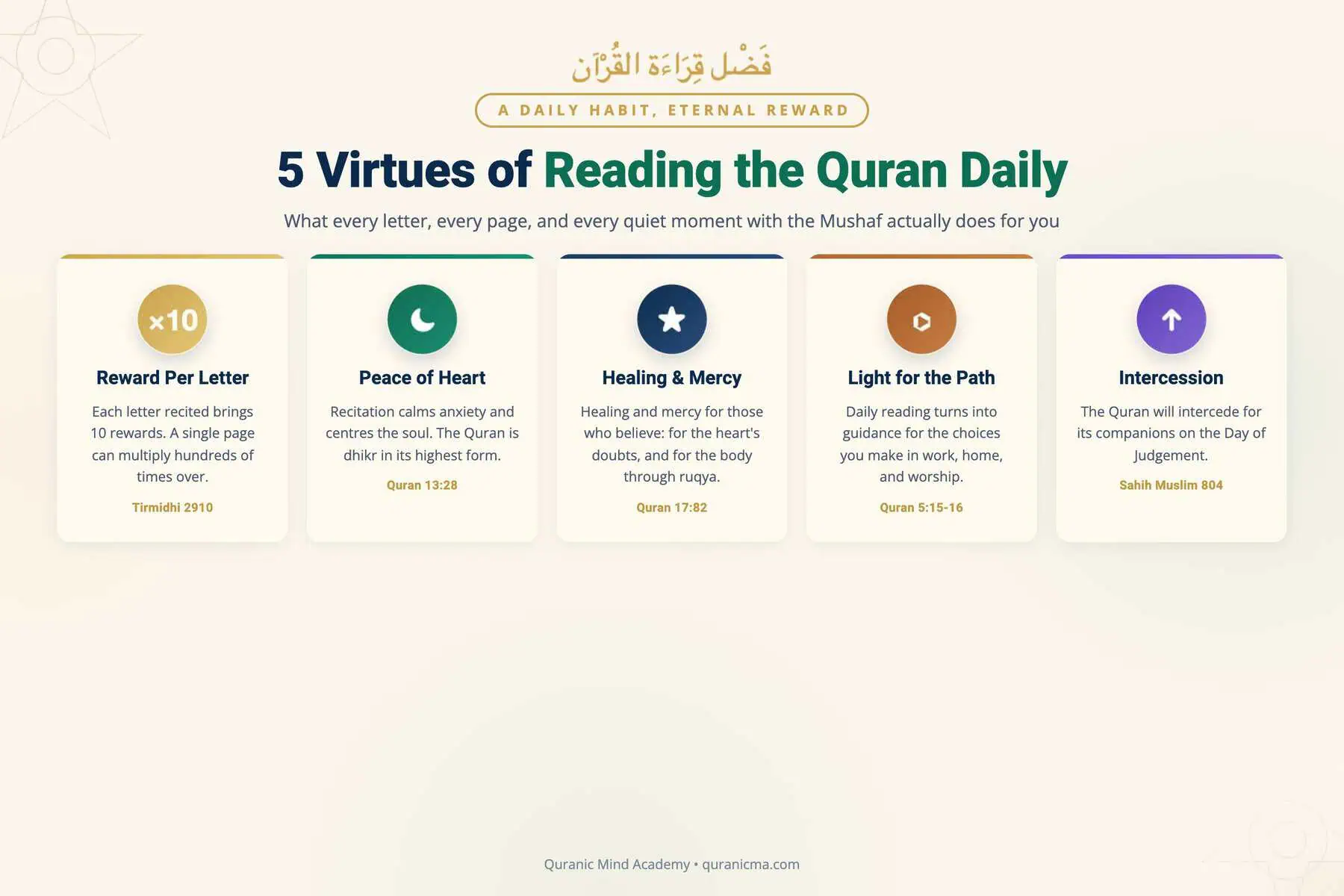
1. Peace That Settles in the Heart
Allah says in Surah Ar-Raʿd 13:28, trans. Abdel Haleem: “… truly it is in the remembrance of God that hearts find peace.” Recitation is the highest form of dhikr. Many students describe their morning recitation as the only ten minutes of the day where the mind is genuinely still.
2. Healing for the Body and the Soul
In Surah Al-Isrāʾ 17:82, trans. Abdel Haleem, Allah says: “We send down the Quran as healing and mercy to those who believe …” Classical scholars understood this on two levels: spiritual healing of the doubts, fears, and diseases of the heart, and physical healing through Prophetic ruqya using verses like Al-Fātiḥah (Sahih al-Bukhari 5007). A Muslim who recites daily is, in effect, taking spiritual medicine consistently rather than waiting until something breaks.
3. Light for the Path Ahead
In Surah Al-Māʾidah 5:15-16, trans. Abdel Haleem, Allah says: “… A light has now come to you from God, and a Scripture making things clear, with which God guides to the ways of peace those who follow what pleases Him …” The way that light shows up in daily life is small and quiet. A verse you read in the morning surfaces in the afternoon when you face a hard decision. A surah you recite weekly rewires your instinct toward forgiveness, patience, or generosity. The Quran is guidance the way a compass is guidance: not by shouting, but by always pointing.
4. Intercession on the Day of Judgement
The Prophet ﷺ said: “Recite the Quran, for indeed it will come on the Day of Resurrection as an intercessor for its companions.” (Sahih Muslim 804). Specific surahs are mentioned by name, including Al-Baqarah and Āl ʿImrān, which appear “like two clouds” defending those who recited them in the world. A daily reader is building this intercession quietly, page by page.
5. Reward Multiplied Ten Times Over
The mathematics are unforgettable. A page of the standard 604-page Madinah Mushaf holds about 550 Arabic letters on average (our count of the quran.com text). At ten rewards per letter, that is over five thousand rewards from a single page in less than five minutes. A daily reader who manages a page after Fajr is at around two million rewards a year from that habit alone, before counting the spiritual fruits.
Most people who read less Quran than they mean to are not short on intention. They are short on fluency, so every page costs more effort than it should and the habit quietly stops. That is a fixable problem, and it is usually the first thing a teacher works on. Book a free trial lesson and have someone listen to a page before you decide anything.
The Quran Reads You Back: Reflection (Tadabbur)
Recitation is the first step. Reflection is where the Quran begins to read you. Allah asks in Surah Muḥammad 47:24, trans. Abdel Haleem: “Will they not contemplate the Quran? Do they have locks on their hearts?” The verse links closed reflection to closed hearts. Reading without reflection is still rewarded, but reading with reflection is what changes a person.
Practical ways to add tadabbur to a daily reading session:
- Pause at the end of every page and ask one question: What is Allah trying to tell me here?
- Keep a short translation alongside the Mushaf for the verses you don’t yet understand.
- Pick one ayah a week and live with it. Carry it on your phone, write it on a card, repeat it during commutes.
- Connect verses to your real life. Surah Yūsuf to forgiveness, Surah Al-Kahf to patience, Surah Maryam to trust during hardship.
Specific Surahs the Prophet ﷺ Recommended Daily and Weekly
Several surahs carry their own protections and benefits when read on a regular schedule:
- Surah Al-Fātiḥah is a required part of every rakʿah for the imam and for the person praying alone. The Hanafi school holds that it is obligatory in the first two rakʿahs of an obligatory prayer and recommended in the remaining ones (islamweb fatwa 62272, citing Ibn Nujaym’s al-Bahr al-Raʾiq). Behind an imam the schools differ: the Shafiʿi school holds that the follower must recite it, while the Hanafi school holds that the follower should not (Dar al-Ifta al-Misriyyah, fatwa 5899). Outside the prayer, the Prophet ﷺ called it the “greatest surah” (Sahih al-Bukhari 4474).
- Ayat al-Kursī after every obligatory prayer: the Prophet ﷺ said nothing prevents its reciter from entering Paradise except death (Sunan an-Nasāʾī al-Kubrā 9848; Ibn Hibban included it in his Sahih, and Ibn Kathir notes that its chain meets al-Bukhari’s conditions).
- Surah Al-Mulk intercedes for its reciter until he is forgiven (Jami at-Tirmidhi 2891, graded hasan by al-Tirmidhi) and protects from the punishment of the grave (narrated by Ibn Masʿud, authenticated by al-Albani in al-Silsila al-Sahiha 1140).
- Surah Al-Kahf on Fridays brings light between the two Fridays (Mustadrak al-Hakim, authenticated by al-Albani in Sahih at-Targhib 736).
- Surah Al-Baqarah in the home keeps shayṭān at a distance (Sahih Muslim 780).
- The last three surahs (Al-Ikhlāṣ, Al-Falaq, An-Nās) three times in the morning and evening protect from harm (Sunan Abi Dawud 5082, graded hasan by al-Albani).
None of these need to be done all at once. Picking two or three and being consistent for a year does more than attempting all of them and burning out in a month.
Why Recitation Quality Matters
The Quran is not just words. It is words in a specific structure of sounds, rhythms, and pauses called Tajweed. Some mistakes, such as changing a letter or a vowel, can alter the meaning; others take away from the beauty and precision of the recitation.
This is why we encourage every adult learner to begin with a qualified teacher in online Quran classes for adults. Our Online Quran Recitation Course takes a beginner from the alphabet to fluent reading with Tajweed in around 18 to 24 months at three sessions a week. For more on the science itself, our Tajweed Rules guide explains every rule with examples.
The Virtues of Reading the Quran for Children
Children who grow up around recitation absorb the sound and rhythm of the Quran into the deepest layers of memory. A child who hears Al-Fātiḥah from a parent every week often carries that recitation for life, and early exposure makes later learning easier.
Beyond the spiritual reward, the daily Quran reading habit gives children:
- Discipline and focus that quietly transfers into school.
- A sense of Islamic identity that is internal, not imposed by external rules.
- Arabic phonemes that will make later Tajweed and Hifz dramatically easier.
- An emotional anchor for hard times. A child who associates the Quran with peace will return to it when life gets hard.
For families in the UK, this matters even more. Children grow up surrounded by English. Without a deliberate connection to the Mushaf at home, the Quran becomes a Friday object rather than a daily companion. We offer dedicated Online Quran Classes for Kids that build this habit early, with one-to-one Al-Azhar teachers and parent feedback every session. Parents and children learning together are covered on our online Quran classes in the UK page.
How to Start When You Don’t Know Where to Begin
Many adults want to read the Quran daily but have not been able to make it stick. The barrier is almost always one of these three:
- You can’t read Arabic yet. Start with Noorani Qāʿidah. In our teachers’ experience, most adults finish it in four to six weeks and can then read short surahs from Juz Amma at a slow but real pace.
- You can read but it is slow and full of mistakes. A teacher fixes this faster than self-study ever will. In our teachers’ experience, two months of one-to-one correction makes a lasting difference to a reader.
- You read fluently but don’t read consistently. The fix here is not knowledge, it is system. Pick the time of day where you have ten minutes that are reliably yours, attach Quran reading to an existing habit (after Fajr, with morning coffee, before sleep), and stop trying to do half a juz when one page would actually happen.
If you’d like a structured path, our course list covers reading, Tajweed, Arabic, memorisation, and Islamic Studies. Most students start with the recitation course and add other tracks once the daily habit is anchored. Two free trial classes are included before any commitment.
Reading vs. Memorising: Which Should You Prioritise?
Both are virtuous, and most students benefit from a combination. As a rough rule:
- If you cannot read fluently yet, daily reading is your priority. Memorising what you cannot read is fragile, and the verses fade quickly.
- Once you can read a page in five to seven minutes with reasonable Tajweed, light memorisation of the surahs you use in salah is the natural next step.
- Once you read fluently and have memorised half of Juz Amma, structured Hifz becomes realistic and sustainable.
For a deeper guide on memorisation specifically, see our Effective Methods to Memorize the Quran.
Reading the Quran in English Translation
If you are not yet fluent in Arabic, reading the Quran in English translation still carries enormous value. It builds an immediate connection to the meanings, prepares your heart before you can read the original, and lets you live with the verses while you learn the alphabet. A common path is to read translation for fifteen minutes in the evening while building Arabic recitation in the morning, until the two slowly converge.
Reliable English translations include those by Saheeh International, Mustafa Khattab (The Clear Quran), and Abdel Haleem (Oxford). Each has trade-offs but all three are accurate and modern in tone.
A Simple 7-Day Plan to Build the Habit
If you have never read the Quran daily for an extended stretch, the next seven days are a useful experiment:
- Day 1: Read Surah Al-Fātiḥah seven times slowly with a translation open. Notice every line.
- Day 2: Read the last three surahs (Al-Ikhlāṣ, Al-Falaq, An-Nās) three times each, morning and evening.
- Day 3: Listen to a single page recited by Al-Ḥuṣarī. Read along silently if you can.
- Day 4: Read aloud the first ten verses of Surah Al-Baqarah. Slowly, no rush.
- Day 5: Read Surah Al-Mulk before bed.
- Day 6 (Friday): Read the first ten verses of Surah Al-Kahf in the morning.
- Day 7: Look back. Pick the one moment of the week where the Quran landed clearly. That is your anchor verse for the next month.
Seven days is enough to feel the difference. Thirty days is enough for the difference to feel normal.
Related Guides
- Effective Methods to Memorize the Quran — proven techniques for sustainable Hifz.
- Complete Guide to Tajweed Rules — every rule explained with examples.
- Sciences of the Quran — the disciplines that surround the Mushaf.
- How the Quran Influences Muslims’ Lives Today
- The Impact of the Quran — how it transforms lives and hearts.
Frequently Asked Questions
What is the reward of reading the Quran daily?
Each letter recited carries ten rewards (Tirmidhi 2910, graded hasan sahih by al-Tirmidhi), and a single page can yield over five thousand rewards in less than five minutes. The spiritual benefits, including peace, healing, guidance, and intercession on the Day of Judgement, are layered on top of the numerical reward.
Can I earn reward for reading the Quran in English translation?
You earn the reward of reflection and understanding, which is itself praised, but the multiplier of ten rewards per letter applies specifically to reciting the Arabic. Most learners read both: translation for meaning and Arabic for recitation.
How much should I read daily to get the benefits?
One page consistently is more valuable than one juz once a week. Beginners should target five to ten minutes a day. Once that is automatic, increase gradually. Consistency is the variable that matters most.
Is it permissible to read the Quran without wudu?
Reciting from memory without touching the Mushaf is unanimously permitted. Most scholars hold that touching a printed Mushaf requires wudu. Dar al-Ifta al-Misriyyah allows someone for whom keeping wudu causes real hardship, to the point of abandoning their daily reading, to follow the scholars who permit it (fatwa 4823). Reciting in major impurity (after sexual relations, menstruation, or postnatal bleeding) follows specific rulings best discussed with a qualified scholar.
Why is the Quran considered a healing?
Allah Himself describes it as “healing and mercy” in Surah Al-Isrāʾ 17:82, trans. Abdel Haleem. The healing operates on two levels: spiritual healing of the heart from doubt, fear, and disease of character, and physical healing through Prophetic ruqya using specific surahs and verses.
How do I make Quran reading a daily habit that lasts?
Attach the reading to an existing habit (after Fajr, with morning tea, before bed), keep the daily target small enough that you cannot fail (one page, not one juz), and use the same Mushaf every day so your eyes know where verses sit on the page. The system carries you on days motivation does not.
Start Your Quran Reading Journey
If you want help building this habit, two free trial classes with one of our Al-Azhar teachers will give you a clear picture of where you are and where to start. No commitment, no pressure.
Start with 2 Free Trial Lessons →
Have questions? Chat with us on WhatsApp.