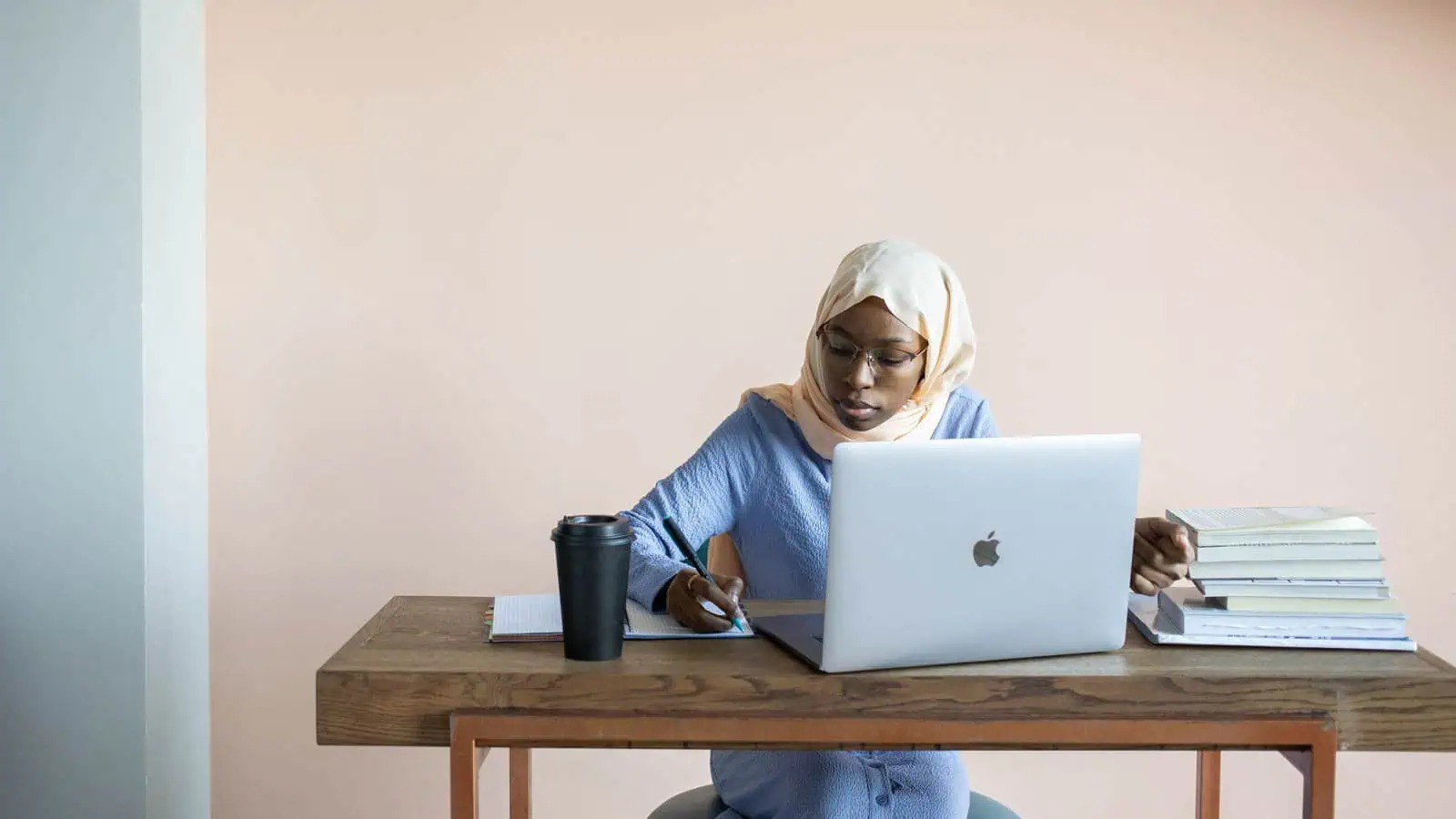

For a long time, studying Islamic Studies seriously meant travelling to a teacher, enrolling in a local institute, or simply hoping a knowledgeable relative had time to teach you. For Muslims living in the UK and across Europe, that often meant the option was not really there at all. Studying online has changed that completely. A qualified teacher, a structured syllabus, and a real classroom are now available from your own home, on your own schedule.
This guide explains what studying Islamic Studies online actually involves, which subjects matter most, how to choose a programme that is genuinely sound, and what realistic progress looks like. Everything here reflects how Islamic Studies are taught at Quranic Mind Academy, where students learn one to one with qualified teachers trained in the Egyptian Al-Azhar tradition.
Why seeking this knowledge matters
Before the practical detail, it is worth being clear about why this study is worth your time. The pursuit of religious knowledge is not optional decoration on top of faith. The Prophet ﷺ said: “Seeking knowledge is an obligation upon every Muslim” (Sunan Ibn Majah 224; the chain in Ibn Majah is very weak, but this opening sentence is authentic through other chains and was graded sahih by al-Albani in Hidayat al-Ruwat 214). It is a duty, not a hobby.
That knowledge is also a path with a destination. “Whoever travels a path in search of knowledge, Allah will make easy for him a path to Paradise” (Sahih Muslim 2699). And the Qur’an itself draws a sharp line between the two states: “Say, ‘How can those who know be equal to those who do not know?’” (Surah Az-Zumar, 39:9, trans. Abdel Haleem). To study is to move from one side of that line to the other. We explore this duty in more depth in our article on the importance of seeking knowledge.
What studying online actually looks like today
The picture many people still carry is of a pre-recorded video playing to no one. Genuine online Islamic Studies is nothing like that. A typical programme is built on live, scheduled lessons with a real teacher who can see your work, hear your questions, and adjust the pace to you.
A lesson usually combines a short reading from a set text, the teacher’s explanation, a chance for you to ask the questions that have been sitting with you all week, and a small amount of preparation for the next session. The screen is shared, the text is on it, and the conversation is two-way. It is a classroom that happens to be delivered through a camera rather than a building.

The subjects that make up Islamic Studies
Islamic Studies is not one subject. It is a family of connected disciplines, each answering a different question about how a Muslim believes, worships, and lives. A good programme introduces them in a sensible order rather than throwing everything at you at once.
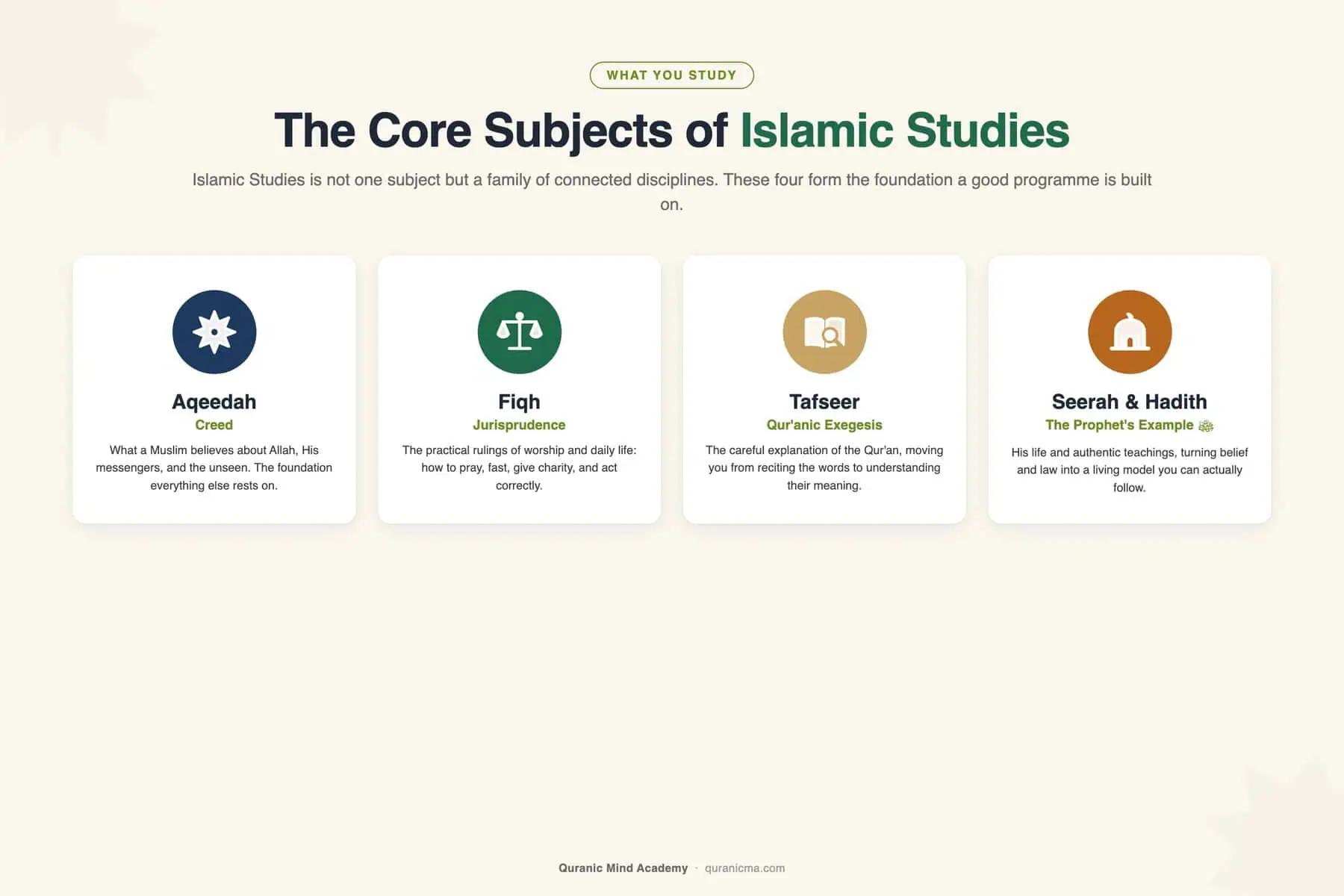
Aqeedah (creed) is the foundation: what a Muslim believes about Allah, His messengers, and the unseen. Fiqh (jurisprudence) is the practical side: how to pray, fast, give charity, and handle the rulings of daily life, which you can explore further in our overview of Fiqh principles. Tafseer is the careful explanation of the Qur’an, moving from reciting words to understanding them. And the Seerah and Hadith together give you the example of the Prophet ﷺ, turning belief and law into a living model you can actually follow.
These subjects are not separate boxes. Aqeedah gives Fiqh its meaning, the Seerah brings Tafseer to life, and Hadith threads through all of them. A teacher’s job is to keep showing you how they connect, which is part of how Islamic Studies are best taught.
Different ways to study, so it fits your life
One of the real advantages of learning online is flexibility in format, not just timing. Different people need different structures.
Some learners want a full, ordered curriculum that takes them from the basics through to a serious grounding over a year or more. Others want focused short courses on a single subject, such as the rulings of prayer or an introduction to Aqeedah. Many simply want a weekly one-to-one session where a teacher answers the questions their own life keeps raising. A good academy supports all three, because the goal is steady learning that survives a busy week, not a rigid timetable you abandon after a month.
Who benefits most
Online Islamic Studies suits a wider range of people than a local class ever could. Busy professionals fit lessons around work. Parents study after the children are asleep. Reverts, who often have the most questions and the least local support, get a patient teacher who starts from the very beginning without judgement. University students keep a connection to their faith while away from home.
It suits younger learners too, in a safe, supervised setting, building a foundation that schools in the UK and Europe rarely provide. For adults returning to study after years away, the experience is often a relief: there is no embarrassment in a one-to-one lesson, only patient teaching, something we cover in our guide for adult learners.
How to choose a sound programme
Not every online offering is trustworthy, and in matters of religion the quality of the source matters more than anywhere else. A few checks separate a serious programme from a weak one.
Look at the teachers’ grounding. Who trained them, and in what tradition? Knowledge in Islam is transmitted through reliable chains, not picked up casually. A programme rooted in an established scholarly tradition, such as the Al-Azhar tradition, gives you confidence in what you are being taught.
Check that it is live and interactive. Recorded videos can supplement learning, but they cannot correct your misunderstandings. Real teaching needs a teacher you can question.
Ask about structure. A serious programme has a syllabus and a sense of progression. If you cannot tell what you will know in six months, that is a warning sign.
Make sure it fits your level. A good programme assesses where you are and starts there, whether you are a complete beginner or returning to deepen what you already know.
The role of a real teacher
It is tempting to think that with so much material freely available online, a teacher is optional. The opposite is true. The flood of information is exactly why a guide matters. A teacher filters what is sound from what is doubtful, answers the question behind your question, and keeps you from the confident half-knowledge that does more harm than honest ignorance.
A teacher also keeps you accountable. It is easy to let private study slide; it is much harder to skip a lesson where someone is expecting you and tracking your progress. That gentle accountability is often the difference between intending to learn and actually learning. The honest learner’s prayer remains the one taught in the Qur’an: “Lord, increase me in knowledge!” (Surah Ta-Ha, 20:114, trans. Abdel Haleem).
The tradition a teacher belongs to matters as much as the subject. Knowledge that has been passed down carefully, teacher to student, across generations is more reliable than anything assembled from scattered articles. This is why the established schools of learning, like the Al-Azhar tradition of Egypt, place such weight on studying under recognised scholars rather than alone. When you study online with teachers trained in that way, you are not just downloading information; you are joining a chain of transmission that stretches back centuries.
What realistic progress looks like
Progress in Islamic Studies is quieter than people expect. There is rarely a single dramatic moment. Instead, over a few months, you notice that the khutbah makes more sense, that you understand why you pray the way you do, and that a verse you have heard a hundred times suddenly opens up.
In our teachers’ experience, a committed learner taking one or two lessons a week can build a solid grounding in the essentials of belief and practice within a year. Deeper study, especially of Tafseer and the sciences of Hadith, is the work of many years, as it has always been. The point is not to rush to a finish line but to keep walking the path, which is itself an act of worship.
A simple plan to begin
Starting is more straightforward than it looks. First, be honest about your level and your available time, even if that is just two short sessions a week. Second, choose a programme with qualified teachers and a clear structure rather than the first free video you find. Third, begin with the foundations, Aqeedah and the Fiqh of worship, before branching into the subjects that most interest you. Then simply keep going, because consistency over months is what turns a beginner into a knowledgeable Muslim.
Frequently asked questions
Is it difficult to start as a complete beginner?
No. A good programme assumes no prior background and starts with the foundations. Many of our students are complete beginners.
Do I need to know Arabic first?
Not to begin. Core subjects such as Aqeedah, Fiqh, and Seerah are taught in English, with Arabic terms introduced gradually. Learning Arabic alongside your studies deepens everything, but it is not a prerequisite for starting.
How long until I see progress?
In our teachers’ experience, most committed learners feel a clear difference in their understanding within a few months, and a solid grounding in the essentials takes around a year of steady weekly study.
Is online study suitable for reverts?
Especially so. Reverts often have many questions and little local support, and a patient one-to-one teacher who starts from the basics is exactly what helps most.
Can children study safely online?
Yes, in a supervised, one-to-one setting with a qualified teacher. For many families in the UK and Europe, it is the most reliable way to give children a structured Islamic education; our online Quran classes in the UK page shows how the lessons fit a UK week.
Begin your studies
Studying Islamic Studies online has removed the old barriers of distance and access. What remains is the same as it ever was: a sincere intention, a sound teacher, and steady effort. If you are ready to take the first step, you can book a free trial lesson and speak with a qualified teacher who will help you find your level and map out where to begin.