For many Muslim families in the UK and across Europe, giving children a proper Quran education used to mean a weekend trip to the local mosque, an evening class across town, or hoping a relative had the time and patience to teach. Those options still exist, but they do not suit every family or every child. Online Quran classes have become a calm, reliable alternative: a qualified teacher, a structured lesson, and a familiar home setting, all without the commute.
This guide explains how online Quran classes for children actually work, whether they are safe, what your child will learn, and how to tell a serious programme from a weak one. It reflects how children are taught at Quranic Mind Academy, where every child learns one to one with a qualified teacher trained to work with young learners.
Why parents are choosing online classes
The appeal is rarely about technology for its own sake. It is about removing the friction that used to make consistent Quran learning so hard. There is no travel, so a lesson fits into a school evening without eating the whole night. The teaching is one to one, so a shy child is not lost in a crowded room. And parents can see exactly what is happening, because the lesson takes place at the kitchen table rather than behind a closed door.
Underneath the convenience is something every Muslim parent feels as a duty. The Prophet ﷺ said: “The best of you are those who learn the Qur’an and teach it” (Sahih al-Bukhari 5027). Giving a child the ability to read the Book of Allah is one of the most lasting gifts a parent can offer, and online classes simply make that gift easier to give consistently.
There is comfort, too, in knowing the task is not as hard as it can look from the outside. Allah says of His Book: “And We have certainly made the Qur’an easy to remember, so is there anyone who will be mindful?” (Surah Al-Qamar, 54:17). Children, with their flexible memories and quick ears, often take to it more naturally than the adults around them expect.
Who these classes are for
Online Quran classes suit a wider range of children than a single local class ever could. They work for the complete beginner who does not yet know a single Arabic letter and needs a gentle, patient start, much as we describe in our wider guide to learning Quran for kids. They work for the child who has attended a mosque class but struggled to keep up or stay focused in a group. And they work for families simply wanting a calm, consistent routine they can rely on week to week.
Because the pace adapts to the individual child, a class can be slowed down for a nervous five-year-old or moved along for a confident ten-year-old who is ready for more. That flexibility is difficult to achieve in a room of twenty children working from the same page at the same speed.
What your child will actually learn
A good programme follows a clear sequence rather than jumping between topics. Children begin with the Arabic letters and their correct sounds, often through a structured primer such as the Qaida Noorani. From there they learn to join letters, then to read short words and verses, and gradually to read from the Mushaf itself.
Alongside reading, the teacher works on pronunciation through gentle, immediate correction, introducing the most essential rules of Tajweed as the child is ready for them. The aim at this age is not to overwhelm a child with rules but to build accurate habits and quiet confidence, so that reading the Quran becomes something they enjoy rather than dread.
How online classes work, step by step
Parents are often surprised by how simple getting started is. The process is designed to remove pressure from both the child and the family before any commitment is made.
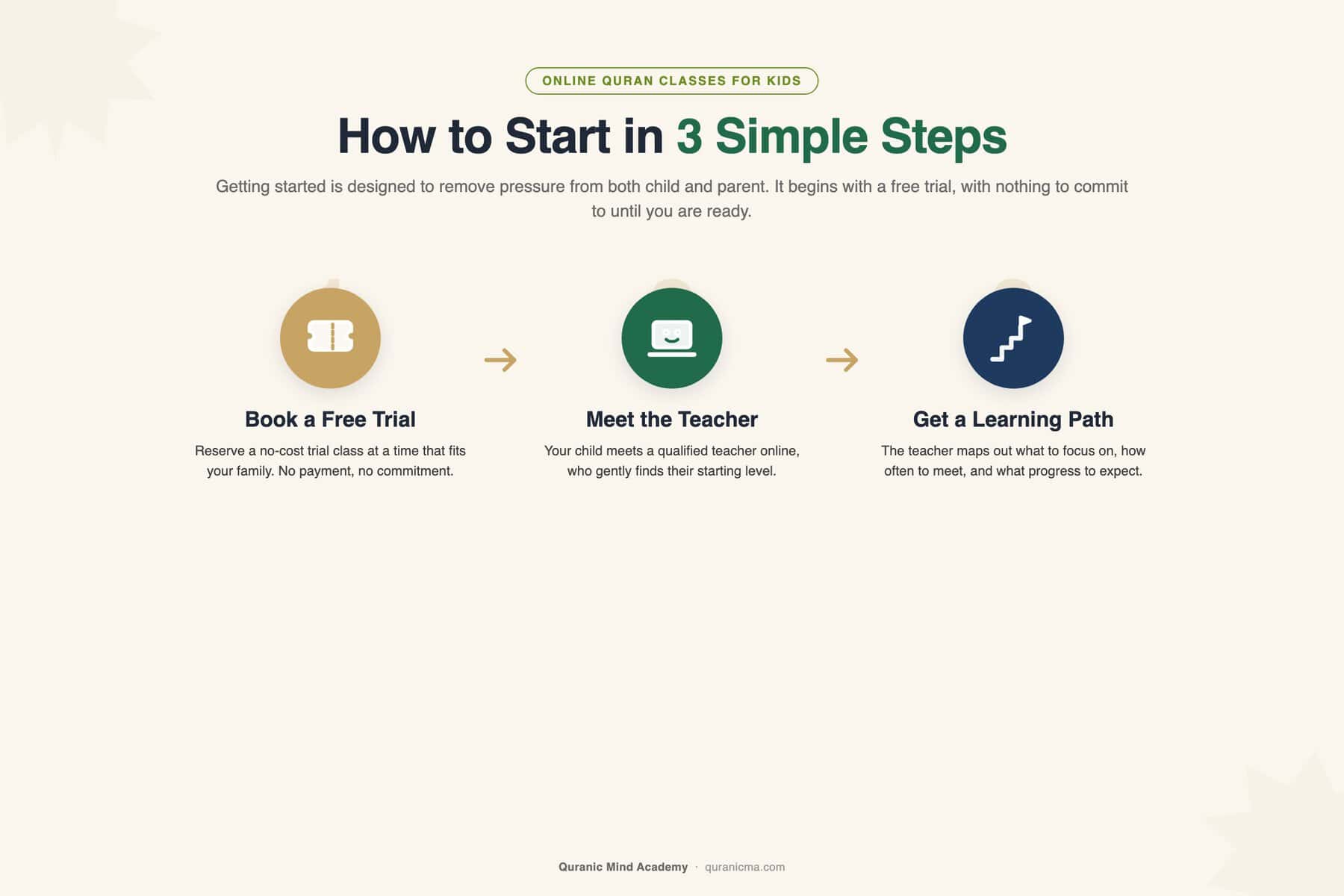
It usually begins with a free trial class, which lets your child meet a teacher and experience a lesson with nothing at stake. In that first session the teacher gently gauges where the child is, whether that is complete beginner or somewhere further along. Afterwards, the teacher suggests a simple learning path: what to focus on first, how often to meet, and what realistic progress looks like. Only then does the family decide whether to continue. There is no test to pass and no pressure to commit on the spot.
Is online Quran learning safe for children?
This is the question most parents ask first, and rightly so. A well-run online class is, in several ways, easier to supervise than a traditional one. The lesson happens in your own home, in a shared space, where you can see and hear what is going on. There is no drop-off at an unfamiliar building and no closed door.
A serious academy supports this with sensible safeguards: qualified teachers, lessons that parents are welcome to observe, and a setup designed to keep the focus squarely on learning. For many families, that visibility makes online learning feel safer than some of the alternatives, not less safe.
Keeping children engaged
Children do not learn the way adults do, and a teacher who understands that is the difference between a child who looks forward to class and one who resists it. Three things matter most at this age.
Lessons are kept short and clearly structured, because a young child’s attention is a limited resource and a focused twenty or thirty minutes achieves more than an exhausting hour. Correction is gentle and free of pressure, so that mistakes feel like a normal part of learning rather than a reason to feel small. And practice between lessons is kept light and realistic, the kind that fits around homework and family life rather than adding a heavy burden to the week.
How parents stay involved
Online learning does not push parents to the sidelines. If anything, it brings them closer to the process. Because the lesson is in the home, a parent can listen in, hear how their child is progressing, and pick up the correct pronunciation themselves to help with practice during the week.
The most effective Quran learning for children is a partnership between a patient teacher and an encouraging parent. A teacher provides the structure and correction; a parent provides the warmth and the gentle reminders that keep a routine alive. Children whose parents take a quiet, supportive interest almost always progress faster and enjoy it more. It is, in its own small way, an answer to the prayer of the believers: “Our Lord, grant us from among our spouses and offspring comfort to our eyes, and make us a model for the righteous” (Surah Al-Furqan, 25:74).
What about screen time?
It is a fair concern. Many parents work hard to limit their children’s hours in front of a screen, and a weekly online class can feel as though it cuts against that. The honest answer is that not all screen time is the same. A focused, supervised lesson with a real teacher, building a real skill, is closer to a video call with a grandparent than to passive scrolling. The lessons are short by design, the child is actively engaged rather than consuming, and a parent is usually nearby. Used this way, the screen is simply the doorway to a teacher, not the activity itself. For families who prefer it, our guidance on learning the Quran from home covers how to build a calm study routine around the lesson.
Choosing the right programme
Not every online class is equal, and a few checks help parents choose wisely. Look for genuinely qualified teachers who are trained to work with children, not just adults. Make sure lessons are live and one to one, so your child receives real attention and correction rather than a recording. Check that there is a clear structure and a sense of progression, so you can tell what your child will know in a few months. And look for an academy that welcomes a free trial, because a programme confident in its teaching will happily let you try before you commit.
Frequently asked questions
What age can my child start?
Most children can begin around the age of four or five, once they can sit and focus for a short session. A good teacher adjusts the pace and length of the lesson to suit very young learners. The early years are well spent building familiarity with the letters and a love of the sound of the Quran, long before the age at which the Prophet ﷺ instructed that children be taught to pray: “Command your children to pray when they are seven” (Sunan Abi Dawud 495).
Are online classes really effective for children?
Yes. One-to-one attention, a consistent routine, and immediate correction often make online learning more effective than a crowded group class, where a quiet child can easily be overlooked.
Can I observe my child’s class?
Absolutely, and you are encouraged to. The lesson takes place in your home, so listening in is natural. Many parents pick up correct pronunciation themselves this way.
How often should my child have lessons?
Two or three short sessions a week works well for most children. Regular, shorter lessons keep the Arabic script fresh far better than a single long class.
What if my child is shy or loses focus easily?
This is exactly where one-to-one online learning helps most. Without a group to feel self-conscious in, a shy child relaxes, and a patient teacher can hold a wandering attention far more easily than in a busy classroom.
Start with a free trial
Online Quran classes have made consistent, quality Quran learning realistic for children whose families could never quite make the local options work. With a qualified teacher, a calm home setting, and a parent’s quiet encouragement, a child can move from not knowing the letters to reading the Book of Allah with confidence.
If you would like to see how it works for your child, you can book a free trial class. Your child meets a teacher, you watch a real lesson, and there is no obligation to continue. It is the simplest way to find out whether online learning is right for your family. For older beginners and adults, our beginner reading course follows the same patient, structured approach.