
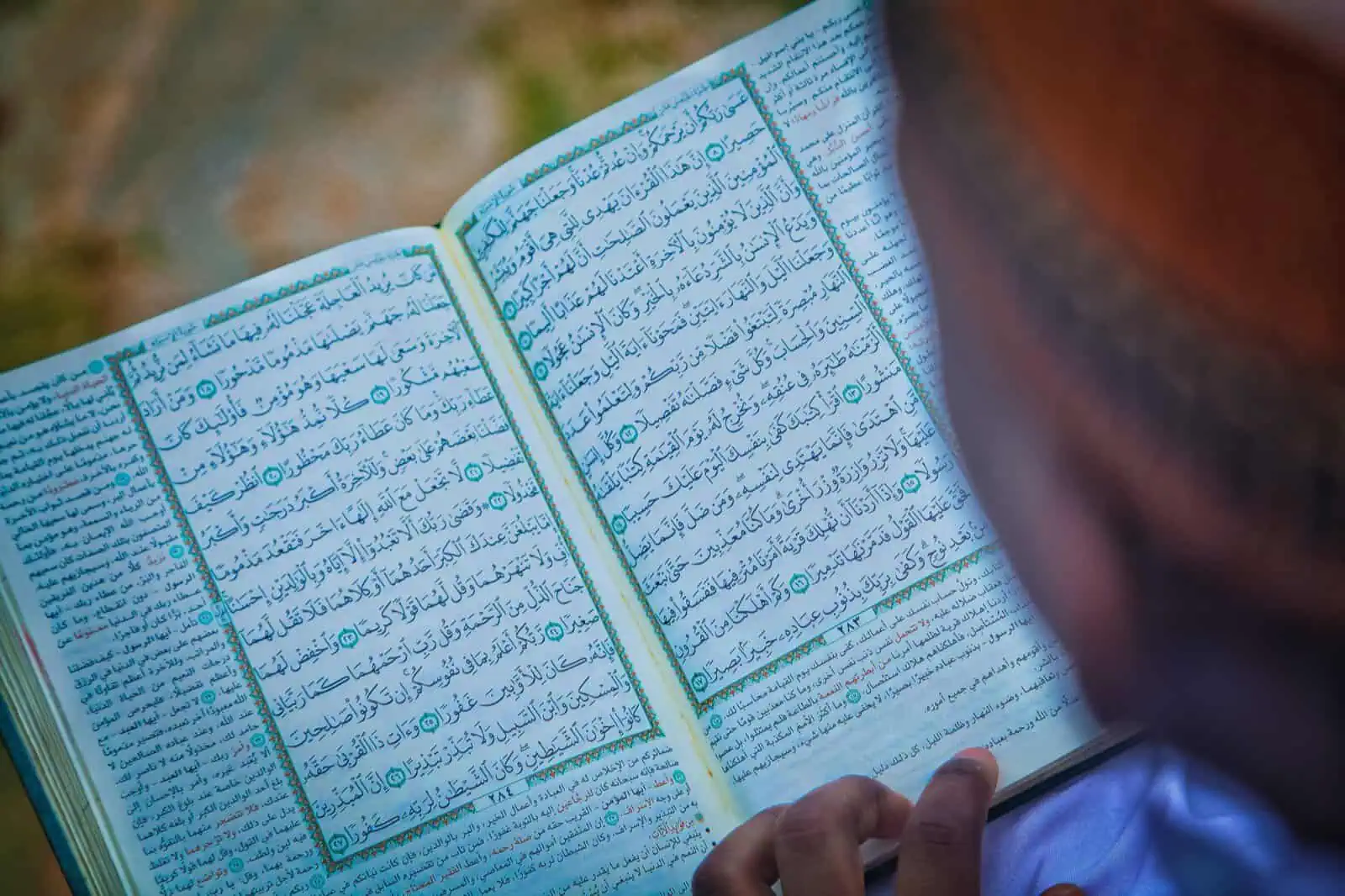
Ask a practising Muslim what holds their life together, and the answer almost always returns to one source: the Qur’an. Fourteen centuries after it was revealed, it still shapes how more than a billion people pray, speak, treat their families, earn a living, and face hardship. This article looks at how that influence actually works, why it reached far beyond the Arabs who first heard it, and what it takes to feel it in your own life rather than admire it from a distance.
It is a question worth answering carefully, because the Qur’an itself describes its purpose plainly: “This is the Scripture in which there is no doubt, containing guidance for those who are mindful of God” (Surah Al-Baqarah, 2:2, trans. Abdel Haleem). Guidance is not an abstract idea here. It is meant to change how a person lives.
How the Quran changed the first Muslims
The clearest evidence of the Qur’an’s power is what it did to the first generation who received it. In a single lifetime, it took a society fractured by tribal feuds, female infanticide, and endless blood vengeance and reshaped it into a community defined by justice, mercy, and worship of one God.
This was not the work of a new political slogan. It was the work of words that reached into hearts. When Aisha was asked to describe the character of the Prophet ﷺ, she answered simply: “His character was the Qur’an” (Sahih Muslim 746). He was a living example of what the Book asks of a person, which is precisely why those around him were transformed by it.
The change reached into the smallest corners of daily conduct. People who had buried daughters alive began to see the protection of the weak as a sacred duty. Tribes locked in generational revenge learned to forgive. Wealth that had been hoarded was redirected to the poor as an act of worship. These were not gradual cultural drifts but a direct response to verses being revealed and lived, week by week, in front of them.
Why its influence reached beyond the Arabs
If the Qur’an’s power were merely the beauty of its Arabic, its influence would have stopped at the borders of Arabia. It did not. Within a few centuries its message had reshaped the lives of Persians, Africans, Turks, and countless others who did not speak Arabic as a first language, and today it guides Muslims on every continent.
The reason is that the Qur’an addresses something universal in the human being. It speaks to the conscience, to the fear of death, to the longing for meaning and justice that every culture feels. Allah describes it as a healing for what is inside a person: “We send down the Quran as healing and mercy to those who believe …” (Surah Al-Isra, 17:82, trans. Abdel Haleem). A heart in need of healing is not an Arab heart or a non-Arab heart. It is simply a human one.
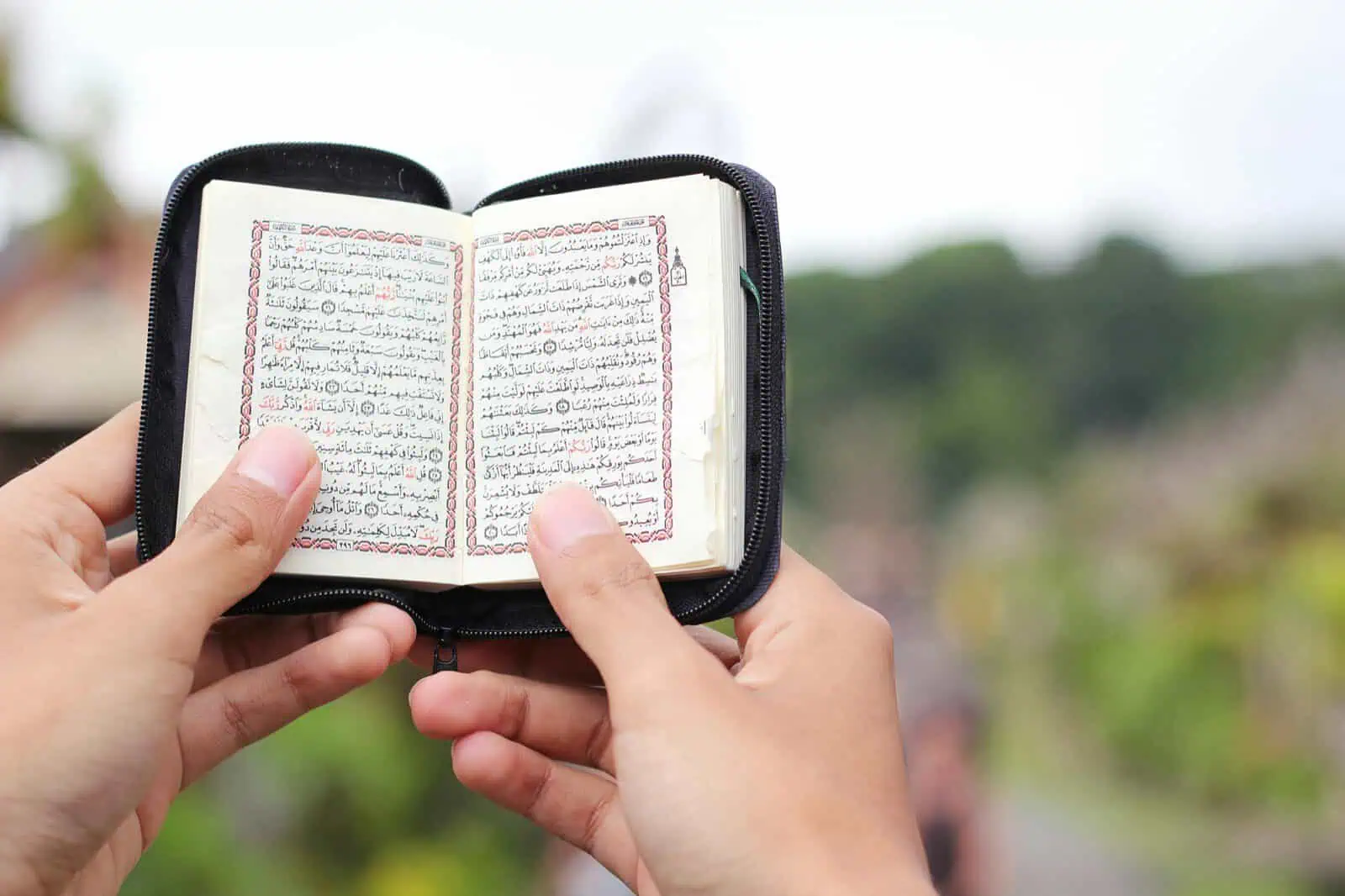
Where the Quran shapes a Muslim’s life today
The Qur’an’s influence is not confined to the prayer mat. For someone who lives with it, it quietly orders almost every part of daily life. Four areas stand out.
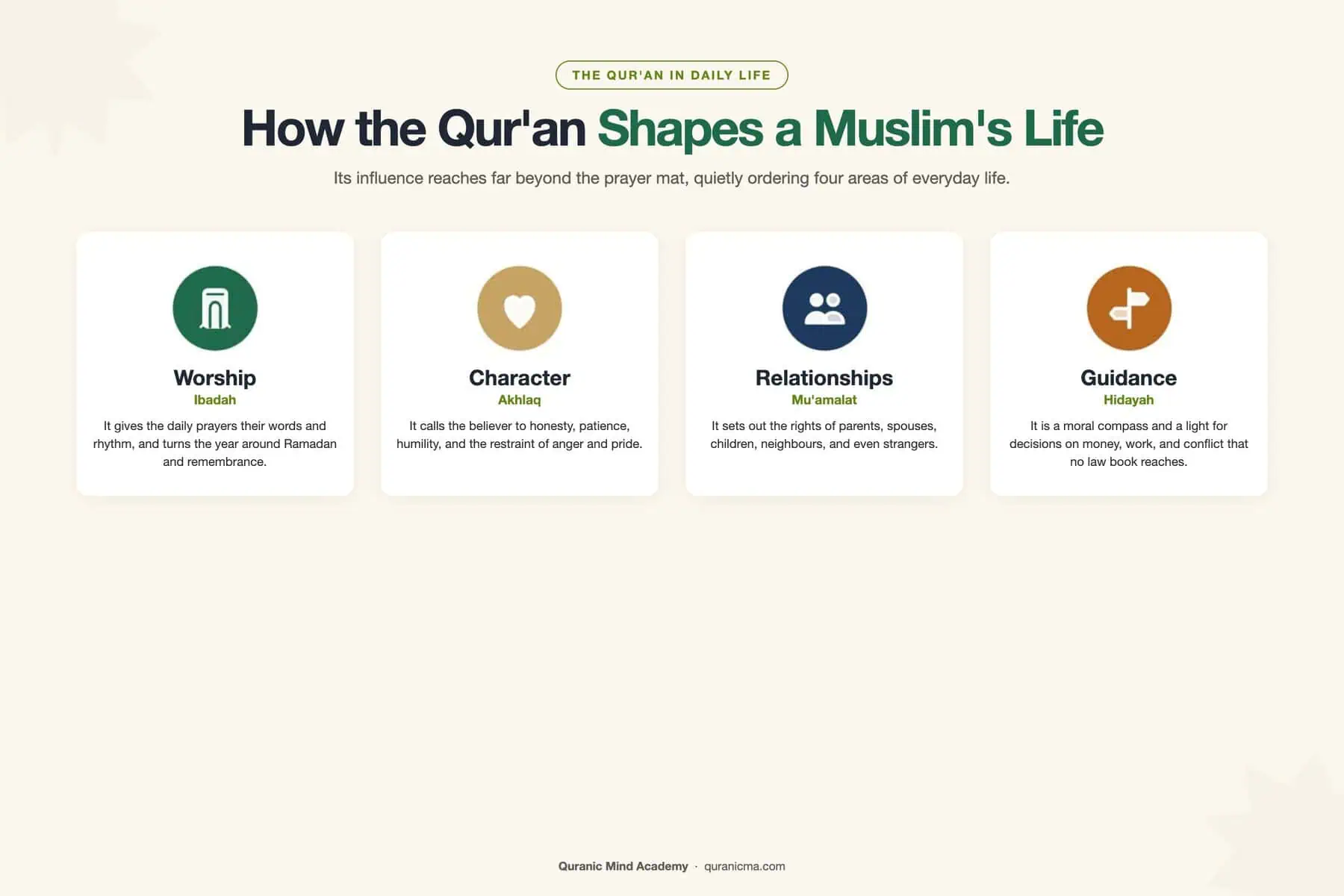
It shapes worship, giving the five daily prayers their words and rhythm and turning the year around Ramadan and the remembrance of Allah. It refines character, calling a believer to honesty, patience, humility, and restraint of anger long after anyone else would have looked away. It governs relationships, setting out rights for parents, spouses, children, neighbours, and even strangers. And it guides decisions, giving a Muslim a moral compass for questions of money, work, and conflict that no law book reaches into. Lived this way, the Qur’an is less a book on a shelf than a constant companion.
Why reading alone is not enough
Here is the difficulty many Muslims quietly feel: they read the Qur’an, sometimes daily, yet do not sense it changing them. The recitation is there, but the influence is faint. The reason is usually that recitation has become separated from understanding.
The Qur’an anticipates exactly this. It does not ask only to be recited; it asks to be pondered. “Will they not contemplate the Quran? Do they have locks on their hearts?” (Surah Muhammad, 47:24, trans. Abdel Haleem). And it states its own purpose: “This is a blessed Scripture which We sent down to you [Muhammad], for people to think about its messages, and for those with understanding to take heed” (Surah Sad, 38:29, trans. Abdel Haleem). Reading delivers the words to the tongue; reflection delivers them to the heart.
The role of proper learning
This is where most people get stuck, and it is rarely for lack of sincerity. They were taught to pronounce the Arabic but never to understand it, or they learned as children and never returned to it as adults with adult questions. The gap is not effort. It is structure and guidance.
Learning the Qur’an properly, with correct recitation through Tajweed on one side and meaning through study on the other, is what turns reading into reflection. A teacher who can explain why a verse was revealed, what a word actually carries, and how a passage applies to a modern life bridges the gap that private reading alone leaves open. This is also the heart of wider Islamic study, which gives the Qur’an its full context.
Building consistency through structured learning
Feeling the Qur’an’s influence is not the result of an occasional burst of motivation. It comes from consistency, the same small habit returned to week after week until it becomes part of who you are. The Prophet ﷺ said: “The most beloved of deeds to Allah are those that are most consistent, even if they are small” (Sahih al-Bukhari 6464).
For many Muslims today, especially busy adults and families across the UK and Europe, that consistency is hard to build alone. A regular lesson with a teacher, the format of our online Quran classes for adults, provides the structure that private intention often cannot sustain. Learning through online Quran classes removes the barriers of travel and timing, making a steady weekly rhythm realistic rather than aspirational. For UK families, the timetable and the pricing in pounds are on our online Quran classes in the UK page.
Reflection (Tadabbur): the key to lasting influence
The single practice that deepens the Qur’an’s influence more than any other is tadabbur: slow, deliberate reflection on its meaning. It is the difference between reading a letter from someone you love quickly and reading it slowly, weighing every line.
Tadabbur does not require scholarship to begin. It requires only that you slow down. Read a short passage with its translation and pause on it. Ask what it is asking of you specifically, today. Pick a single verse and carry it through your day, noticing where it applies. Return to the same passage over weeks and watch it open further. Done regularly, this is what moves the Qur’an from the page into the way you actually live, and it builds on the guidance the Qur’an offers at every stage of life.
How this shows up in faith, character, and relationships
When reading, understanding, and reflection come together, the change is gradual but unmistakable. Faith steadies, because conviction now rests on understanding rather than habit. Character softens, as the constant reminders of patience and humility slowly wear down old reflexes of anger and pride. And relationships improve, because a person shaped by the Qur’an becomes more forgiving, more just, and more attentive to the rights of others.
None of this happens overnight, and none of it happens by accident. It is the natural fruit of a sustained relationship with the Book, which is the very thing the Qur’an promises to those who hold to it. The reward described for that effort is itself part of the encouragement, captured in the related virtues of reading the Qur’an.
A companion in hardship
Perhaps the clearest place the Qur’an’s influence shows today is in difficulty. When a Muslim faces grief, illness, anxiety, or loss, it is to the Qur’an that they most often turn, and not out of habit alone. The Book speaks directly to a troubled heart: “… truly it is in the remembrance of God that hearts find peace” (Surah Ar-Ra’d, 13:28, trans. Abdel Haleem).
In a time of widespread anxiety, that steadying effect is something many Muslims describe in almost identical terms: a recitation listened to on a hard night, a verse remembered in a moment of fear, a passage that puts a worldly worry back into perspective. The Qur’an does not always remove the difficulty, but it reliably changes how a believer carries it. This quiet anchoring in the middle of modern life is, for many, the most personal proof of its influence.
Frequently asked questions
How does the Quran influence Muslims today?
It shapes daily worship, moral character, family and social relationships, and personal decisions. For a practising Muslim it functions as a constant guide rather than an occasional reference.
Can non-Arabs truly feel the Quran’s impact?
Yes. The Qur’an addresses universal human needs, and its meaning can be studied and reflected upon in any language. Its influence has never been limited to Arabic speakers.
Why do some Muslims read the Quran but feel little change?
Usually because recitation has become detached from understanding. Reflecting on the meaning, ideally with proper teaching, is what allows the words to actually shape a person.
What makes the Quran’s influence last?
Consistency and reflection. A small, regular habit of reading with understanding does far more over time than rare bursts of intense effort.
Can online classes help me feel more connected to the Quran?
For many people, yes. A structured weekly lesson with a teacher provides the accountability and understanding that private reading alone often lacks.
Bring the Quran into your daily life
The Qur’an’s influence on Muslims today is as real as it was in the first generation, but it is not automatic. It grows in proportion to how seriously a person reads, understands, and reflects on it. The Book is willing; the question is how closely we are willing to listen.
If you would like to move from reciting the words to understanding and living them, you can book a free trial lesson with a qualified teacher who will help you read with understanding and reflect with purpose.