
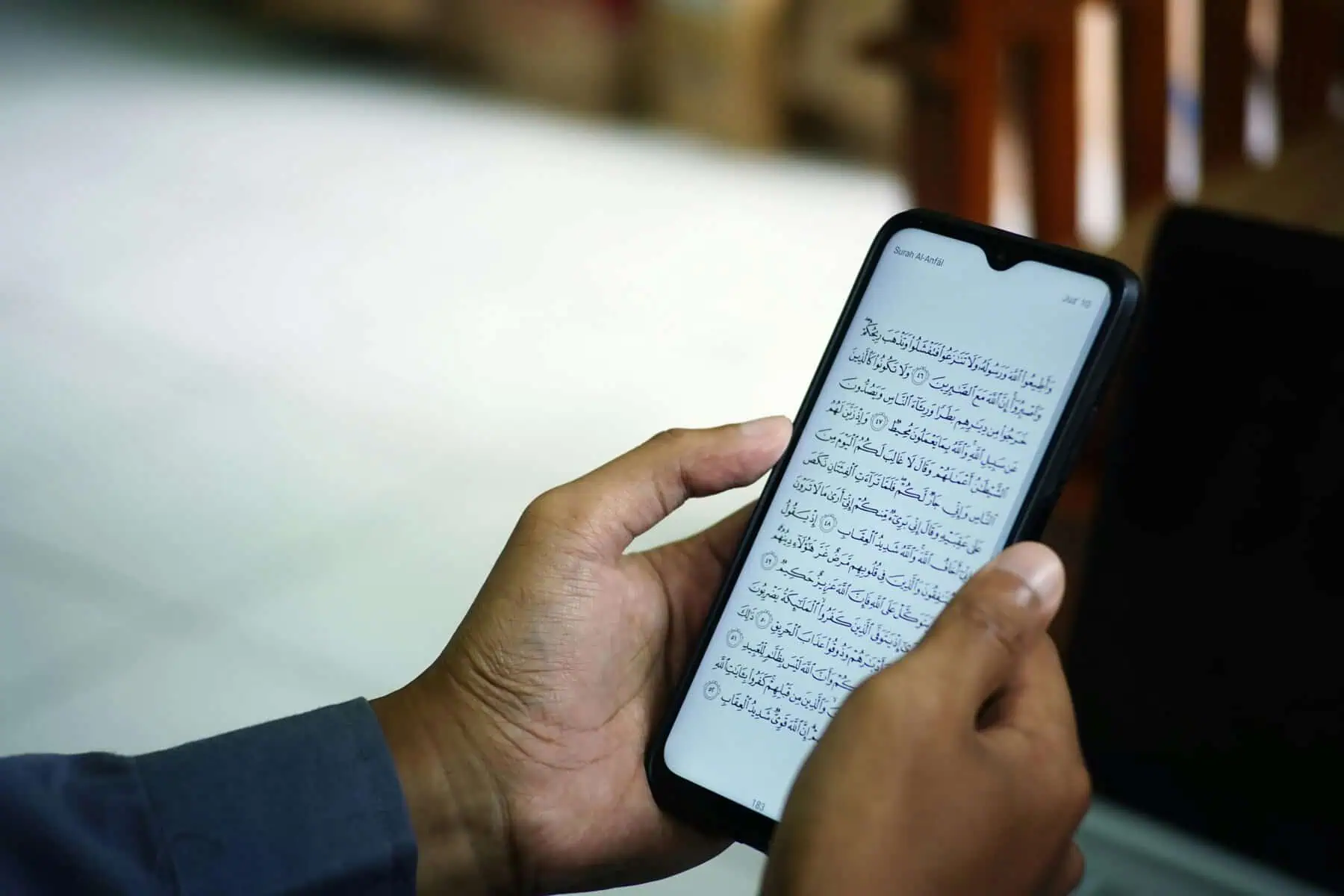
Memorising the Quran is harder than memorising any other text. Each verse needs to come back letter-perfect, in the right Tajweed, often years after you first learned it. The right app does not replace a teacher, but it does three things well: it makes daily revision happen, it catches mistakes you cannot hear yourself making, and it turns the long arc of Hifz into measurable progress.
This guide covers eight Quran memorization apps that genuinely earn their place on a Hifz student’s phone in 2026. Each is reviewed for what it does well, where it falls short, who it suits, and what it costs.
One note before the list. Apps work best as the second tool, not the first. The first is a qualified teacher. The Hifz programme that actually finishes for most students looks like this: daily one-to-one lessons, a structured revision schedule, and one or two of these apps filling the gaps between lessons. We come back to that at the end.
What makes a good Quran memorization app
Before the list, the rubric. These six features separate apps that help with Hifz from apps that just display the Mushaf:
- Recitation listening. The single most important feature. The app listens while you recite and flags mistakes in real time. Without this, you are reading the Mushaf with extra steps.
- Verse-by-verse repetition control. Loop a single verse, a half-verse, or a custom range, with adjustable repeat count and pause between repeats. Many apps fail this basic test.
- Spaced repetition for revision. Hifz collapses without revision. Good apps schedule old material to surface again at intervals that match how memory actually decays.
- Reciter selection with consistent qira’ah. Pick one reciter (Mishary, Al-Sudais, Al-Husary, Al-Minshawi) and stay with them. Switching reciters mid-juz is a common reason memorisation collapses.
- Mushaf with line-locked layout. Hifz students lock pages of the Mushaf to memory; a layout that reflows breaks visual recall. The 15-line Madinah Mushaf is one of the most widely used layouts for Hifz.
- Offline mode. Salah on the bus. Revision in a place with no signal. Audio downloaded ahead of time is non-negotiable.
The apps below all hit at least four of the six. The ones that hit all six are noted explicitly.
The 8 Best Quran Memorization Apps in 2026
1. Tarteel AI — Best overall
Free with paid Premium · iOS, Android, web · 4.7/5 App Store · 4.6/5 Google Play (108,000+ reviews)
The one to install first. Tarteel listens while you recite and highlights mistakes in real time — missed words, swapped words, gaps. The AI is trained on thousands of hours of qari recordings and works on adult and child voices alike. Memorisation Mode lets you pick a verse range and recite it back; the app verifies and tracks progress over time.
Where it falls short: the free tier limits how many verses you can run through the AI per day. Premium removes the cap and adds advanced analytics. The Tajweed-error feedback is improving but is not yet at the level of a human teacher’s ear, especially on the finer rules of madd and idghaam.
Best for: anyone serious about Hifz who wants real feedback between lessons.
An app can hear that you dropped a word. It cannot hear that your qaf is coming out as a kaf, because it matches your recitation against the text rather than against the point each letter is articulated from. Those errors set hardest, because you rehearse them every day without knowing. Recite a page for an Al-Azhar teacher in a free trial lesson and find out which ones you have.
2. Memorize – Explore the Quran (Greentech) — Best for kids and visual learners
Free with in-app purchases · iOS, Android · 4.8/5 App Store
Built around the pattern-repeat method: the verse plays, you repeat aloud, the app moves on, then comes back. The interface is simple enough for a 7-year-old. The Mushaf view matches the 15-line Madinah print, which is critical for visual recall.
Where it falls short: no recitation listening. The app cannot hear if you got the verse wrong; it relies on your honesty.
Best for: children learning their first juz, and adult learners who absorb better by listening than by reading.
3. Quran Companion — Best for gamified daily habit
Free with Premium · iOS, Android
A spaced-repetition system wrapped around the Mushaf. Set a daily goal; the app delivers your new verses for the day plus the old verses scheduled for revision, and you tick them off as you go. Streaks, badges, leaderboards. It works because Hifz is, at its core, a habit problem — and Quran Companion treats it as one.
Where it falls short: no recitation listening, so it cannot verify you actually said the verse correctly. Some learners find the gamification becomes its own goal.
Best for: students who struggle to show up daily and need an external nudge.
4. Ayah – Quran App — Best free, no-fluff option
Completely free, no ads, no in-app purchases · iOS, Android
Open-source. Maintained by IslamicNetwork. Clean Mushaf view, multiple reciters, verse-by-verse repeat with adjustable count and pause. Bookmarks and a personal “memorisation” tag. No AI, no listening, but everything else done quietly well.
Where it falls short: development cadence is slow; new features arrive every six months or so.
Best for: students who want a tool, not a product, and are happy to bring their own discipline.
5. Al Muhaffiz — Best for traditional Hifz tracking
Free · iOS, Android, web
Built for the traditional daily Hifz routine: new memorisation (today’s lesson), recent revision (yesterday’s lesson) and distant revision (the long-term rotation). The app tracks each separately, which is exactly how a Hifz teacher in a traditional school would expect a student to revise.
Where it falls short: the interface looks dated. No recitation listening.
Best for: students whose teacher uses the new-memorisation / recent-revision / distant-revision routine and wants a digital tracker for it.
6. Muallim AI — Newer AI alternative to Tarteel
Free with Premium · iOS, Android
The most credible alternative to Tarteel. Real-time recitation listening, mistake highlighting, and a slightly different UX that some learners prefer. Smaller user base means the AI is less mature, but updates ship frequently.
Where it falls short: still catching up to Tarteel’s accuracy, especially with non-Arab voices and child speakers.
Best for: students who want a leaner alternative to Tarteel, or who want to compare them side by side.
7. Quran Majeed — Best general-purpose app with memorisation features
Free with Premium · iOS, Android, Windows · 4.8/5 App Store
Not strictly a memorisation app, but its repeat function and reciter library are deep enough to support Hifz revision. The Tafsir layer (multiple translations and commentaries) is the strongest of any app on this list. If you want one app for reading, Tafsir, and revision, this is it.
Where it falls short: memorisation tools are an add-on, not the core.
Best for: students who want one app to cover reading, Tafsir, and revision.
8. MemorizeQuran.app — Best web-based option
Free · Browser-based, no install
Pure web app. Works on any device with a browser. Loops verses with adjustable repetition. Useful as a backup when phones aren’t available — at the desk, in the library, on a school Chromebook.
Where it falls short: no offline mode; lives entirely in the browser.
Best for: students who want a quick browser-based revision tool without committing to an install.
At-a-glance comparison
| App | Recitation listening | Spaced repetition | Best for | Price |
|---|---|---|---|---|
| Tarteel AI | Yes | Yes | Serious Hifz students | Free + Premium |
| Memorize (Greentech) | No | Limited | Kids, visual learners | Free + IAP |
| Quran Companion | No | Yes | Habit-building | Free + Premium |
| Ayah | No | No | Minimalists | Free |
| Al Muhaffiz | No | Yes | Traditional three-part revision routine | Free |
| Muallim AI | Yes | Yes | Tarteel alternative | Free + Premium |
| Quran Majeed | No | Limited | Reading + Tafsir + revision | Free + Premium |
| MemorizeQuran.app | No | No | Browser-only revision | Free |
How to actually use an app for Hifz
The mistake most students make is downloading three apps and using none of them. Pick one for recitation feedback (Tarteel or Muallim) and one for daily structure (Quran Companion or Al Muhaffiz), and stop there. Two apps used daily beat eight apps used inconsistently.
A practical daily flow that works:
- Morning (15–20 min): new verses for today. Listen to your reciter on Quran Majeed or Ayah. Repeat each verse 10 times looking at the Mushaf, then 3 times from memory.
- Midday or commute (10 min): Tarteel or Muallim listens to today’s new verses and flags mistakes.
- Evening (15 min): Quran Companion or Al Muhaffiz delivers yesterday’s verses plus the scheduled revision rotation. Recite them aloud.
- Before salah: revise the verses you’ll recite in fard salah.
In our teachers’ experience, this pattern, run daily, adds roughly 3–5 new lines a day for adults with full schedules, and more for full-time students. Pair it with a teacher through our online Quran classes for adults and the mistakes get caught before they set. The honest framework behind it is in our 6 Pillars Behind Every Hāfiẓ guide.
The honest truth: apps alone won’t get you to Hifz
The Prophet ﷺ said: “The best of you is the one who learns the Quran and teaches it.” (Sahih al-Bukhari 5027) That hadith does not say the best learner is the fastest one. It praises the one who learns and teaches, and learning well takes consistency.
In our teachers’ years of teaching Hifz, almost no student has finished on apps alone. The students who finish do three things together: they study with a qualified teacher, they follow a structured schedule, and they use one or two apps to fill the gaps.
A teacher catches Tajweed errors that apps still miss, especially in subtler rules like ikhfa, idghaam, and the degrees of madd. A teacher paces the load — when to push, when to consolidate. A teacher provides accountability that streaks and badges can only imitate.
Our Quran memorisation programme is built around the daily habits that actually produce Hifz, with Al-Azhar-certified teachers, structured progression, and weekly revision audits. Students choose their pace. In our teachers’ experience, many adults take 5–8 years to complete Hifz, teens 3–5, and children with daily lessons 2–4.
The trial is two lessons with two different teachers, so you can hear how each of them corrects you before choosing one. Book your two free Hifz trial lessons.
Frequently Asked Questions
Are Quran memorization apps free?
Most have a free tier. Tarteel AI, Quran Companion, and Muallim AI charge for premium features (advanced analytics, unlimited AI verification). Ayah and MemorizeQuran.app are completely free with no paid tier. Al Muhaffiz is free with no premium upgrade.
Which Quran memorization app is best for kids?
Memorize – Explore the Quran (Greentech). The pattern-repeat interface and 15-line Madinah Mushaf match how children are taught in classrooms. For older children who can recite back, Tarteel AI adds verification. Neither replaces a teacher hearing the child read; that is what our online Quran classes for kids are for.
Can an app correct my Tajweed?
Tarteel AI and Muallim AI now flag obvious Tajweed errors in real time — missed madd, wrong qalqalah, swapped harakat. Subtler rules (the precise duration of madd lazim, the difference between idghaam with and without ghunnah) still need a human teacher’s ear. Use apps to catch what you can hear yourself missing; use a teacher for what you can’t.
How do I memorise the Quran without a teacher?
You can start with apps and self-study, but almost no one finishes Hifz alone. The bottleneck is not memorisation — it is correction, pacing, and revision discipline. Pair an app with at least a weekly check-in with a qualified Quran teacher, even if daily lessons are not feasible.
Which app does Tarteel AI work in?
Tarteel AI is a standalone app on iOS, Android, and the web at tarteel.ai. Some other apps integrate Tarteel’s API for recitation listening, but the canonical experience is the Tarteel app itself.
Start your Hifz journey with structured guidance
Apps make daily revision happen. A teacher makes Hifz finish. At Quranic Mind Academy, every Hifz student gets a one-to-one Al-Azhar-certified teacher, a structured schedule of new memorisation, recent revision and older revision, and weekly progress audits — the framework that turns daily practice into a finished Hifz.