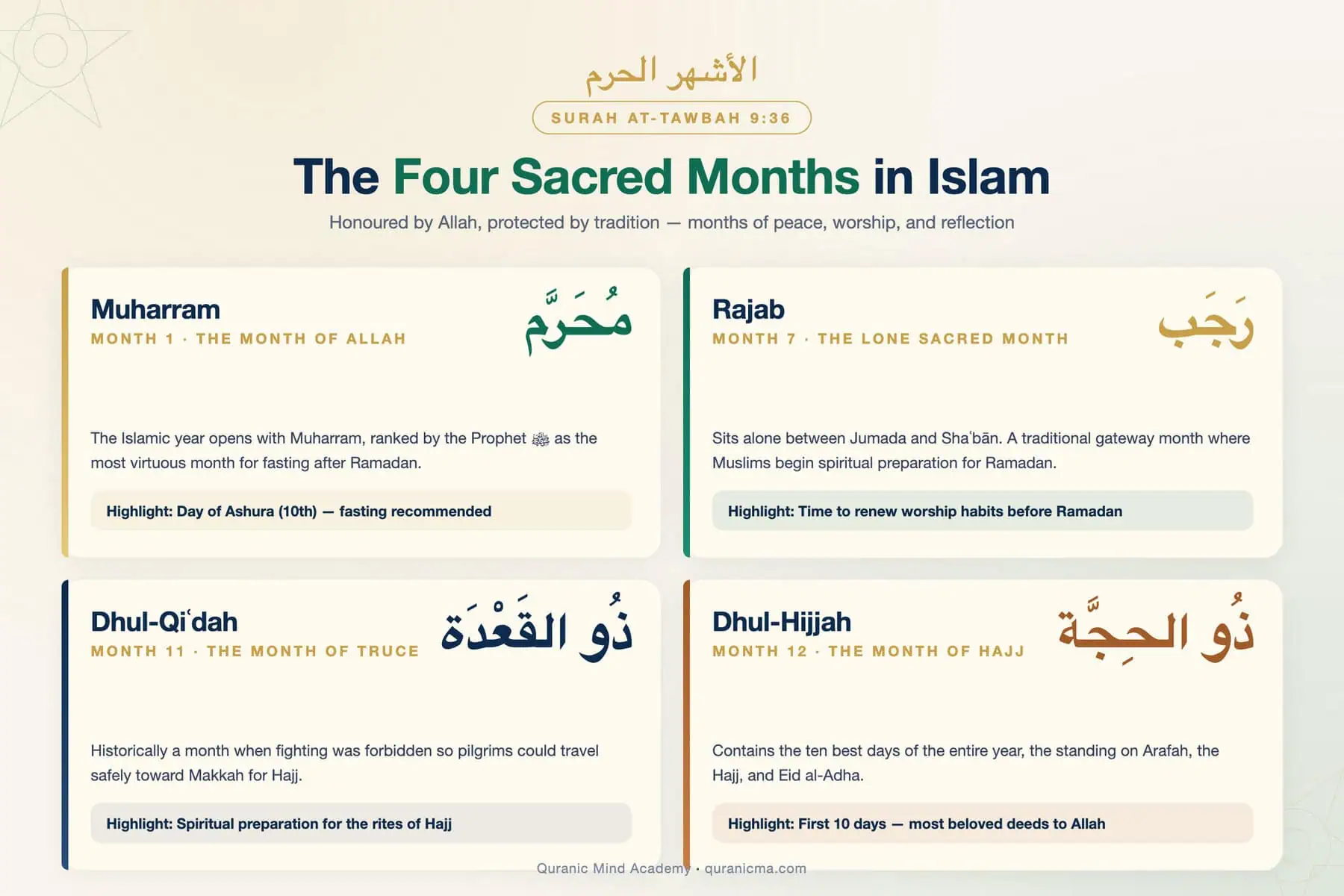
Time, in Islam, is not flat. The lunar year carries a quiet rhythm built into the calendar by Allah Himself, and four months in that rhythm are marked as sacred. Muslims are asked to slow down inside them, fast a little more, give a little more, and avoid wronging others.
This guide explains what the four sacred months are, why they were given that status, and how to honour them in a way that fits a normal modern life. The aim is to take what can sound like an old, abstract concept and make it usable today, for adults and for the children sitting beside us.
The Quranic Foundation: At-Tawbah 9:36
Allah names the sacred months in Surah At-Tawbah, verse 36 (trans. Abdel Haleem):
“God decrees that there are twelve months – ordained in God’s Book on the Day when He created the heavens and earth – four months of which are sacred: this is the correct calculation. Do not wrong your souls in these months…”
The verse does two things at once. It anchors the calendar in Allah’s design, not in human convention, and it gives a direct instruction not to wrong ourselves inside these specific months. The wording is striking, because Allah does not say do not wrong others; He says do not wrong your souls. Sin in these months is a wound the believer inflicts on their own soul.
The Prophet ﷺ identified the four months by name during the Farewell Sermon, the final pilgrimage of his life:
“The year is twelve months. Of these, four are sacred: three in succession — Dhul-Qiʿdah, Dhul-Hijjah and Muharram — and Rajab of Muḍar, which lies between Jumādā and Shaʿbān.”
Reported in Sahih al-Bukhari 3197. The hadith confirms which four months Allah is referring to and shows a small but beautiful detail: three sit together across the turn of the year (Dhul-Qiʿdah and Dhul-Hijjah close it, Muharram opens the next), and one sits alone in the middle, as if the year carries a steady pulse of stillness.
Why These Months Are Called Sacred
The sacredness of the four months works on three levels.
1. Reward and accountability are amplified. The classical scholars, including Ibn ʿAbbās and Qatādah, explained that good deeds in these months carry greater reward and sins carry greater weight. The line from At-Tawbah 9:36, Do not wrong your souls in these months, is the basis of this view. The believer is being asked to use a heightened spiritual season well.
2. Fighting was traditionally prohibited. Allah refers to the prohibition in Surah Al-Baqarah, verse 217: “They ask you [Prophet] about fighting in the prohibited month. Say, ‘Fighting in that month is a great offence…'” (trans. Abdel Haleem) The pre-Islamic Arabs already honoured these months with a truce so that pilgrims could travel safely; Islam confirmed the sanctity of these months; scholars differ on whether the ban on starting a war in them still applies. The trade caravans, the Hajj routes, and family travel could happen without the constant fear of raids.
3. The months frame the calendar’s two great pilgrimages. Three of the four sacred months sit around Hajj. Dhul-Qiʿdah is the month of arrival, Dhul-Hijjah is the month of the rites themselves, and Muḥarram closes the season as worshippers return home and the new year begins. Rajab, the lone one in mid-year, was kept sacred so that people from the far reaches of Arabia could travel safely to Makkah for ʿumrah and return home (Ibn Kathir on 9:36). Today many also treat it as the start of the road to Ramadan.
For the modern Muslim, the takeaway is simple. The calendar tells you when to slow down. The sacred months are stretches in which the soul is given more room.
Muharram: The Month of Allah
Muharram opens the Hijri year. The Prophet ﷺ called it Shahrullāh, the month of Allah, and ranked its fasting above any voluntary fasting outside Ramadan:
“The best fasting after Ramadan is the month of Allah, Muharram, and the best prayer after the obligatory prayers is the prayer of the night.” (Sahih Muslim 1163)
The high point of the month is Ashura, the tenth day. The Prophet ﷺ fasted Ashura because it was the day Allah saved Mūsā ʿalayhi al-salām and his people from Pharaoh, and he encouraged Muslims to do the same. He also recommended fasting the ninth, in order to differ from the practice of others, so the standard sunnah is to fast the ninth and tenth, or the tenth and eleventh.
What to do in Muharram, practically:
- Fast the ninth and tenth (or tenth and eleventh) of Muharram.
- Increase quiet acts: a little extra Quran, a few more rakaʿāt at night, a small additional ṣadaqah.
- Use the start of the new Hijri year to set a real spiritual intention. The first day of Muharram is the calendar’s natural reset.
- Teach the children, even briefly, why this day matters. The story of Mūsā and the Red Sea is a story they will remember.
The sacred months are the easiest time of year to make a resolution about the Quran and the hardest to keep one, because nothing changes about the week except the intention. A fixed lesson in the diary is usually what makes the difference. Book a free trial lesson and see whether it holds.
Rajab: The Lone Sacred Month
Rajab is the seventh month and the only sacred month that stands alone. It lies between Jumādā al-Ākhirah and Shaʿbān, and traditionally functions as the opening of the road to Ramadan.
One important note: no authentic hadith singles out a special Rajab fast or a special Rajab prayer, as Ibn Hajar explained, and the narrations circulated about a “Rajab fast” or a “night of Rajab prayer” are largely weak or fabricated. What is established is that Rajab is sacred, that voluntary fasting in it is recommended because it is a sacred month, as the majority of jurists hold (Dar al-Ifta), and that the Prophet ﷺ fasted more in Shaʿbān, the month after Rajab, than in any other month outside Ramadan (Sahih al-Bukhari 1969).
Many Muslims mark the Isra and Mi’raj, the night journey from Makkah to Jerusalem and the ascent to the heavens, on the night of 27 Rajab, the date most scholars prefer, and marking it with acts of worship is legitimate (Dar al-Ifta).
How to use Rajab well:
- Treat it as a runway. If you intend to fast more in Ramadan, start now with a few voluntary fasts, especially Mondays and Thursdays.
- Audit your salah. Rajab is a quiet month; use it to fix any rusted parts of your prayer before Ramadan arrives.
- Begin Quran revision. Rajab and Shaʿbān together give you sixty days to refresh what you forgot since last Ramadan.
Dhul-Qiʿdah: The Month of Truce
Dhul-Qiʿdah is the eleventh month and the first of three consecutive sacred months. Its name comes from qiʿdah, meaning sitting — historically, the Arabs would sit from fighting, allowing safe travel for pilgrims headed to Makkah.
The Prophet ﷺ performed all of his ʿumrahs in Dhul-Qiʿdah except the one combined with his Hajj: the Treaty of Ḥudaybiyyah ʿumrah, the qaḍāʾ ʿumrah the following year, the ʿumrah from Jiʿrānah after Ḥunayn, and the ʿumrah of his Farewell Hajj. The month carries that quiet sense of preparation and travel toward something sacred.
What Dhul-Qiʿdah is good for:
- Spiritual preparation if you are going for Hajj or ʿUmrah, including reading on the rites and intentions.
- Settling debts, mending family ties, and resolving disputes before the great gathering of Hajj.
- Increased duʿāʾ, especially if you have a long-standing need. The sacred months are an ideal time to ask.
Dhul-Hijjah: The Month of Hajj and the Best Days of the Year
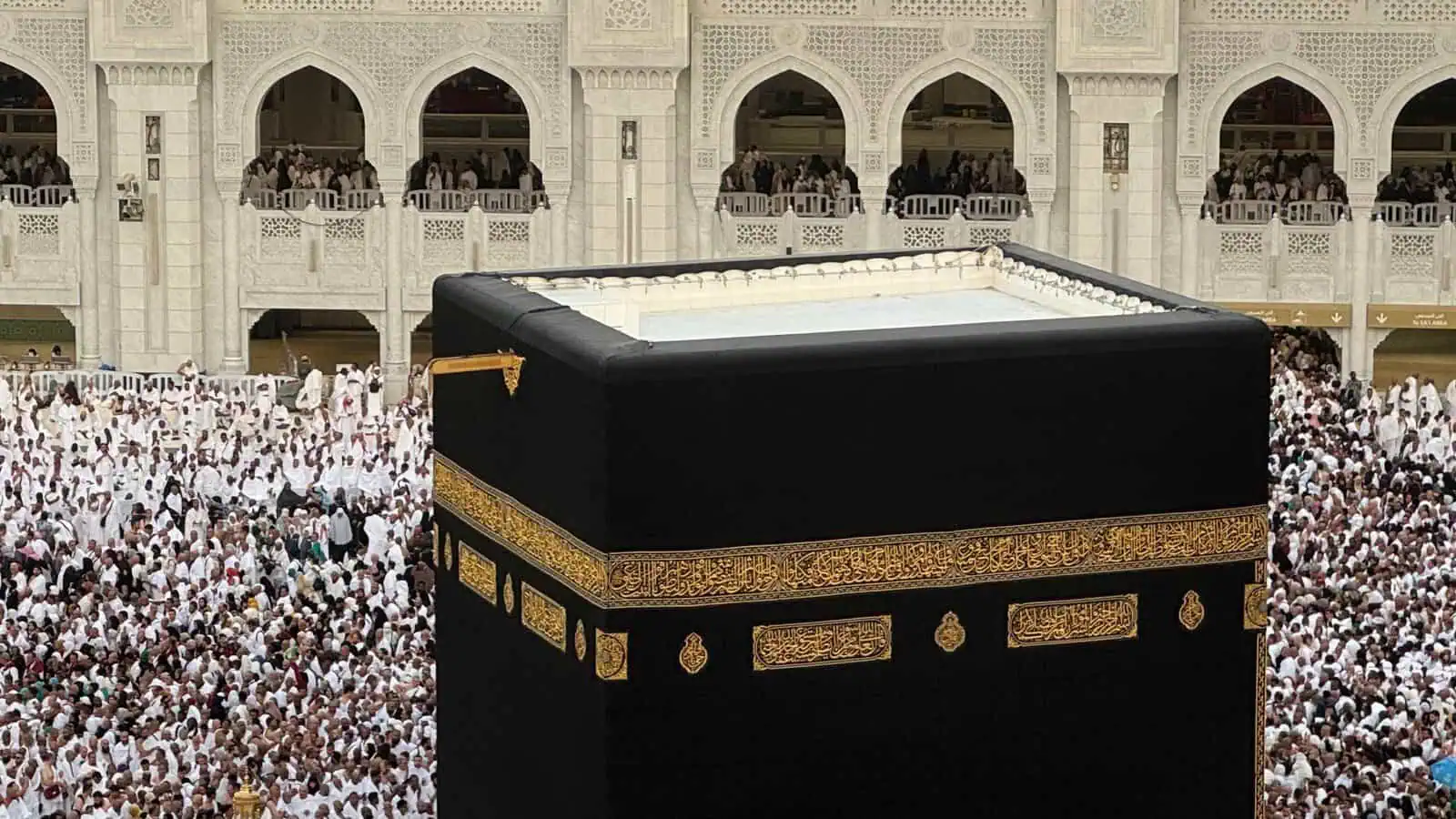
Dhul-Hijjah is the twelfth and final month of the Hijri year, and within it sit the most virtuous days of the entire calendar. The Prophet ﷺ said:
“No good deeds done on other days are superior to those done on these (first ten days of Dhul Hijja).” Then some companions of the Prophet ﷺ said, “Not even Jihad?” He replied, “Not even Jihad, except that of a man who does it by putting himself and his property in danger (for Allah’s sake) and does not return with any of those things.” (Sahih al-Bukhari 969)
Two specific days inside this stretch deserve their own line.
The Day of Arafah — the ninth of Dhul-Hijjah — is the day pilgrims stand on the plain of ʿArafāt and Allah forgives in unimaginable measure. For those not on Hajj, the Prophet ﷺ said he hoped from Allah that fasting the day of Arafah would expiate the sins of the year before and the year after (Sahih Muslim 1162).
Eid al-Adha — the tenth of Dhul-Hijjah — closes the great worship of Hajj with the sacrifice that re-tells the story of Ibrāhīm and Ismāʿīl ʿalayhimā al-salām. The days of tashrīq that follow (the eleventh, twelfth, and thirteenth) carry their own praise of Allah. We have a separate guide on Eid al-Adha if you want the rituals in detail.
How to make the first ten days count, even if you are not on Hajj:
- Fast as many of the first nine days as you reasonably can. The ninth (Arafah) is the most important.
- Increase takbīr, taḥmīd, and tahlīl from the first day onwards. The good deeds the Prophet ﷺ praised in these days (Sahih al-Bukhari 969) include remembrance of Allah, as Dar al-Ifta explains.
- Read a portion of Quran every morning of these days, even if it is one page.
- Plan your sacrifice (uḍḥiyah) in advance and budget for it.
- Use the children. Tell the story of Ibrāhīm and Ismāʿīl in plain language; the lesson lands.
Where the Sacred Months Sit in the Hijri Year
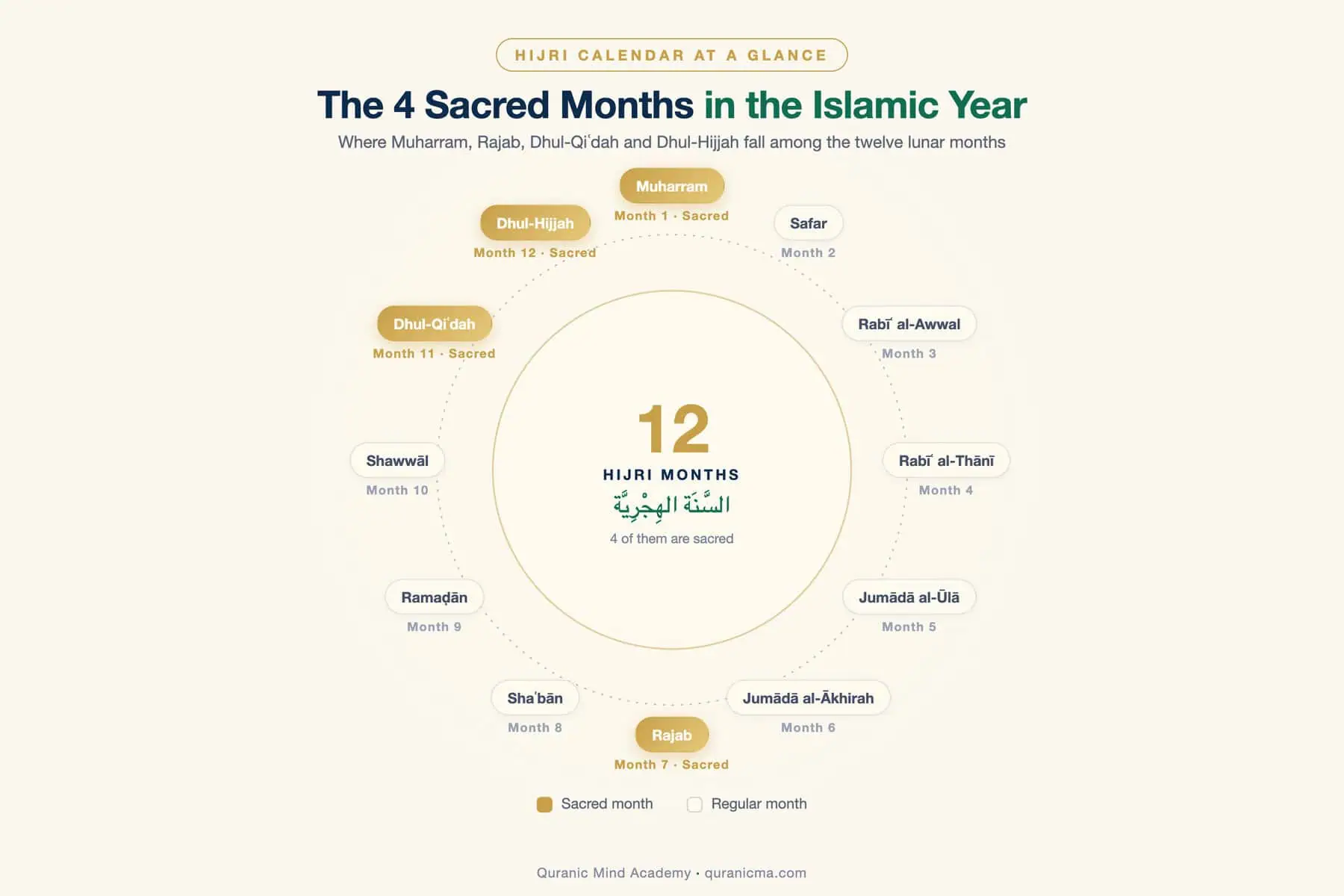
Visualised on a Hijri wheel, the pattern is striking: the year is bookended with sacredness. Three consecutive sacred months span the turn of the year (Dhul-Qiʿdah, Dhul-Hijjah, Muharram) and one (Rajab) in the middle, like a reminder halfway through the year. Allah did not space them evenly because the year is not a flat road; it has seasons of rest built in.
Practical Acts of Worship Across All Four Months
If you’d rather not memorise a different routine for each sacred month, the Prophet ﷺ’s general pattern suggests a small core of habits that suit all four:
- Voluntary fasting: Mondays and Thursdays, and the three white days (13th, 14th, 15th of each lunar month).
- Night prayer: two rakaʿāt of tahajjud before fajr, even briefly, twice a week.
- Quran: aim for one page in the morning and one in the evening. By the end of any sacred month you will have read close to three juzʾ.
- Charity: a small fixed amount each week, even if it is only a few pounds. Continuity outweighs size.
- Holding the tongue: the verse “Do not wrong your souls” includes our own speech. The sacred months are the worst time to gossip and the best time to bite the tongue.
Teaching Children About the Sacred Months
Children learn the calendar by living inside it. If the four sacred months pass without anything different happening in your home, they will pass through the child’s awareness as well. A few small touches are enough to anchor them:
- Print a simple Hijri calendar and mark the four sacred months in one colour. Hang it in the kitchen.
- The night before Ashura, tell the story of Mūsā and Pharaoh. Fast together as a family if the child is old enough to manage half a day.
- On the first night of Dhul-Hijjah, teach the child the ten-day pattern and pick one small act to do daily as a family — extra Quran, extra dhikr, or a small sadaqah jar on the counter.
- On the day of Eid al-Adha, walk through the story of Ibrāhīm in age-appropriate language, then pray Eid together.
Children remember years through the rituals attached to them. The sacred months are made for that.
Why This Still Matters in 2026
Modern life flattens time. One week looks like the next, the calendar is mostly a productivity tool, and the only signal that the year has shifted is the season changing outside. Islam pushes back on that flatness. The four sacred months ask the believer to stop, four times a year, and reset.
That reset is not nostalgic. It is practical. A Muslim who actually inhabits Muharram, Rajab, Dhul-Qiʿdah, and Dhul-Hijjah ends the year in a different state to one who treats them like any other month — a little more fasted, a little more forgiven, a little better at noticing that the calendar is not their property to begin with.
Learn the Islamic Calendar in Depth
If you’d like your children, or yourself, to understand the Islamic year inside out — its months, its events, its significance — our Islamic Studies course covers it as part of a broader curriculum that ties Quran, Seerah, and Fiqh into a single picture. Two free trial classes are included before any commitment.
Related Guides
- Ramadan Significance in Islam — spiritual growth in the most blessed month.
- Ramadan Preparation — how to enter Ramadan ready.
- Eid al-Adha — the meaning, rituals, and dates of the festival of sacrifice.
- Seeking Knowledge in Islam — why learning is a lifelong duty.
- Sciences of the Quran — a structured guide for serious learners.
- Explore all our courses — Quran reading, memorisation, Tajweed, Arabic, and Islamic Studies.
Frequently Asked Questions
What are the four sacred months in Islam?
They are Dhul-Qiʿdah, Dhul-Hijjah, Muharram, and Rajab. The first three run consecutively across the end of one Hijri year and the start of the next; Rajab is the lone sacred month in the middle of the year.
Why are these specific months considered sacred?
Allah declared them sacred in Surah At-Tawbah 9:36 and the Prophet ﷺ named them in his Farewell Sermon (Sahih al-Bukhari 3197). Inside them, fighting was prohibited, sins are weightier, and good deeds are amplified.
Are there special acts of worship recommended in the sacred months?
Yes. Fasting on Ashura (Muharram) and the day of Arafah (Dhul-Hijjah) is strongly emphasised, and increasing dhikr, charity, and Quran across all four months is recommended. No fixed Rajab ritual is established by an authentic hadith; general voluntary worship in Rajab, including fasting, is recommended.
Is fighting really forbidden in the sacred months?
The Quran confirms the prohibition in 2:217. Scholars later differed: the majority, as al-Qurtubi reports, held that the ban on initiating fighting was abrogated, while others such as ʿAtaʾ held that it still stands. Both views concern starting a war; fighting back when attacked was permitted (Ibn Kathir on 9:36).
How do I teach my child about the sacred months in a way that sticks?
Mark the months on a Hijri calendar in your home, attach one or two simple rituals to each (a fast, a story, a small charity jar), and tell the relevant Prophetic stories — Mūsā for Ashura, Ibrāhīm for Dhul-Hijjah. Repetition over years makes the calendar part of the child’s identity.
Do all schools of Islamic thought agree on the four sacred months?
Yes. Sunni and Shia scholarship both affirm the same four months on the basis of Quran 9:36 and the Farewell Sermon hadith. Differences exist on some specific practices but not on the months themselves.
Honour the Sacred Months This Year
The simplest way to start is small: fast Ashura, fast the day of Arafah, mark the calendar in the kitchen, and read one extra page of Quran each morning during the four months. Do that for one Hijri year and the difference is real.
Start with 2 Free Trial Lessons →
Have questions? Chat with us on WhatsApp.