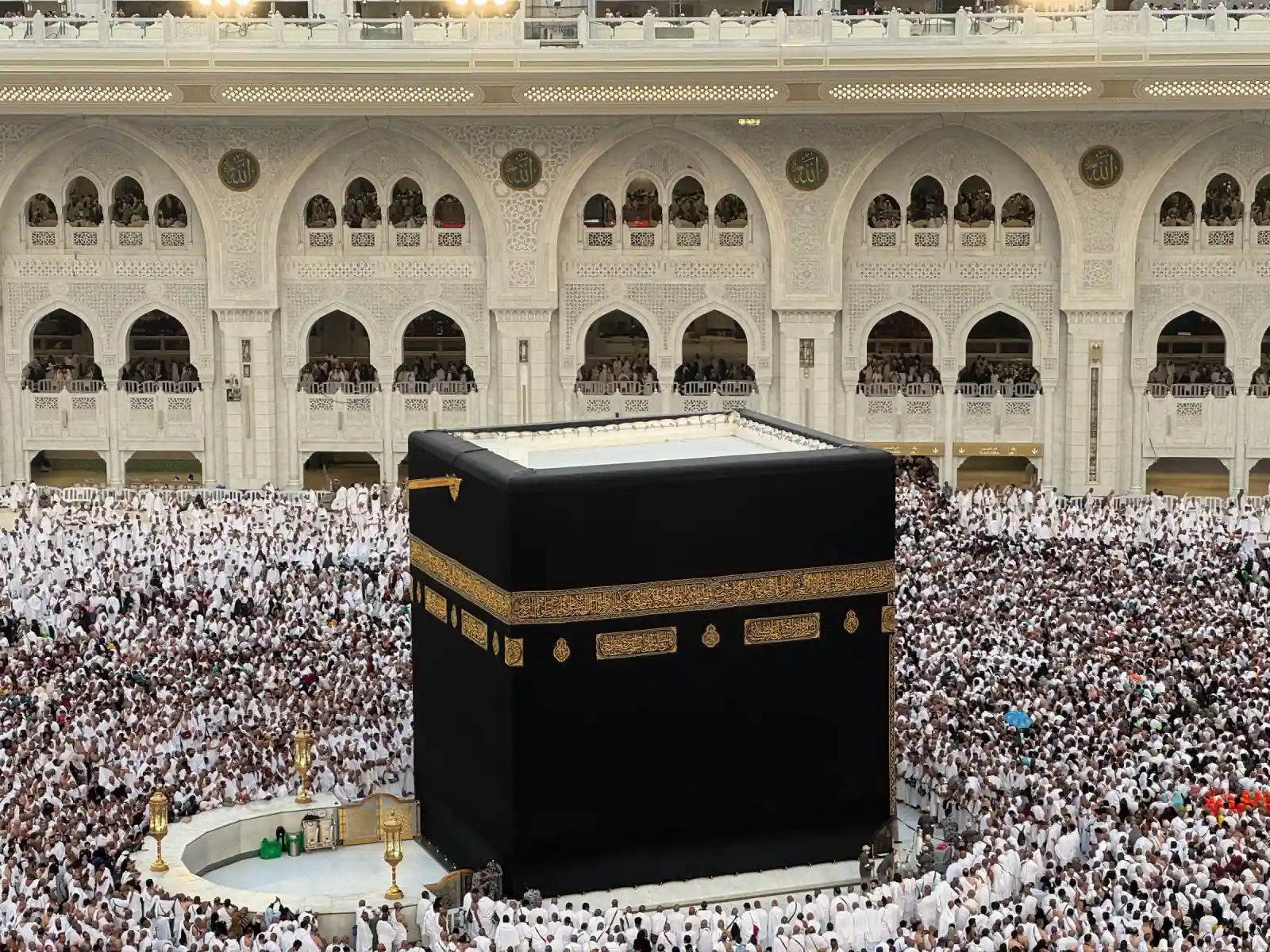
Eid al-Adha is one of the two major festivals of the Islamic year and the one most closely tied to the rites of Hajj. It commemorates the moment Prophet Ibrahim ﷺ was willing to sacrifice his son Ismail ﷺ at Allah’s command, and it falls on the 10th of Dhul-Hijjah, the day after the pilgrims stand at Arafah. The festival lasts three to four days, opens with a special congregational prayer, and includes the Qurbani (sacrificial offering) whose meat is divided between the family, relatives, and the poor.
This guide explains what Eid al-Adha actually is, the story behind it, how the prayer and sacrifice are performed, and how Muslims in different countries observe the day. It is written for both Muslim readers preparing for the festival and non-Muslim readers who want to understand what their neighbours and colleagues are celebrating.
What Eid al-Adha Is and When It Falls
Eid al-Adha translates from Arabic as “the Festival of the Sacrifice.” It begins on the 10th day of Dhul-Hijjah (the Day of Sacrifice), the twelfth and final month of the Islamic lunar calendar. The three days that follow, the 11th to the 13th, are the Days of Tashreeq. Because the Islamic calendar is lunar, the festival shifts roughly eleven days earlier each year against the Gregorian calendar. Many Muslim-majority countries declare the date based on the official moon sighting in Saudi Arabia at the start of Dhul-Hijjah, since Hajj itself follows the Saudi calendar; other communities follow local moon sighting committees.
Eid al-Adha is distinct from Eid al-Fitr in two important ways. Eid al-Fitr marks the end of Ramadan and a month of fasting. Eid al-Adha marks the climax of Hajj, the annual pilgrimage to Mecca, a duty once in a lifetime for every Muslim who is able. The festival also lasts longer (three to four days) and centres on the act of sacrifice rather than the breaking of a fast.
The Story Behind the Festival
The festival commemorates the test given to Prophet Ibrahim ﷺ. After years of prayer for a son, he was finally granted Ismail ﷺ, and once the boy had grown enough to walk with him, Ibrahim ﷺ saw a recurring dream in which he was commanded to sacrifice him. The Qur’an records the moment with extraordinary tenderness:
“When the boy was old enough to work with his father, Abraham said, ‘My son, I have seen myself sacrificing you in a dream. What do you think?’ He said, ‘Father, do as you are commanded and, God willing, you will find me steadfast.’ When they had both submitted to God, and he had laid his son down on the side of his face, We called out to him, ‘Abraham, you have fulfilled the dream.’ This is how We reward those who do good- it was a test to prove [their true characters]- We ransomed his son with a momentous sacrifice …” (Qur’an 37:102-107, trans. Abdel Haleem)
The test was the willingness, not the act. At the moment of submission, Allah sent a ram to be sacrificed in Ismail’s place. Eid al-Adha re-enacts this every year, not as theatre, but as a practical reminder that the highest worship is the readiness to give up what is most beloved when Allah asks.
Allah Himself makes the spiritual point explicit:
“It is neither their meat nor their blood that reaches God but your piety …” (Qur’an 22:37, trans. Abdel Haleem)
The Connection to Hajj and the Day of Arafah
Hajj is the fifth pillar of Islam, obligatory once in a lifetime on every Muslim who is physically and financially able (Qur’an 3:97). The pilgrimage rites run from the 8th to the 12th or 13th of Dhul-Hijjah, with the central moment on the 9th of the month: the day pilgrims gather at the plain of Arafah, standing in du’a from noon until sunset. The Prophet ﷺ said:
“The Hajj is Arafah.” (Tirmidhi 889, graded sahih by Darussalam)
For Muslims not at Hajj, the 9th of Dhul-Hijjah is the Day of Arafah, recommended for fasting. The Prophet ﷺ said:
“I seek from Allah that fasting on the day of ‘Arafa may atone for the sins of the preceding and the coming years.” (Muslim 1162a)
The day after Arafah, the 10th of Dhul-Hijjah, the pilgrims at Hajj perform their own sacrifice at Mina while Muslims around the world celebrate Eid al-Adha together. The synchrony is the point: a single global act of submission marking a single sacred moment.
The Takbeer of Eid
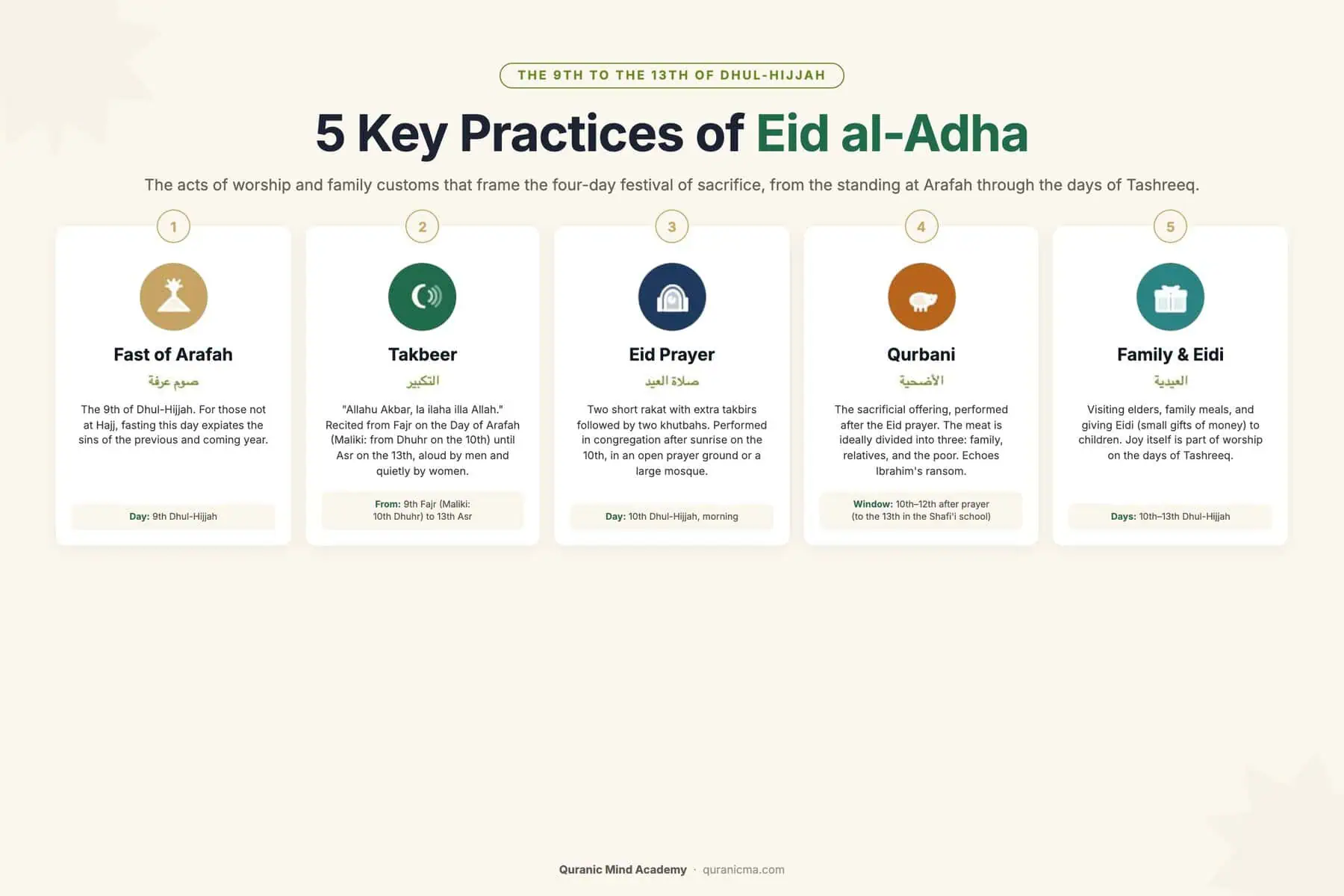
From Fajr on the Day of Arafah (the 9th of Dhul-Hijjah) until Asr on the 13th, Muslims recite the Takbeer of Eid loudly in mosques, homes, and on the way to the Eid prayer. This timing follows the Hanbali school and others; the Maliki school begins it at Dhuhr on the 10th (Dar al-Ifta). The standard wording is:
اللهُ أَكْبَرُ، اللهُ أَكْبَرُ، اللهُ أَكْبَرُ، لاَ إِلَهَ إِلاَّ اللهُ، اللهُ أَكْبَرُ، اللهُ أَكْبَرُ، وَلِلَّهِ الْحَمْدُ
Allahu Akbar, Allahu Akbar, Allahu Akbar, la ilaha illa Allah, Allahu Akbar, Allahu Akbar, wa lillahi al-hamd.
“Allah is the Greatest, Allah is the Greatest, Allah is the Greatest. There is no god but Allah. Allah is the Greatest, Allah is the Greatest, and to Allah belongs all praise.”
The Takbeer is repeated audibly by men and quietly by women. It is the sound of Eid al-Adha across the Muslim world, from the streets of Cairo to the mosques of London, all the way to the plain of Mina where the pilgrims chant it as they stone the pillars.
How the Eid Prayer Is Performed
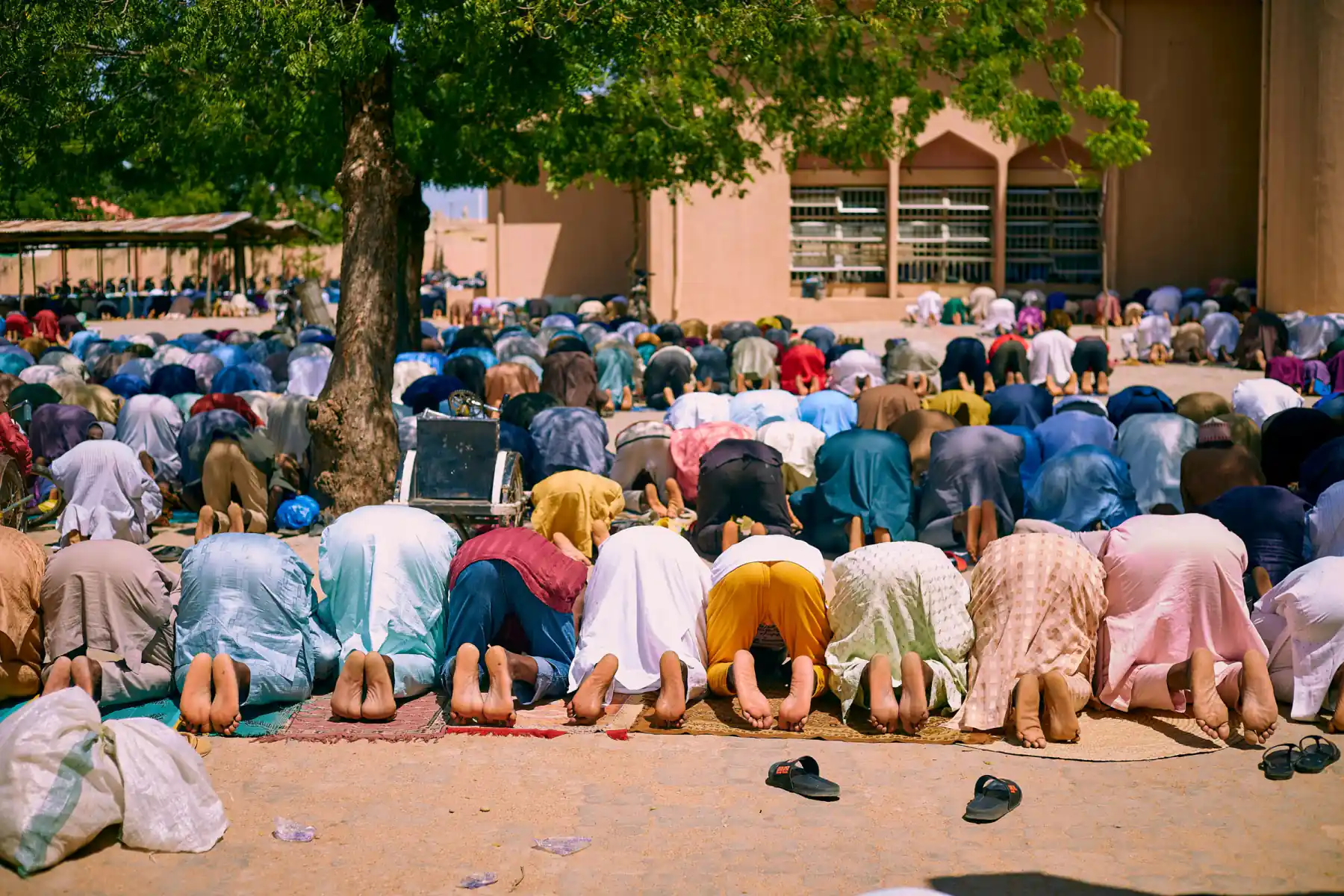
The Eid prayer (Salat al-Eid) is performed once, in congregation, on the morning of the 10th of Dhul-Hijjah, shortly after sunrise has fully risen and before the time of Dhuhr. It is two short rakat with extra takbirs. As Dar al-Ifta al-Misriyyah describes it:
- First rakah: After the opening takbir, the imam adds seven additional takbirs before reciting Surah al-Fatihah and a portion of Qur’an aloud.
- Second rakah: After standing up, the imam adds five more takbirs before reciting Fatihah and another portion of Qur’an aloud. In the Hanafi school the imam adds three takbirs in each rakah instead, before the recitation in the first and after it in the second (islamweb), so follow the form your imam uses.
- The khutbah follows the prayer, not before it. The imam delivers two short sermons reminding the congregation of the meaning of sacrifice, the etiquette of the day, and the duties of the Qurbani.
The Prophet ﷺ encouraged everyone to attend, including women and even those menstruating (who attend the gathering but stand apart from the prayer rows):
Umm Atiyyah reported: “We were ordered to bring out our menstruating women and veiled women in the religious gatherings and invocation of Muslims on the two ʿId festivals. These menstruating women were to keep away from their Musalla.” (Bukhari 351)
The Prophet ﷺ used to pray Eid at the musalla, an open prayer ground (Bukhari 956), so many scholars prefer an open space where possible, with the prayer moved indoors in rain or bad weather. In the Shafi’i school, a mosque large enough for the whole congregation is better (al-Nawawi, al-Majmu’).
The Qurbani: Rules, Animals, and Meat Distribution
The Qurbani (also called udhiyah) is the sacrificial offering. The majority of scholars, and Dar al-Ifta al-Misriyyah, hold that it is a Sunnah Mu’akkadah (strongly encouraged practice) for every adult Muslim who has the financial means. The Hanafi school holds that it is wajib (obligatory) for a resident adult who owns the nisab, the same threshold as zakat (islamweb).
- Animals. A sheep or goat counts for one person and, in the majority view, for his household; a cow or camel can be shared by up to seven people (Muslim 1318a). The animal must be healthy, free of visible defects, and of the minimum age. Dar al-Ifta al-Misriyyah gives six months for sheep (a well-grown jadha’a, Muslim 1963), one year for goats, two years for cows and five for camels. The Maliki and Shafi’i schools require a sheep to have completed a full year (islamweb), so a sheep of a year or more is accepted by all four schools.
- Time window. From after the Eid prayer on the 10th. The majority of scholars (Hanafi, Maliki, Hanbali) end it at sunset on the 12th (islamweb); the Shafi’i school, followed by Dar al-Ifta al-Misriyyah, extends it to sunset on the 13th. A Qurbani slaughtered before the Eid prayer is not valid.
- Method. Halal slaughter performed by a competent person, with the name of Allah pronounced at the moment of slaughter. The animal is treated humanely throughout. Many Muslims in countries without home-slaughter traditions arrange Qurbani through a charity that performs it on their behalf in another country, with the meat distributed to the poor there.
- Distribution. It is recommended to divide the meat into three parts: one-third for the family, one-third for relatives and neighbours, and one-third for the poor. Dar al-Ifta calls this the best way, not a condition.
The Prophet ﷺ said:
“Whoever can afford it and does not offer a sacrifice, let him not come near our prayer place.” (Ibn Majah 3123, graded hasan by Darussalam)
The strong wording shows how much weight the Prophet ﷺ gave to the sacrifice: for anyone who can afford it, Qurbani is not a mere ornament but the practical heart of the festival.
Charity and the Three Days of the Festival
Beyond the Qurbani meat distribution, Eid al-Adha is a strong moment for general charity. Many Muslims add cash donations to relief organisations on the day, particularly to causes serving Muslims in poverty or conflict. The festival days are also days of family visiting, gift-giving (especially to children), wearing fresh clothes, and shared meals. Fasting on these specific three days is actually forbidden, a reminder that joy is itself part of worship.
The Prophet ﷺ said:
“The days of Tashreeq are days of eating, drinking, and remembrance of Allah.” (Muslim 1141b)
How Eid al-Adha Is Celebrated Around the World
The core (prayer, takbeer, Qurbani) is identical everywhere. The cultural details differ. Egyptian families gather for fattah, a rice-and-bread dish layered with lamb broth and meat from the Qurbani. South Asian households serve biryani and kheer. Moroccan tables centre on roasted lamb shoulder. Indonesian and Malaysian families slice the Qurbani meat into small portions distributed widely through the neighbourhood. Turkish families serve baklava and visit elders to seek their du’a.
In the United Kingdom and across Europe and North America, Eid al-Adha typically combines a community prayer at a local mosque or hired hall, a charity-organised Qurbani sent overseas, a family lunch, and visits to relatives. Many Muslims also take the day off work, and a growing number of UK schools and workplaces formally recognise the day.
For Muslims Living Abroad
For Muslims in countries where Eid is not a public holiday, the festival can feel quieter than back home. A few practical ways to keep the spirit of the day:
- Attend the Eid prayer in person. Most mosques publish their Eid prayer times two weeks in advance. The takbirs in congregation are part of the day’s spirit.
- Arrange Qurbani in advance. Online charities accept Qurbani payment up to a week before. They handle the slaughter, the meat distribution, and send you confirmation. Costs typically range from a single sheep share to a full cow.
- Plan a shared meal. If extended family is far away, invite friends or another family to share lunch. Even one shared table changes the day.
- Phone the elders. Across the Muslim world, Eid is a day for calling parents, grandparents, and teachers. A short call carries weight.
- Recite the takbeer at home. The takbeer is recited from the dawn of Arafah day until the afternoon of the 13th. Saying it aloud at home, even just before the prayer, sets the tone.
Teaching children the takbeer is one of the simpler ways to make the day feel like Eid in a country where nothing outside the house marks it. If you would rather they learned it properly than by imitation, a free trial lesson with an Al-Azhar teacher is a reasonable place to start.
For Non-Muslims
If a colleague, neighbour, or friend is celebrating, a simple “Eid Mubarak” (literally “blessed festival”) is the standard greeting. Some Muslims also exchange “Eid Saeed” (happy Eid). Gifts of dates, sweets, or flowers are appreciated. The day itself is family-oriented, so do not expect an open invitation; if invited, dress modestly and the meal will involve halal meat. The day commemorates Prophet Ibrahim, a shared figure across Islam, Judaism, and Christianity, which is one of the reasons the festival sits at a deep ecumenical point of common ground.
Common Mistakes to Avoid
- Slaughtering before the Eid prayer. A Qurbani performed before the prayer is not valid. Wait until the prayer is finished.
- Skipping the Eid prayer because of work. Most Eid prayers are over by 8:30am. Plan to attend, even if you go straight to work afterwards.
- Treating Qurbani as charity-only. The Sunnah is for the family to eat some of the meat as well. The full three-way distribution is the ideal.
- Fasting on the festival days. Fasting on the 10th, 11th, 12th, or 13th of Dhul-Hijjah is forbidden. The fast of Arafah on the 9th is what is encouraged.
- Treating the day as a generic holiday. The festival is rooted in worship: the prayer, the takbeer, and the sacrifice. The family meal sits on top of all that, not in place of it.
Related Guides
- Sacred months in Islam: the four sacred months and their place in the Islamic year.
- Ramadan significance in Islam: the other great Islamic festival season.
- Islam as a holistic life: how worship, family, and society fit together in Islam.
- Umrah meaning and significance: the lesser pilgrimage and its connection to Hajj.
- Prophetic biography: the life of Prophet Muhammad ﷺ and his teachings on Eid.
Frequently Asked Questions
When is Eid al-Adha 2026?
In 2026, Eid al-Adha fell on Wednesday 27 May in Saudi Arabia, with the Day of Arafah on Tuesday 26 May (Gulf News). The exact date depends on the moon sighting at the start of Dhul-Hijjah, so check with your local mosque or moon sighting committee in the final days of Dhul-Qa’dah.
What is the difference between Eid al-Adha and Eid al-Fitr?
Eid al-Fitr is the smaller of the two festivals, marking the end of Ramadan after a month of fasting. It falls on the 1st of Shawwal. Eid al-Adha is the greater of the two, marking the climax of Hajj on the 10th of Dhul-Hijjah, and is centred on the act of Qurbani. Both involve a special congregational prayer in the morning, but Eid al-Adha lasts three to four days while Eid al-Fitr is typically a single day.
Do all Muslims have to perform Qurbani?
The majority of scholars hold that Qurbani is a strongly recommended Sunnah for anyone who can afford it. In the Hanafi school it is obligatory on every resident adult Muslim who owns the nisab (the same threshold as zakat). Households that cannot afford a full animal share are not obliged. Many Muslims who can afford more give multiple shares so additional families can receive meat.
Can I fast on the Day of Arafah if I am not at Hajj?
Yes. For those not on Hajj, fasting the Day of Arafah (9th of Dhul-Hijjah) is a strongly recommended Sunnah. The Prophet ﷺ said he sought from Allah that it would atone for the sins of the preceding and the coming years (Muslim 1162a). Pilgrims at Hajj do not fast on that day, as they need their strength for the standing at Arafah.
Can women attend the Eid prayer?
Yes. The Prophet ﷺ explicitly commanded women to attend the Eid gathering, including those who could not physically pray. Most mosques arrange a designated section for women and provide childcare or family seating for the prayer.
Is it permissible to send Qurbani abroad?
Most scholars allow it, particularly where the meat would reach those in greater need. Many UK and European Muslims send their Qurbani to charities that perform the slaughter in Yemen, Sudan, Somalia, Bangladesh, or other communities where fresh meat is scarce. Local Qurbani in a halal abattoir is equally valid for those who prefer it.
What greetings are appropriate?
“Eid Mubarak” (blessed festival) is the universal greeting and works for both Muslims and non-Muslim wellwishers. “Eid Saeed” (happy Eid) is also common. In Arabic countries you may also hear “Kul am wa antum bi khair” (may every year find you well).