

Most Muslims read the Quran. A smaller group studies it through the lens of tafsir. Fewer still encounter the broader academic discipline that surrounds the Mushaf and asks deeper questions about it: how it was revealed, when, in what circumstances, how it was preserved, what its language reveals about its meaning, and how its different recitations relate to one another. That discipline is called ʿUlūm al-Qurʾān — the Sciences of the Quran.
This guide is a clear, structured introduction to those sciences. The classical scholar Imām al-Suyūṭī (d. 911 AH) catalogued eighty distinct branches in his masterwork Al-Itqān fī ʿUlūm al-Qurʾān, and noted in its introduction that, if he had separated the topics he merged, they would exceed three hundred (Musāʿid al-Ṭayyār’s lesson on the introduction). We focus on the eight most important: the disciplines a serious student begins with and that anchor everything else.
What Are the Sciences of the Quran?
ʿUlūm al-Qurʾān is the umbrella discipline that studies everything connected to the Quran: its revelation, compilation, readings, abrogation, inimitability and the principles of tafsir (islamweb fatwa 24880). Tafsir itself, the verse-by-verse explanation of meaning, is its largest branch and is often taught as a discipline of its own. Modern textbooks such as Mannāʿ al-Qaṭṭān’s Mabāḥith fī ʿUlūm al-Qurʾān define it as the study of everything connected to the Quran, including:
- The Quran’s revelation (when, where, why specific verses came down)
- Its compilation and preservation (oral and written)
- Its readings (the qirāʾāt)
- Its language and rhetoric
- Its rulings, abrogation, and unique features
Allah Himself frames the Quran as a book to be studied carefully, not just recited. Surah Ṣād 38:29, trans. Abdel Haleem: “This is a blessed Scripture which We sent down to you [Muhammad], for people to think about its messages, and for those with understanding to take heed.” The verb is yaddabbarū, from tadabbur, deep reflection. The sciences exist to help honest readers reflect more deeply.
Why a Student Should Care About These Sciences
A few practical reasons:
- Context unlocks meaning. Knowing asbāb al-nuzūl turns a verse from an abstract sentence into a real conversation with real people in a real moment.
- Confidence in authenticity. The compilation history (jamʿ al-Qurʾān) and the canonical readings (qirāʾāt) explain how the same Quran is recited in Cairo, Karachi, and Birmingham today.
- Defence against confusion. Doubts about abrogation, “errors,” or alleged contradictions evaporate once a student understands the sciences that already addressed them centuries ago.
- Better recitation. Tajweed is one branch of these sciences; learning it within the wider context makes the rules feel motivated, not arbitrary.
The Prophet ﷺ said: “The best of you are those who learn the Quran and teach it.” (Sahih al-Bukhari 5027) Learning here means more than memorisation; it includes understanding the disciplines that surround the Mushaf.
A Short History of the Discipline
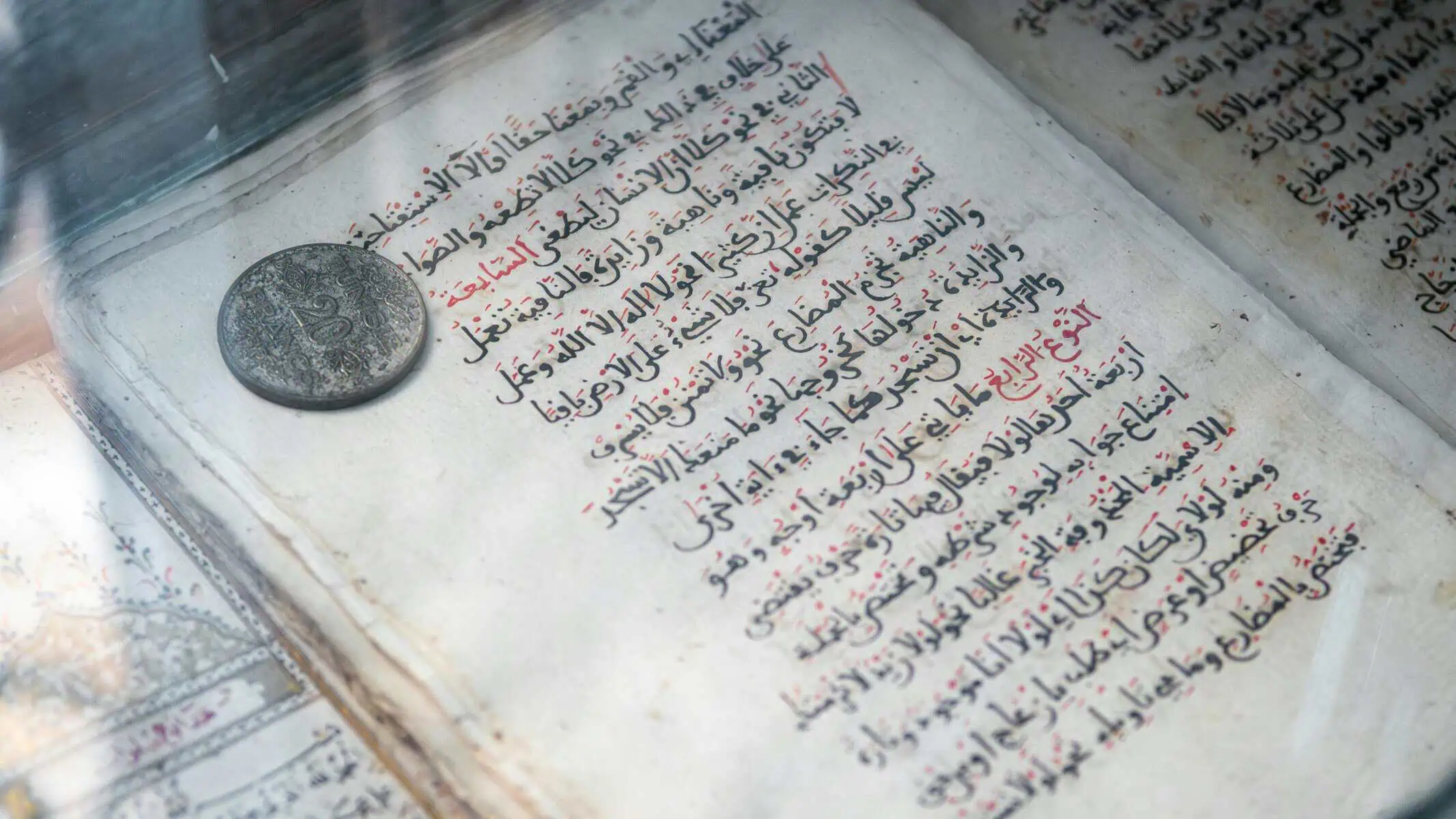
Era 1 — Prophetic Period
The sciences existed orally from the moment of revelation. The Prophet ﷺ explained context, settled questions, and identified the occasions of revelation as he went. The Companions absorbed this without writing it down because they were living it.
Era 2 — The Companions and the Standardisation
Caliph ʿUthmān (RA) standardised the Mushaf around 25 AH, sending master copies to the major regions and burning variant private copies to prevent confusion (Sahih al-Bukhari 4987). This act preserved the textual unity of the Quran and laid the foundation for the science of jamʿ al-Qurʾān. Caliph ʿAlī (RA) is credited with commissioning the first work on Arabic grammar, partly to protect the Quran from linguistic corruption as Islam spread to non-Arab populations.
Era 3 — The Umayyad and Abbasid Codification
Tafsir, qirāʾāt, and grammar were written down in systematic works during the late 1st and 2nd centuries AH. By the 4th century, Imām Ibn Mujāhid had codified the seven canonical readings in Kitāb al-Sabʿah.
Era 4 — The Classical Compendiums
Two towering reference works emerged that still anchor the discipline today:
- Al-Burhān fī ʿUlūm al-Qurʾān by Imām Badr al-Dīn al-Zarkashī (d. 794 AH) — 47 sciences treated systematically.
- Al-Itqān fī ʿUlūm al-Qurʾān by Imām Jalāl al-Dīn al-Suyūṭī (d. 911 AH) — 80 sciences treated, drawing on al-Zarkashī and expanding it.
Every modern textbook on ʿUlūm al-Qurʾān ultimately traces back to these two works.
The eight branches below are a map, not a course. Each was developed to be taught in sequence, with a teacher deciding what you are ready for next, which is not something a reading list can do. Book a free trial Islamic Studies lesson and find out which branch you should actually start with.
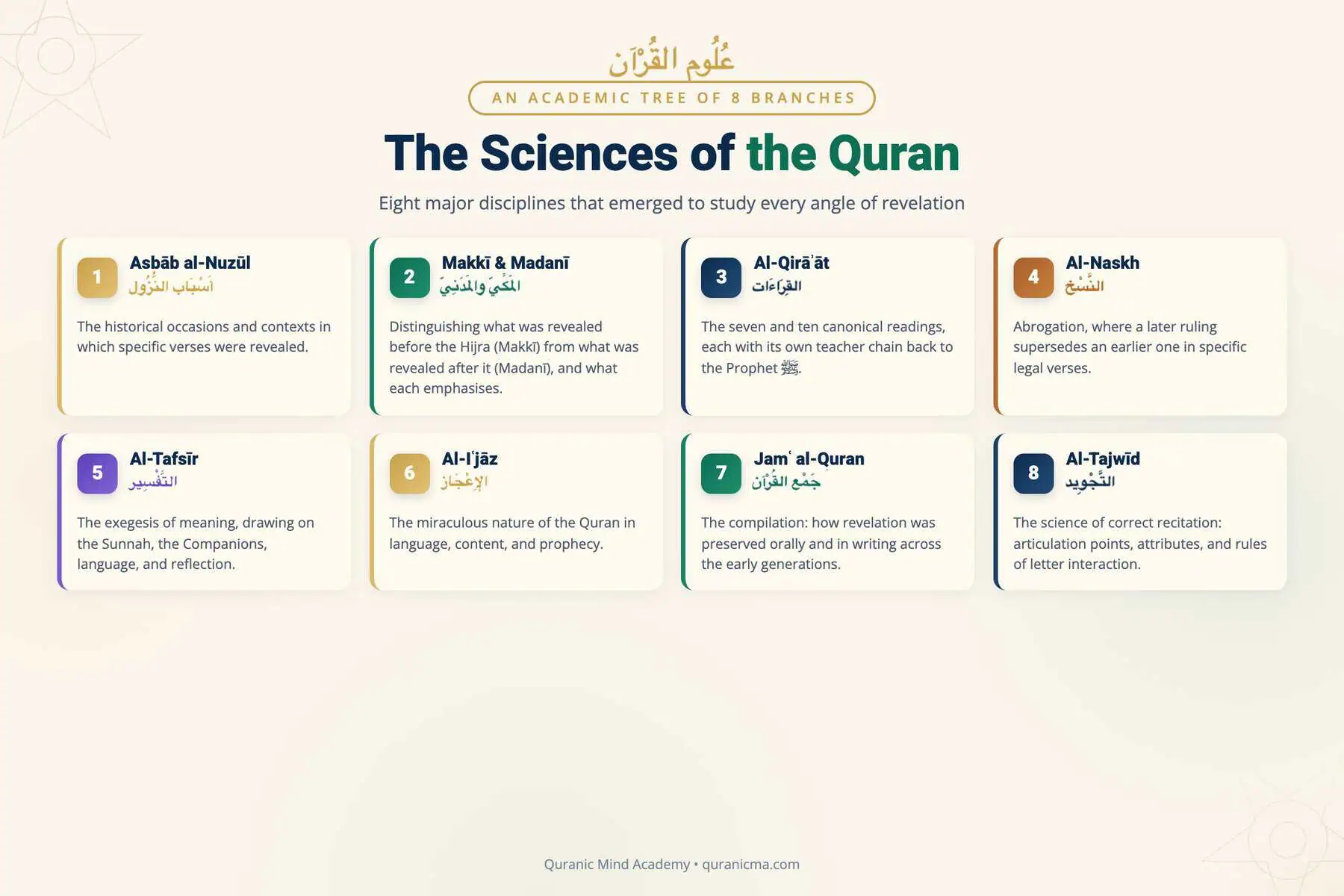
The 8 Major Branches Every Student Should Know
1. Asbāb al-Nuzūl (Reasons of Revelation)
The historical occasions in which specific verses or surahs were revealed. A famous example: the verses prohibiting alcohol came in stages over years, addressing real situations among the early Muslims. The classical reference is Asbāb al-Nuzūl by al-Wāḥidī (d. 468 AH).
2. Makkī and Madanī (Meccan and Medinan Verses)
Distinguishing what was revealed before the Hijra (Makkī) from what was revealed after it (Madanī), even if a Madanī verse came down in or near Makkah. Standard textbooks such as al-Qaṭṭān’s Mabāḥith prefer this time-based definition to the place-based one. The two periods have different emphases: the Meccan verses focus on tawhīd, the afterlife, and stories of past prophets. The Medinan verses cover community law, social ethics, and inter-faith relations. Knowing which is which sharpens both reading and application.
3. Al-Qirāʾāt (The Canonical Readings)
The seven and ten canonical recitations of the Quran, each with its own teacher chain back to the Prophet ﷺ. Imām Ibn Mujāhid codified the seven in Kitāb al-Sabʿah. Works on ten readings already existed long before Ibn al-Jazarī, such as Ibn Mihrān’s (d. 381 AH) al-Ghāya fī al-Qirāʾāt al-ʿAshr. Ibn al-Jazarī (d. 833 AH) gathered the three readings that complete the ten in his poem al-Durrah al-Muḍiyyah and documented all ten in al-Nashr fī al-Qirāʾāt al-ʿAshr. Most Muslims today recite via Ḥafṣ ʿan ʿĀṣim, but other readings remain authentic and used regionally. For more, see our Science of Tajweed guide.
4. Al-Naskh (Abrogation)
The principle that a later ruling can lift an earlier legal ruling. In the type a reader meets in the Mushaf, the abrogated verse is still recited and only its ruling is no longer applied; scholars also describe verses whose recitation itself was lifted (islamweb fatwa 3715). Abrogation applies only to specific legal verses, not to creedal statements or stories. The classic case is the staged prohibition of alcohol. The standard work is Al-Nāsikh wa al-Mansūkh by al-Naḥḥās (d. 338 AH).
5. Al-Tafsīr (Exegesis of Meaning)
The discipline of explaining what the Quran means, drawing on the Sunnah, the statements of the Companions, the Arabic language, and reflection. Tafsīr is the largest single branch; some scholars treat it as a discipline parallel to ʿUlūm al-Qurʾān rather than a sub-branch. The major classical tafsīrs include those of al-Ṭabarī (d. 310 AH), al-Qurṭubī (d. 671 AH), Ibn Kathīr (d. 774 AH), and al-Rāzī (d. 606 AH). This branch is treated in depth in its own guide: what is tafseer, covering the four kinds of tafsīr and how far a student can go without a teacher.
6. Al-Iʿjāz (The Miraculous Nature)
The study of how the Quran is inimitable. Classical scholars identified linguistic iʿjāz (the impossibility of producing matching Arabic prose), legislative iʿjāz, and informational iʿjāz (statements about past or future that could not be known by the Prophet ﷺ). Allah issued the famous challenge: “If you have doubts about the revelation We have sent down to Our servant, then produce a single sura like it…” (Surah Al-Baqarah 2:23, trans. Abdel Haleem). The challenge has stood for fourteen centuries.
7. Jamʿ al-Qurʾān (The Compilation)
How the Quran was preserved orally during the Prophet’s lifetime ﷺ, gathered into a single volume during the caliphate of Abū Bakr (RA) after the deaths of many memorisers at the Battle of Yamāmah, and then standardised by ʿUthmān (RA) (Sahih al-Bukhari 4986). Understanding this history is the strongest single response to claims that the Quran was redacted or altered.
8. Al-Tajwīd (Correct Recitation)
The science of articulation points (makhārij), letter attributes (ṣifāt), and the rules governing letter interactions. Tajwīd ensures the Quran is recited the way it was revealed. The foundation work is Ibn al-Jazarī’s Al-Muqaddimah al-Jazariyyah. For practical study, see our Complete Guide to Tajweed Rules.
The Difference Between Tafsīr and ʿUlūm al-Qurʾān
A common confusion. The simplest way to think about it:
- Tafsīr answers: What does this verse mean?
- ʿUlūm al-Qurʾān answers: What is the Quran, and how do we approach it?
Tafsīr is one of the eight branches above. ʿUlūm al-Qurʾān is the umbrella that contains tafsīr alongside the other seven sciences. Put simply: tafsīr is one branch of ʿUlūm al-Qurʾān, not the whole tree.
How Many Sciences Are There, Really?
The honest answer is that the count depends on how finely you slice the discipline.
| Scholar | Count | Reference |
|---|---|---|
| Al-Zarkashī | 47 sciences | Al-Burhān fī ʿUlūm al-Qurʾān |
| Al-Suyūṭī | 80 sciences | Al-Itqān fī ʿUlūm al-Qurʾān |
| Al-Suyūṭī (subdivided) | 300+ | His own note in the introduction to Al-Itqān |
For most students, mastering the eight major branches above is more useful than chasing the longer lists. The longer counts often subdivide single branches (e.g., breaking tafsīr into a dozen sub-disciplines based on method or source).
Famous Scholars in the Tradition
- Ibn Jarīr al-Ṭabarī (d. 310 AH) — author of the foundational tafsīr Jāmiʿ al-Bayān; often called “the father of tafsīr.”
- Ibn al-Jazarī (d. 833 AH) — the central figure in qirāʾāt and tajwīd, author of Al-Muqaddimah and Ṭayyibat al-Nashr.
- Imām al-Qurṭubī (d. 671 AH) — author of Al-Jāmiʿ li-Aḥkām al-Qurʾān, the standard tafsīr from the legal angle.
- Ibn Kathīr (d. 774 AH) — author of one of the best-known tafsīrs, focused on hadith-based interpretation.
- Imām al-Rāzī (d. 606 AH) — author of Mafātīḥ al-Ghayb, a major tafsīr of the rational (dirāyah) approach.
- Imām al-Suyūṭī (d. 911 AH) — the encyclopaedist of ʿUlūm al-Qurʾān; Al-Itqān is still the standard reference.
- Muḥammad al-Ṭāhir Ibn ʿĀshūr (d. 1393 AH / 1973 CE) — modern Tunisian scholar whose Al-Taḥrīr wa al-Tanwīr is one of the major tafsīrs of the 20th century, especially for its rhetorical analysis.
How to Begin Studying ʿUlūm al-Qurʾān
An honest path that works for non-specialist students:
- Read a clear introduction. Aḥmad Von Denffer’s ʿUlūm al-Qurʾān: An Introduction to the Sciences of the Quran is concise and well-respected. For a richer modern English entry point, Yasir Qadhi’s An Introduction to the Sciences of the Quran is a strong alternative.
- Build a foundation in tafsīr. A short tafsīr like Al-Tafsīr al-Muyassar (Arabic, King Fahd Complex) gives you the meaning-by-meaning layer. In English, Dr Mustafa Khattab’s The Clear Quran, a translation with explanatory footnotes, is a good starting point.
- Add Tajweed alongside. Practical Tajweed should always run in parallel with theoretical study; learn the rules while reading them. Our Online Quran Recitation Course covers this.
- Pick one branch for depth. Once the overview is in place, choose one of the eight branches that pulls you. For most students, qirāʾāt and asbāb al-nuzūl are the most rewarding entry points.
- Read alongside a teacher. ʿUlūm al-Qurʾān is too rich to navigate alone. A qualified teacher saves years.
For students who want a structured online path, our Islamic Studies course covers ʿUlūm al-Qurʾān as part of a broader curriculum, with Al-Azhar teachers who can guide you through the foundations and beyond.
Practical Applications in Daily Life
A common question: If I’m not studying Islam academically, why do I need this? The honest answer is you do not need all of it, but a working familiarity with the basics changes how you read the Quran:
- You read a verse and ask when was this revealed rather than abstracting it from history.
- You hear an alternative recitation and recognise it as canonical, not “different.”
- You encounter a critic’s claim about textual variants and have a calm answer.
- You teach your children the Quran with the historical depth that turns rote memorisation into genuine understanding.
The sciences are not an academic luxury. They are the equipment that turns Quran reading into Quran study, and Quran study into Quran living.
Recommended Books
- Al-Itqān fī ʿUlūm al-Qurʾān — Imām al-Suyūṭī (Arabic; partial English translations available)
- Al-Burhān fī ʿUlūm al-Qurʾān — Imām al-Zarkashī (Arabic)
- An Introduction to the Sciences of the Quran — Dr Yasir Qadhi (English)
- ʿUlūm al-Qurʾān: An Introduction to the Sciences of the Quran — Aḥmad Von Denffer (English)
- Mabāḥith fī ʿUlūm al-Qurʾān — Manna’ al-Qaṭṭān (Arabic; widely taught textbook)
Related Reading
- The Science of Tajweed: A 1,400-Year Chain
- Complete Guide to Tajweed Rules
- The Virtue of Reading the Quran Daily
- How to Memorise the Quran: 6 Pillars
- The Importance of the Arabic Language in Understanding Islam
- The Impact of the Quran on Hearts and Lives
Frequently Asked Questions
What are the Sciences of the Quran?
An academic discipline that studies the Quran’s revelation, compilation, readings, language, miraculous nature, and rulings. The two foundational reference works are al-Zarkashī’s Al-Burhān and al-Suyūṭī’s Al-Itqān.
Who wrote the foundational works on ʿUlūm al-Qurʾān?
The two classical references are Imām al-Zarkashī (d. 794 AH) with Al-Burhān fī ʿUlūm al-Qurʾān and Imām al-Suyūṭī (d. 911 AH) with Al-Itqān fī ʿUlūm al-Qurʾān. Modern English introductions include works by Yasir Qadhi and Aḥmad Von Denffer.
How many sciences are there?
Al-Zarkashī catalogued 47, al-Suyūṭī expanded to 80, and noted they would exceed 300 if the topics he merged were separated. Most students focus on the eight or so major branches: asbāb al-nuzūl, makkī and madanī, qirāʾāt, naskh, tafsīr, iʿjāz, jamʿ al-Qurʾān, and tajwīd.
What is the difference between tafsīr and ʿulūm al-qurʾān?
Tafsīr explains what specific verses mean. ʿUlūm al-Qurʾān is the broader umbrella discipline that contains tafsīr alongside seven other branches: occasions of revelation, Makkī and Madanī, readings, abrogation, inimitability, compilation, and tajwīd.
Do I need to know Arabic to study these sciences?
You can begin in English with reliable introductions. Deep mastery requires Arabic because the primary sources and most classical texts are in Arabic. Most serious students study English introductions in parallel with building Arabic over years.
Can I study ʿUlūm al-Qurʾān online?
Yes. Several modern online programmes cover the foundations well. We recommend a structured curriculum with a teacher rather than self-study, because ʿUlūm al-Qurʾān is wide and benefits from guidance on what to read in what order.
Begin the Journey
The Sciences of the Quran are not a museum piece. They are a living discipline that any serious student can begin today, with the right introduction and a qualified teacher. Two free trial sessions with one of our Al-Azhar teachers will give you a clear picture of where to start.
Start with 2 Free Trial Lessons →
Have questions? Chat with us on WhatsApp.