The Quran does not introduce itself as a holy book. It introduces itself as guidance. The opening of the second surah is uncompromising:
“This is the Scripture in which there is no doubt, containing guidance for those who are mindful of God …” (Surah Al-Baqarah 2:2, trans. Abdel Haleem)
Fourteen centuries of human history confirm what the verse claims. The Quran has shaped the lives of merchants and shepherds, kings and slaves, scholars and people who never learned to read. It has changed enemies into allies, hardened hearts into soft ones, and confused minds into clear ones. This guide is about how that transformation happens — historically, in famous lives, and in ordinary lives today.
The Quran as Guidance: The Quranic Foundation
Allah describes the Quran, and the one who benefits from it, across the Mushaf with words that all point in the same direction: it is meant to change the human being who engages with it.
- “This Quran does indeed show the straightest way.” (Surah Al-Isrāʾ 17:9, trans. Abdel Haleem)
- “A light has now come to you from God, and a Scripture making things clear, with which God guides to the ways of peace those who follow what pleases Him …” (Surah Al-Māʾidah 5:15-16, trans. Abdel Haleem)
- “This is a blessed Scripture which We sent down to you [Muhammad], for people to think about its messages, and for those with understanding to take heed.” (Surah Ṣād 38:29, trans. Abdel Haleem)
- “There truly is a reminder in this for whoever has a heart, whoever listens attentively.” (Surah Qāf 50:37, trans. Abdel Haleem)
The pattern is consistent. The Quran is described not as something to be admired from a distance but as something to be reflected upon, listened to with presence, and allowed to reshape the listener.
The First Transformations: How the Companions Were Changed
The clearest historical evidence of the Quran’s impact is in the lives of the people closest to its revelation. Three stories make the point particularly well.
ʿUmar ibn al-Khaṭṭāb (RA): From Persecutor to Caliph
ʿUmar was one of the fiercest opponents of the Prophet ﷺ in early Makkah. The sira books, following Ibn Ishaq, relate that he set out one day intending to kill the Prophet ﷺ and on the way learned that his own sister Fāṭimah and her husband had become Muslim. At their house he found Khabbab ibn al-Aratt teaching them Surah Ṭā Hā from a written sheet. After reading its opening himself, ʿUmar said, “How beautiful and noble this speech is!” and asked to be taken to the Prophet ﷺ, where he accepted Islam. The story is widely told by the historians, though its chains are not graded authentic (islamweb fatwa 58536). The man who had set out to kill became one of the closest Companions and, after Abū Bakr, the second caliph of the Muslim community. His reign extended Islam from Egypt to Persia. The Quran did not give him a new policy. It gave him a new identity, and the new identity rewrote his entire trajectory.
Muṣʿab ibn ʿUmayr (RA): From Wealth to Witness
Muṣʿab was the wealthiest, best-dressed young man in Makkah, the favourite son of a leading Quraysh family. After hearing the Quran, he abandoned the wealth and the social status, suffered estrangement from his family, and accepted poverty for the sake of his faith. The Prophet ﷺ later sent him as the first Muslim ambassador to Madinah, where he taught the Quran to the city before the Prophet’s own migration. Muṣʿab died as a martyr at the Battle of Uḥud, with so few possessions that his shroud could not cover both his head and his feet at once. The same young man who had owned everything chose to own nothing, because the Quran had reordered his sense of what value meant.
The Negus of Abyssinia: A Christian King in Tears
When persecution in Makkah grew intolerable, the Prophet ﷺ sent a group of early Muslims to seek refuge with the Negus, the Christian king of Abyssinia. The Quraysh sent envoys after them to demand their return. In the king’s court, Jaʿfar ibn Abī Ṭālib (RA) recited the opening of Surah Maryam, which describes the birth of ʿĪsā ʿalayhi al-salām through Maryam.
Umm Salamah, who was there, narrates that the Negus wept until his beard was wet, and his bishops wept until their scrolls were wet (Musnad Ahmad, graded sahih by al-Albani, as cited by islamweb). He refused to hand over the Muslims, declaring that what they had recited and what Mūsā (Moses) brought came from the same source. Another version of the story names ʿĪsā (islamweb fatwa 107766). The Quran spoke through Arabic, in a Christian court, to a king who was not Muslim, and was understood. The verse that introduces the Quran as a “Scripture making things clear, with which God guides to the ways of peace those who follow what pleases Him” had its first international demonstration in that throne room.
Modern Transformations: When the Quran Reaches a New Heart
The Quran’s effect on hearts is not a closed historical chapter. The same transformations happen today, in language barriers and across continents.
Étienne Dinet (1861–1929)
A celebrated French Orientalist painter who travelled to Algeria to study Arab life as an outsider. After years of close engagement with the language and the Quran, he accepted Islam in 1913 and took the name Naṣr al-Dīn (Nasreddine). He went on to write a respected biography of the Prophet ﷺ in French and was eventually buried in Bou Saâda in Algeria, where he had spent most of his life painting.
Dr Jeffrey Lang
An American mathematician at the University of Kansas who was raised Catholic and became atheist as a student. A Saudi student gave him a translation of the Quran. He read it cover to cover, expecting to dismiss it, and instead found himself returning to it night after night. He converted in 1982, in his late twenties, and has since written several thoughtful books, including Even Angels Ask, on his journey from atheism through the Quran.
Dr Gary Miller
A Canadian mathematician and former Christian missionary. In 1978 he read the Quran expecting it to contain a mixture of truth and falsehood, found that it did not, and became Muslim. He went on to give public talks on Islam, the best known of them published as The Amazing Quran.
Three lives, three very different starting points. The pattern is not coincidental. The Quran does not require you to be Arab, Muslim by birth, or even religious. It only requires presence and reflection.
5 Ways the Quran Transforms a Daily Life
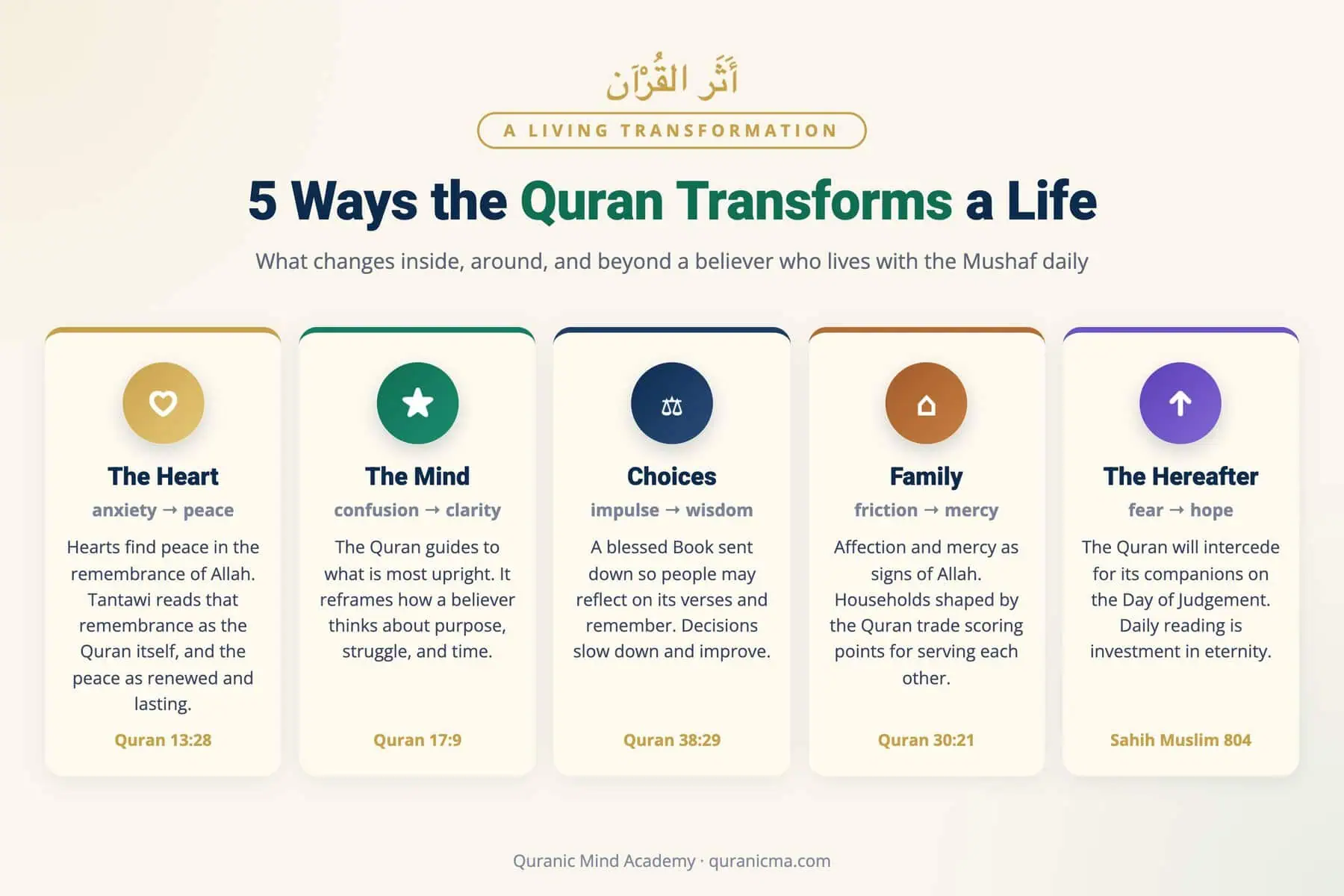
The dramatic conversion stories make headlines, but the Quran’s deeper work is quieter and continuous. For the believer who reads daily, change shows up across five domains.
1. The Heart: Anxiety Becomes Peace
Allah names the effect explicitly:
“… truly it is in the remembrance of God that hearts find peace.” (Surah Ar-Raʿd 13:28, trans. Abdel Haleem)
Recitation is the highest form of dhikr. The calm it produces is well-documented in the lives of the Companions and observable in any honest daily reader today. Many students describe their morning Quran time as the only ten minutes of the day where the mind is genuinely still.
2. The Mind: Confusion Becomes Clarity
The Quran reframes how a believer thinks about big questions: purpose, suffering, time, success, failure. Reading the same verse for the tenth time is not redundant. The verse stays the same; the reader has changed, and the meaning lands differently. Surahs like Yūsuf teach forgiveness, Al-Kahf teaches patience under hardship, Maryam teaches trust during isolation. Decisions made by someone who lives inside these stories tend to be slower and better.
3. Choices: Impulse Becomes Wisdom
A Muslim shaped by the Quran does not stop having impulses. The impulses just get filtered through a different reference point. Again and again the Quran asks its readers to think about its messages and take heed (Quran 38:29; see also 4:82 and 47:24). The pattern that emerges is a kind of slow-motion ethics: a pause between provocation and response, between desire and action. Over years, the pause becomes character.
4. Family: Friction Becomes Mercy
Allah describes marriage itself as one of His signs:
“Another of His signs is that He created spouses from among yourselves for you to live with in tranquillity: He ordained love and kindness between you.” (Surah Ar-Rūm 30:21, trans. Abdel Haleem)
Households shaped by Quranic values trade scoring points for serving each other. Children growing up around recitation absorb a vocabulary of mercy that no parenting book provides. The texture of the home changes — quieter, less reactive, slower to anger.
5. The Hereafter: Fear Becomes Hope
The Prophet ﷺ promised:
“Recite the Quran, for indeed it will come on the Day of Resurrection as an intercessor for its companions.” (Sahih Muslim 804)
The believer who reads daily is investing in eternity in the most direct way Islam describes. The fear of death does not disappear, but it stops being the only frame. The Quran reframes mortality as transition, not termination.
The Engine: Reflection (Tadabbur)
Reading without reflection is still rewarded, but reading with reflection is what changes a person. The Quran asks the question itself:
“Will they not contemplate the Quran? Do they have locks on their hearts?” (Surah Muḥammad 47:24, trans. Abdel Haleem)
The verse links closed reflection to closed hearts. Tadabbur is the engine that converts recitation into transformation. Practical ways to add it to a daily session:
- Pause at the end of every page and ask one question: What is Allah telling me here?
- Read the translation of any verse you don’t yet understand. Once a week is enough.
- Pick one verse to live with for a week. Carry it on your phone, repeat it during commutes, look for it in your decisions.
- Connect verses to your real life. Surah Yūsuf to forgiveness, Surah Al-Kahf to patience, Surah Maryam to trust.
- Write a one-line journal entry after each session: what stayed with you. Over a year, you build a map of how the Quran is reading you.
What If You’re Just Starting?
The Quran’s transformations do not require expertise to begin. They require contact. A Muslim who has never read daily before benefits more from picking the smallest sustainable habit than from setting an ambitious target that collapses by week three. A practical 30-day starter:
- Week 1: Read Surah Al-Fātiḥah every morning, slowly, with the translation. Notice every line.
- Week 2: Add the last three surahs (Al-Ikhlāṣ, Al-Falaq, An-Nās) three times each, morning and evening.
- Week 3: Add five minutes of listening to a slow reciter (Al-Ḥuṣarī or Al-Minshāwī) during a daily commute or chore.
- Week 4: Add reading one page from the Mushaf each morning. Use the same Mushaf every day so your eyes settle.
By day 30, the habit is not a habit anymore. It is part of how the day starts. From that base, growth happens naturally.
Common Obstacles (and Real Fixes)
Three obstacles show up for almost every adult learner trying to build a Quran-centred life.
“I Can’t Read Arabic”
Start with Noorani Qāʿidah. In our teachers’ experience, six to eight weeks of daily practice, ideally with a teacher, gets most beginners reading short surahs from Juz Amma. Until then, read the translation in your own language. The reflection still happens; only the reward currency changes.
“I Read but I Don’t Understand”
This is a very common struggle for adults. The fix is parallel reading: a translation alongside the Arabic. Mustafa Khattab’s The Clear Quran and Saheeh International are both reliable in modern English. Five minutes of translation a day, alongside Arabic recitation, steadily closes the gap.
“I Don’t Have Time”
Almost always inaccurate, and the framing is the problem. The honest version is “I have not yet built the habit.” Five minutes is real. Five minutes after Fajr, every day, beats two hours once a week. The deed Allah loves most is the one done consistently, even if small (Sahih al-Bukhari 6464), and the one who struggles to recite has a double reward (Sahih Muslim 798).
How Quranic Mind Academy Helps
Most students who join us have tried to build a Quran routine on their own and stalled. What works for our families is structure plus accountability:
- Al-Azhar-trained teachers in one-to-one online sessions, scheduled around your life.
- A reading curriculum that takes a beginner to fluent recitation in 18 to 24 months.
- Tajweed taught alongside reading from day one, not bolted on later.
- Female teachers on request for women and daughters who prefer them.
- Two free trial sessions before any commitment.
The full QMA course list covers reading, Tajweed, memorisation, Arabic, and Islamic Studies. Most students start with the Online Quran Recitation Course and add other tracks once the daily habit is anchored.
Related Reading
- The Virtue of Reading the Quran Daily — five virtues with full citations.
- How to Memorise the Quran: 6 Pillars — once daily reading is anchored, structured memorisation becomes the natural next step.
- How the Quran Influences Muslims’ Lives Today
- The Sciences of the Quran
- Complete Guide to Tajweed Rules
Frequently Asked Questions
What is the impact of the Quran on Muslims today?
Daily reading reshapes the heart, mind, decisions, family life, and relationship with the hereafter. The change is gradual rather than dramatic, and consistency is the variable that matters most.
Can the Quran really change someone who has never read it?
Yes. Historical and modern records consistently show people from many backgrounds (Christian kings, Catholic mathematicians, atheist students) accepting Islam after sustained engagement with the Quran. The Quran calls on everyone to reflect on its verses (Quran 38:29), and says its lessons are a reminder “for whoever has a heart, whoever listens attentively” (Quran 50:37, trans. Abdel Haleem).
Do I need to understand Arabic to feel the Quran’s impact?
No. Arabic deepens the experience and unlocks the layers of meaning, but the Quran reaches non-Arabic speakers through translations, recitation, and reflection. Many famous conversions in history happened through translations. Most of QMA’s students do not start fluent in Arabic.
What is tadabbur?
Active reflection on the Quran’s verses with the intent to understand and apply them. It is the difference between reading verses and being read by them. The Quran itself uses the word and asks why people fail to do it (Quran 47:24).
How much should I read daily for the Quran to start changing me?
One page consistently is more powerful than one juz once a week. Beginners should target five to ten minutes a day. Once that is automatic, increase gradually. Sustained contact is what does the work, not volume in a single sitting.
Is reading the translation enough, or do I need Arabic?
Both are valuable for different reasons. The Arabic carries the multiplied reward (Tirmidhi 2910, graded hasan by Darussalam; al-Tirmidhi called it hasan sahih gharib: ten rewards per letter) and the original sound. The translation gives you immediate meaning. Most learners do both: translation for understanding, Arabic for recitation, and over time the two converge.
Begin the Transformation
The Quran has changed kings, mathematicians, persecutors, and ordinary people for fourteen centuries. Two free trial sessions with one of our Al-Azhar teachers will give you a clear picture of where to start. No commitment, no pressure.
Start with 2 Free Trial Lessons →
Have questions? Chat with us on WhatsApp.