The life of Prophet Muhammad ﷺ is not a closed chapter of seventh-century history. It is a richly documented life, recorded by his companions, written down within a generation of his death, and held by over 1.8 billion Muslims today as the working model of how to live a faith-shaped life. Allah Himself calls it the example to follow:
“The Messenger of God is an excellent model for those of you who put your hope in God and the Last Day and remember Him often.” (Qur’an 33:21, trans. Abdel Haleem)
This guide walks through the Seerah in order: the Arabia he was born into, the revelation in the cave, the migration to Madinah, the years of community-building, and finally the Farewell Pilgrimage. By the end you should have a clear timeline and a sense of what each phase asks of you.
The World the Prophet ﷺ Was Born Into
Late sixth-century Arabia was not a vacuum. It was a network of tribes held together by lineage, oaths, and trade caravans crossing between Yemen and Syria. Makkah stood at the centre because of the Kaʿbah, the ancient house built by Ibrahim and Ismaʿil, which by the Prophet’s birth had been surrounded by some 360 idols.
Tribal honour ruled. Blood feuds could last generations. Female infants were sometimes buried alive. Slavery was inherited. Wine and gambling were ordinary. And yet, scattered through this society, there were hunafa: individuals like Waraqah ibn Nawfal and Zayd ibn ʿAmr who rejected idol worship and were quietly waiting for a prophet.
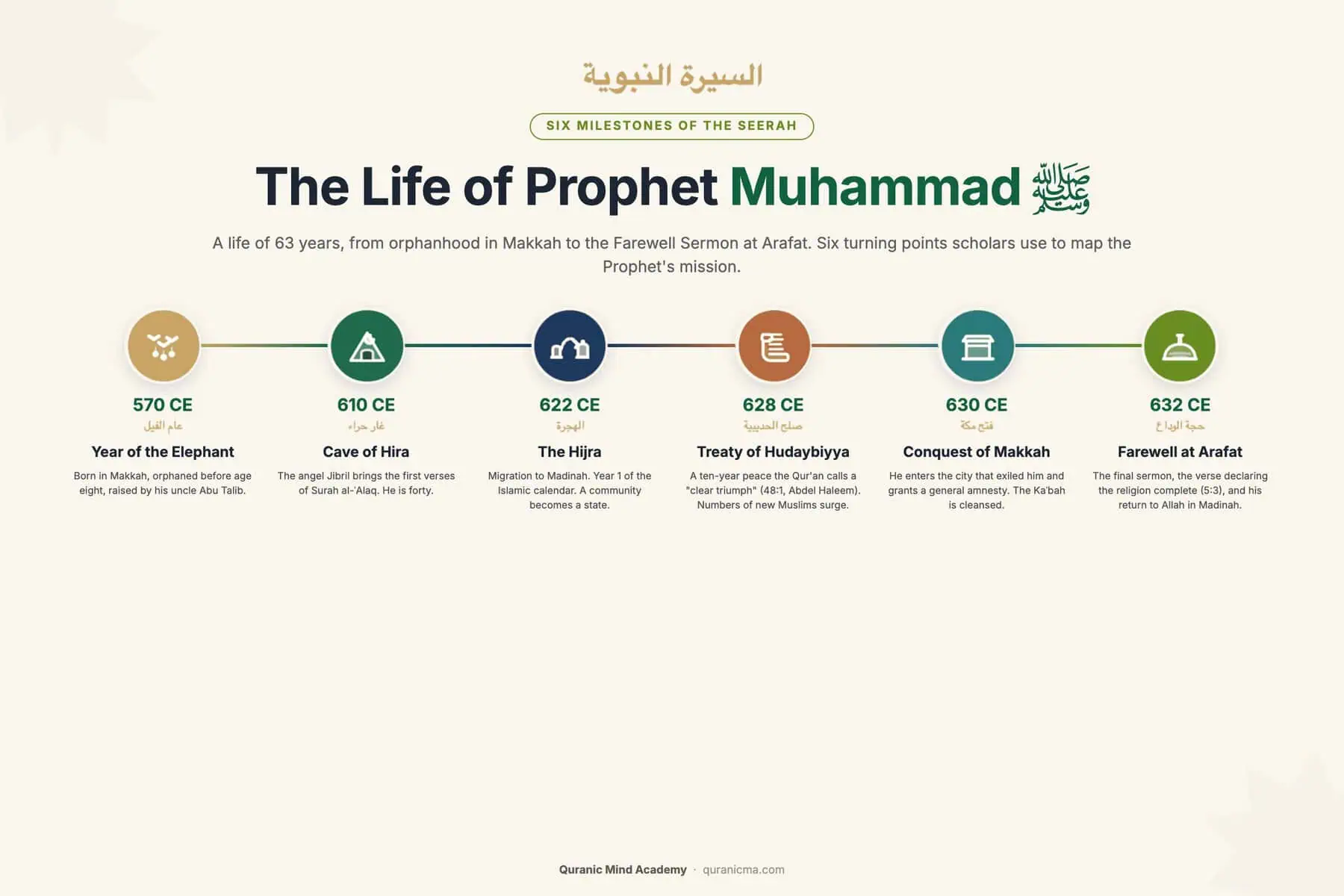
The Prophet ﷺ was born in this Makkah around 570 CE, the year known as ʿAm al-Fil (the Year of the Elephant) after Abraha’s failed Yemeni expedition against the Kaʿbah, which Allah destroyed and which the Qur’an records in Surah al-Fil.
From Orphan to Al-Ameen: The First Forty Years
His father ʿAbdullah died before he was born. His mother Aminah died when he was six. His grandfather ʿAbd al-Muttalib, who took him in, died two years later. By eight he was being raised by his uncle Abu Talib.
From childhood he worked. He shepherded sheep on the hills around Makkah, then joined Abu Talib’s trade caravans to Syria. By his twenties his honesty in trade had earned him a title Quraysh used long before any revelation: al-Ameen, the Trustworthy. People left their valuables with him for safekeeping. Even after they declared war on him, they continued to entrust him with their wealth, and his first instruction at the Hijra was for ʿAli to return every deposit before leaving Makkah.
At twenty-five he married Khadijah bint Khuwaylid, a wealthy widow who had hired him to lead her caravan to Syria. She was forty. They were married for twenty-five years and he took no other wife while she lived. Their household became the first place revelation would touch.
Between thirty-five and forty he developed a habit of retreating to the Cave of Hira on Mount al-Nur outside Makkah, taking food and sitting alone in worship for days at a time. He had no scripture and no formal teacher. He was being prepared.
The Cave of Hira and the First Revelation
In the month of Ramadan, in his fortieth year (around 610 CE), the angel Jibril appeared to him in the cave. ʿAishah preserved his own description of that moment:
The angel came to him and asked him to read. The Prophet ﷺ replied, “I do not know how to read.” The Prophet added, “The angel caught me and pressed me so hard that I could not bear it any more. He then released me and again asked me to read, and I replied, ‘I do not know how to read.’ Thereupon he caught me again and pressed me a second time till I could not bear it any more. He then released me and again asked me to read, but again I replied, ‘I do not know how to read.’ Thereupon he caught me for the third time and pressed me, and then released me and said, ‘Read in the name of your Lord, who has created…'” (Bukhari 3)
The first words of revelation are preserved in Surah al-ʿAlaq: “Read! In the name of your Lord who created: He created man from a clinging form. Read! Your Lord is the Most Bountiful One who taught by [means of] the pen, who taught man what he did not know.” (Qur’an 96:1-5, trans. Abdel Haleem)
He came home shaking. Khadijah covered him, calmed him, and took him to her cousin Waraqah ibn Nawfal, an aged Christian scholar of Hebrew scripture, who recognised the encounter and said, “This is the Namus that came to Moses.” The mission had begun.
The first word revealed was a command to read, and it was not given as a text. It was given aloud, by repetition, from one who already had it, which is how the Quran has been transmitted ever since. Book a free trial lesson and hear the difference between reading the Quran and being taught it.
Thirteen Years in Makkah: Patience Under Persecution
For the first three years the call was private. Khadijah believed first. Then his ten-year-old cousin ʿAli ibn Abi Talib and his freed slave Zayd ibn Harithah, and his close friend Abu Bakr, who brought ʿUthman, Talhah, al-Zubayr, Saʿd, and others. A small house in the Safa quarter, the house of al-Arqam, became the first place of communal worship.
When the call went public, Quraysh turned hostile. Their economy and identity ran through the Kaʿbah, and the message of one God threatened every idol that pilgrims came to visit. They tried bargaining first, offering wealth and leadership if he stopped. He refused. So they moved to persecution.
Bilal ibn Rabah was pinned under a heated stone in the sand by his master Umayyah ibn Khalaf, repeating “Ahad, Ahad” (one God, one God). Sumayyah bint Khabbat became the first martyr of Islam, killed by Abu Jahl with a spear. Khabbab ibn al-Aratt was branded with hot iron. The Prophet ﷺ himself was strangled by ʿUqbah ibn Abi Muʿayt at the Kaʿbah until Abu Bakr pulled the cloak away.
Two waves of believers migrated to Abyssinia (Ethiopia) under the just Christian king Najashi, who protected them. Then Quraysh imposed a three-year economic boycott on the whole clan of Banu Hashim, cutting off food and trade until people were eating leaves. According to the sira, the boycott broke after termites ate the boycott document inside the Kaʿbah, leaving only the words “In Your name, O Allah.”
Then came ʿAm al-Huzn, the Year of Sorrow (around 619 CE), in which Khadijah and Abu Talib both died within months. The Prophet ﷺ travelled to Taʿif looking for support. The sira reports that he was instead pelted with stones by the town’s louts and slaves, whom its leaders set on him, until his feet bled into his sandals, and that on the way back, dejected but never bitter, he made a duʿa that scholars still teach as the model for hardship: he complained only of his weakness to Allah, never of the people who had hurt him.
The Hijra: Migration That Reset the Calendar
In 622 CE, after years of envoys from Yathrib pledging support at ʿAqabah, Allah commanded the believers to migrate. The Prophet ﷺ left last, after almost every other Muslim was safely out, and after Quraysh had agreed to assassinate him in his bed by sending one young man from every clan so that no single tribe could be blamed.
ʿAli slept in his place. The Prophet ﷺ slipped through the assassins, met Abu Bakr, and the two hid for three days in the Cave of Thawr south of Makkah while Quraysh searched. Allah preserved them. Abu Bakr said that if the searchers looked under their feet they would see them, and the Prophet ﷺ answered, “O Abu Bakr! What do you think of two (persons) the third of whom is Allah?” (Sahih al-Bukhari 3653). A report in Musnad Ahmad, graded hasan by Ibn Hajar and Ibn Kathir though al-Albani considered it weak, adds that a spider had spun its web across the cave mouth (islamweb). The Qur’an captures the moment Abu Bakr feared and the Prophet ﷺ told him:
“… he [Muhammad] said to his companion, ‘Do not worry, God is with us’ …” (Qur’an 9:40, trans. Abdel Haleem)
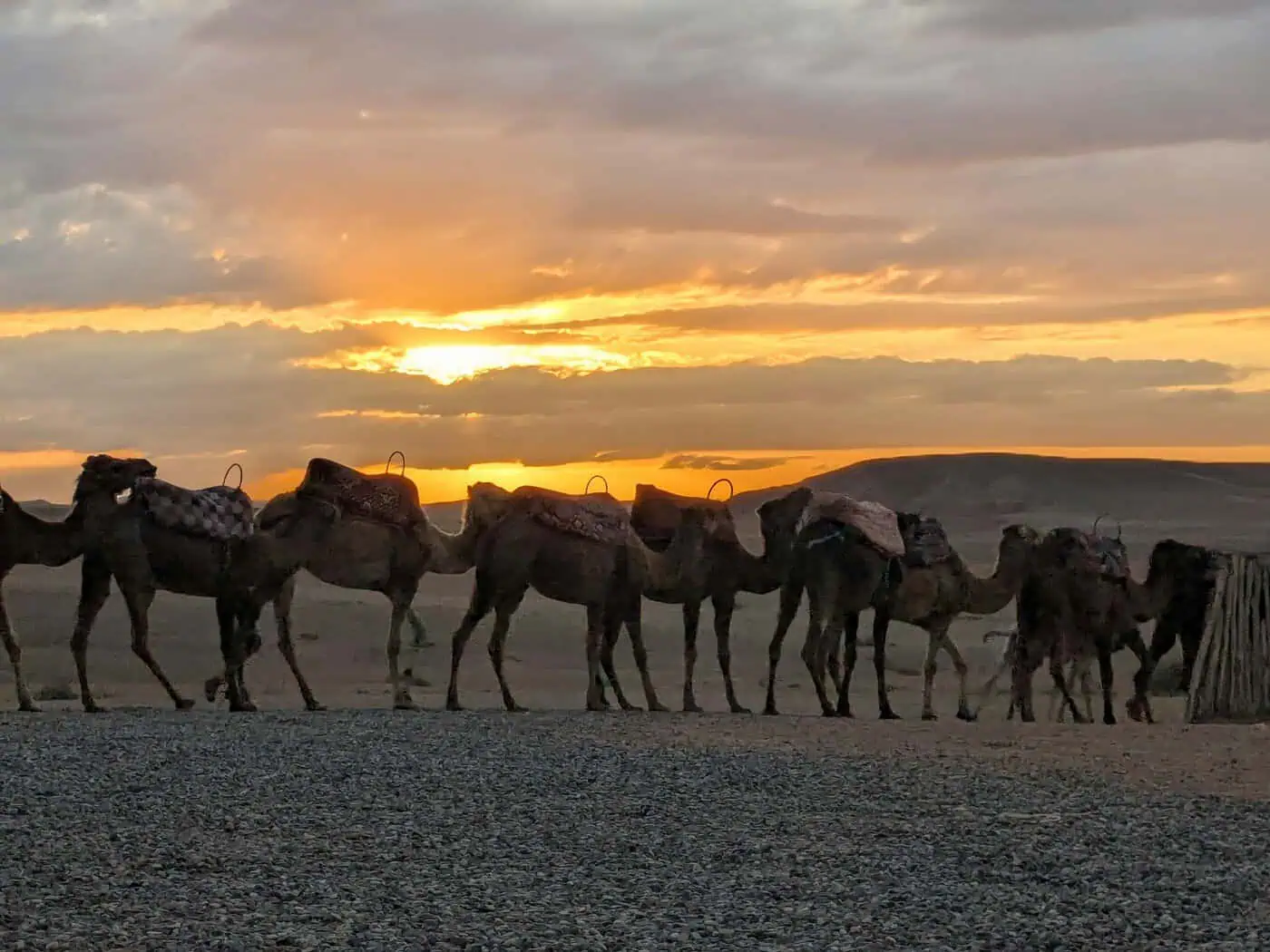
They travelled north by an unusual coastal route on camels, arriving in Yathrib, soon renamed Madinat al-Nabi (the City of the Prophet) or simply Madinah. The arrival in 622 CE became Year 1 of the Hijri calendar, the calendar Muslims still use today. The migration was not just a relocation. It was the moment a persecuted community became a sovereign society.
Building the First Muslim Community in Madinah
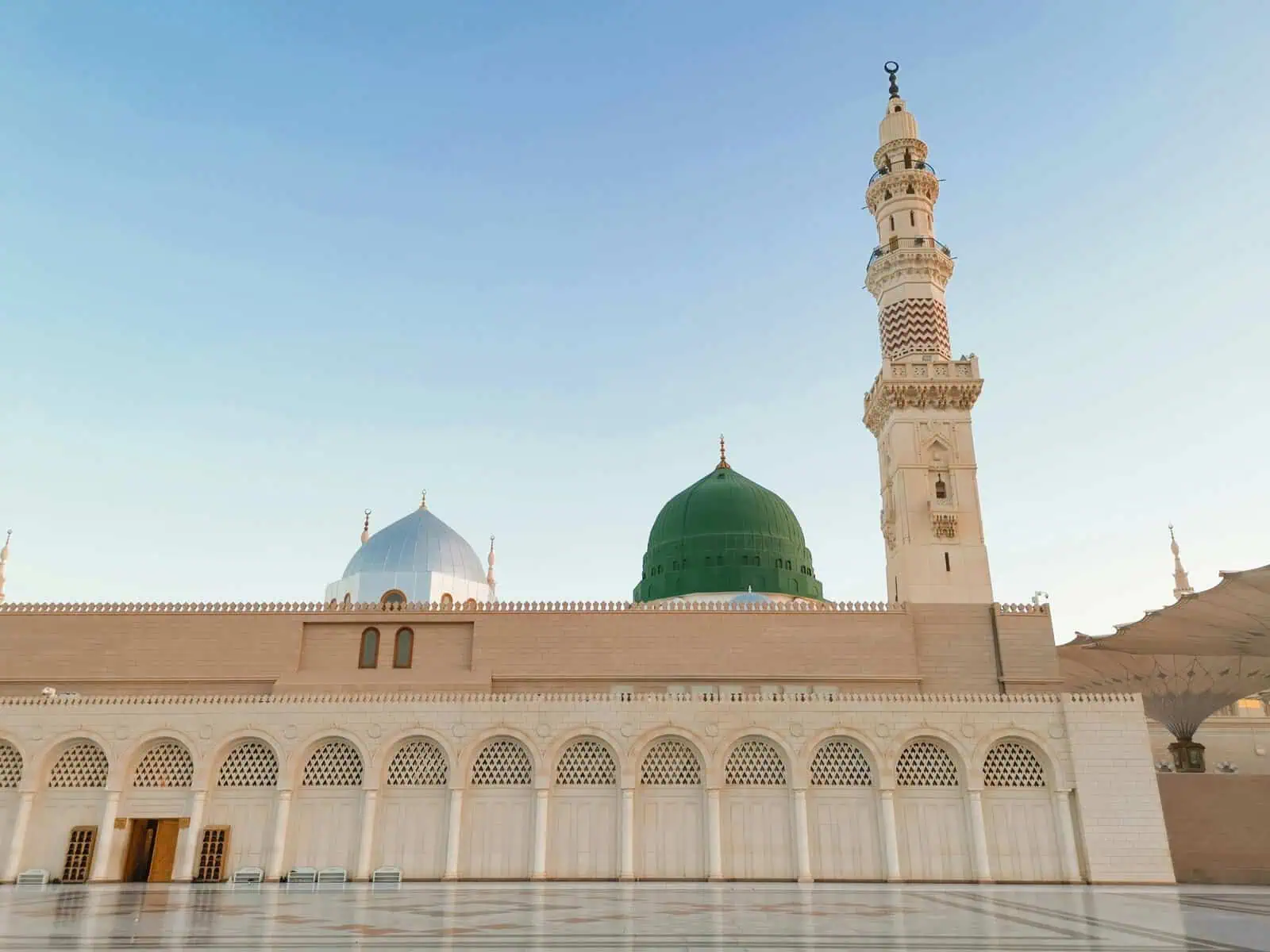
He founded a mosque at Quba on the way in (Sahih al-Bukhari 3906), and the first thing he built in Madinah itself was Masjid al-Nabawi, on a yard used for drying dates, with mud walls and palm-trunk pillars. The mosque was not only for prayer. It was the courtroom, the school, the homeless shelter (the Ahl al-Suffah lived in its rear), and the meeting hall.
The second thing he did was bind the Muhajirun (the Makkan emigrants who had lost everything) and the Ansar (the helpers of Madinah who took them in) into one brotherhood. Each Ansari believer was paired with a Muhajir and shared his home, his food, and sometimes half his property. When ʿAbd al-Rahman ibn ʿAwf was paired with Saʿd ibn al-Rabiʿ, Saʿd offered to split his property with him (Sahih al-Bukhari 3780).
The third thing he drafted was the Constitution of Madinah, a written pact between the Muslims, the pagan Arab clans, and the Jewish clans allied to them. The three large Jewish tribes, Qaynuqaʿ, al-Nadir and Qurayzah, made separate non-aggression pacts with him (Michael Lecker, The Constitution of Medina). It set out collective defence, mutual security, freedom of religion, judicial process, and the principle that no group would shelter a criminal of another. For its time, in a region ruled by tribe and blood, it was a remarkable document of pluralism under a single rule of law.
Battles, Treaties, and the Conquest of Makkah
The Madinan years included a series of confrontations with Quraysh and others. Scholars describe these campaigns as aimed at repelling aggression, protecting the call to Islam and recovering what had been seized from the emigrants, never at forcing anyone into the faith (Dar al-Ifta).
Badr (624 CE / 2 AH): A force of about 313 Muslims defeated a Quraysh army of nearly 1,000, marking the first decisive battle and the public arrival of Islam as a force. The Qur’an refers to it in 3:123 (trans. Abdel Haleem): “God helped you at Badr when you were very weak.”
Uhud (625 CE / 3 AH): A near-victory that turned into heavy losses when archers left their post for the spoils. The Prophet ﷺ was injured. Seventy companions were martyred, including his uncle Hamzah. Uhud became a lesson in obeying instructions even when victory looks certain.
Khandaq, the Trench (627 CE / 5 AH): A coalition of 10,000 besieged Madinah. On the advice of Salman al-Farisi, the Persian companion, a defensive trench was dug around the city, a tactic new to Arabia. After weeks of stalemate a fierce wind scattered the coalition without major battle.
Hudaybiyya (628 CE / 6 AH): The Prophet ﷺ set out on ʿUmrah with 1,400 companions. Quraysh blocked them at Hudaybiyya. He accepted a ten-year truce with terms his own companions found humiliating, including being turned back that year. In the two years of peace that followed, as the early scholar al-Zuhri observed, as many people entered Islam as in all the years before, or more (al-Tabari on 48:27): 1,400 went to Hudaybiyya, and 10,000 marched on Makkah two years later (Sahih al-Bukhari 4276). The Qur’an called the treaty a clear victory (Qur’an 48:1).
Conquest of Makkah (630 CE / 8 AH): When Quraysh broke the treaty, the Prophet ﷺ marched on Makkah with 10,000 companions. The city that had tortured and exiled him fell with almost no fighting. Then came the moment that defined his character. He declared, “Who enters the house of Abu Sufyan, he will be safe” (Sahih Muslim 1780), and pardoned the Quraysh who had spent twenty years trying to destroy him. Ibn Ishaq’s Sirah adds that he stood at the Kaʿbah and asked them, “What do you think I will do with you?” They said, “A noble brother, son of a noble brother,” and he replied, “Go, you are free,” echoing Yusuf’s words to his brothers: “You will hear no reproaches today” (Qur’an 12:92, trans. Abdel Haleem). Al-Albani graded this sira report weak (al-Silsilah al-Daʿifah 1163).
The Farewell Pilgrimage and the Final Sermon
In the tenth year of Hijra (632 CE), the Prophet ﷺ led the Hajj himself for the first and only time. A vast crowd came with him; Jabir ibn ʿAbdullah recalled seeing riders and people on foot as far as his eyes could reach in every direction (Sahih Muslim 1218). On the plain of Arafat he delivered what became known as the Farewell Sermon. It was not a battle speech or a legal verdict. It was a final summary of everything Islam had come to settle in the world.
He declared the end of pre-Islamic blood feuds, the abolition of interest-based usury starting with his own family’s claims, the rights of women on their husbands and the rights of husbands on their wives, the sanctity of life and property among believers, and, in a report in Musnad Ahmad (23489, graded sahih by al-Wadiʿi), that no Arab is superior to a non-Arab, nor a red-skinned person to a black one, except in taqwa (God-consciousness) (dorar.net). The main account of the sermon is in Sahih Muslim 1218.
That same day, on Arafat, one of the last passages of the Qur’an was revealed, the ayah that declared the religion complete (Sahih al-Bukhari 45):
“… Today I have perfected your religion for you, completed My blessing upon you, and chosen as your religion islam: [total devotion to God] …” (Qur’an 5:3, trans. Abdel Haleem)
He returned to Madinah and died a few months later in the room of ʿAishah, his head on her lap, around the age of 63. His last whispered words, repeated by witnesses, were: “Bal al-rafiq al-aʿla” (“Rather, the highest companion”).
What the Seerah Asks of Us Today
The Prophet ﷺ did not pass down only doctrine. He passed down a workable life. The Qur’an describes him with one of the highest compliments in scripture:
“… truly you have a strong character” (Qur’an 68:4, trans. Abdel Haleem)
What does that great character look like translated into daily decisions?
- Trustworthiness at work. He was Al-Ameen before he was a prophet. Promises kept, deposits returned, deadlines met, no padded invoices.
- Kindness inside the home. “The best of you is the one who is best to his family, and I am the best to my family” (Jamiʿ at-Tirmidhi 3895, graded hasan gharib sahih by al-Tirmidhi). He mended his own clothes, helped with chores, and never raised a hand to a wife or a child.
- Patience with people who hurt you. Taʾif, the boycott, the death of his children; he never met cruelty with cruelty.
- Forgiveness when you have the power not to. The Conquest of Makkah is the single most important precedent against revenge politics in Islamic history.
- Consultation in decisions. Badr, Uhud, the trench at Khandaq; he asked his companions for their views even when he had divine guidance available.
- Justice with no double standards. “By Allah, if Fatimah the daughter of Muhammad stole, I would cut off her hand” (Bukhari 3475).
How to Begin Studying the Seerah Properly
The Seerah is one of the most accessible Islamic sciences. You do not need Arabic on day one and you do not need to memorise dates. A workable path:
- Read one accessible chronological account end-to-end. Martin Lings’ Muhammad: His Life Based on the Earliest Sources or Safiur Rahman Mubarakpuri’s al-Raheeq al-Makhtum (The Sealed Nectar) are two widely used starting points in English.
- Pair each event with its Qur’anic reference. When you read about Badr, read Surah al-Anfal. When you read about Hudaybiyya, read Surah al-Fath. The Qur’an and the Seerah explain each other.
- Take one trait per week and live it. Honesty in business this week. Forgiveness next. Generosity at home the week after. Knowing the story is not the goal; resembling the man is.
- Find a teacher. Seerah taught by someone who has studied it sequentially will save you years of half-formed impressions. This is exactly what our Islamic Studies course covers, in plain English, alongside fiqh and the Islamic framework for seeking knowledge.
Related Guides
- The importance of seeking knowledge in Islam: why studying the Seerah is itself an act of worship.
- Principles of Fiqh: the framework that turns the Prophet’s actions into rulings for daily life.
- Islam as a holistic way of life: how the Seerah shaped spiritual, physical, mental, and social practice.
- Ramadan in Islam: the month the revelation began.
- Guidance from the Qur’an: the Book the Prophet ﷺ was sent to deliver.
Frequently Asked Questions
Why is the Seerah important when we already have the Qur’an?
The Qur’an gives the principles. The Seerah shows how a human being lived them under hardship, in family, in trade, in war, and in power. Without the Seerah, large parts of the Qur’an (its references to specific battles, treaties, conversations, and rulings) would be uncontextualised. Without the Qur’an, the Seerah loses its source of authority. They are designed to be read together.
How reliable are the sources of the Prophet’s life?
Highly. The earliest detailed biography, by Ibn Ishaq, was written within 130 years of the Prophet’s death and survives through the recension of Ibn Hisham. The companions’ direct reports were chain-verified by hadith scholars who developed a science (ʿilm al-rijal) specifically to grade who can be trusted to relay what. The major events (birth, marriage, revelation, migration, battles, sermon, death) are mass-transmitted (mutawatir), meaning so many independent witnesses reported them that fabrication is not credible.
What was the Prophet ﷺ like in his daily routine?
Light meals, often dates and water. Five daily prayers plus voluntary night prayer. Active in his home: he sewed, mended sandals, served his family (Sahih al-Bukhari 676), played with his grandchildren al-Hasan and al-Husayn. Slept little. Spoke clearly and slowly so listeners could repeat his words. Smiled often; ʿAishah said his laughter was usually a smile.
Can non-Muslims study the Seerah?
Yes, and many do. The Prophet ﷺ was sent, the Qur’an says, “as a mercy … to all people” (21:107, trans. Abdel Haleem). His treatment of Christians of Najran, Jews of Madinah, and pagan Quraysh after the Conquest are studied today in courses on comparative ethics, diplomacy, and international law.
What is the best age to teach children the Seerah?
From the moment they can listen to stories. Start with the story of the elephant, the orphan boy who became Al-Ameen, the cave, the cave-spider at Thawr, the man who forgave Makkah. Let dates and names come later. The character forms first.
Where can I study the Seerah online with a teacher?
At Quranic Mind Academy our Islamic Studies course covers the Seerah chronologically, paired with Qur’anic references, hadith sources, and practical reflection for daily life. Lessons are one-to-one with vetted teachers and you can book a free trial before committing.