Most Muslims read Islamic content every day. Reels, threads, articles, podcasts, the occasional khutbah. What changes a life is not more content. It is structured Islamic Studies: a sequenced curriculum, with a real teacher, that turns scattered knowledge into stable belief, repeatable worship, and visible character. The Prophet ﷺ said:
“Whoever Allah wishes good for, He gives him understanding of the religion.” (Bukhari 71)
This guide explains what Islamic Studies actually is, which branches make up the curriculum, what it does to your daily life when studied properly, and how to start in a way that fits a working week.
What Islamic Studies Is, and What It Is Not
Islamic Studies is the disciplined study of the religion across its core branches: ʿaqidah (creed), tafsir (Qur’anic exegesis), hadith, fiqh (jurisprudence), Seerah (the Prophet’s biography), and Islamic ethics. Done in sequence, with a teacher, it produces an integrated understanding of what Muslims believe, why they believe it, and how that belief shapes everyday life.
It is not:
- An algorithmic feed of inspirational quotes.
- One-off lectures consumed at random.
- Apologetics-only debating skills.
- Cultural traditions held without textual grounding.
The Qur’an makes the distinction sharply:
“Say, ‘How can those who know be equal to those who do not know?’ Only those who have understanding will take heed.” (Qur’an 39:9, trans. Abdel Haleem)
The Five Branches You Actually Study
A proper Islamic Studies curriculum has more than five branches, but five make up the core that every serious student covers.
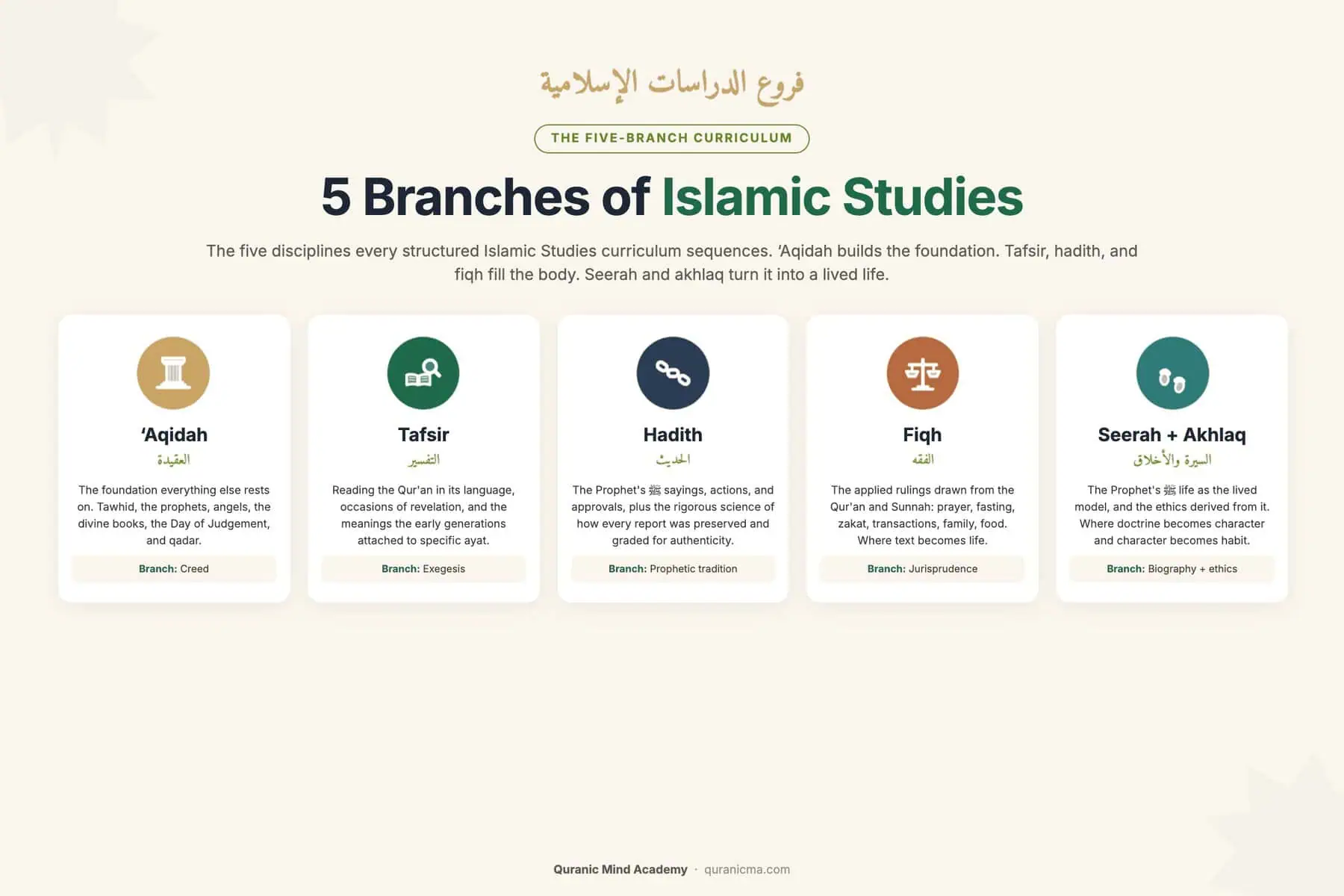
- ʿAqidah (creed): Tawhid (the oneness of Allah), the prophets, angels, divine books, the Day of Judgement, and qadar (divine decree). The foundation everything else rests on.
- Tafsir: Understanding the Qur’an in its language, occasions of revelation, and the meanings the early generations attached to specific ayat. Covered in deeper detail on the Sciences of the Qur’an page.
- Hadith: The sayings, actions, and approvals of the Prophet ﷺ, the science of how those reports were preserved, and how scholars graded them.
- Fiqh: The applied rulings (prayer, fasting, zakat, transactions, family, food) drawn from the Qur’an and Sunnah using the principles covered on the Principles of Fiqh page.
- Seerah and Akhlaq: The life of the Prophet ﷺ as the lived model (full chronology on the Prophetic Biography page) and the ethics derived from it.
These five interlock. ʿAqidah without fiqh stays abstract. Fiqh without ʿaqidah turns into ritual without meaning. Seerah without hadith becomes storytelling. A working curriculum sequences them so each branch supports the next.
What Islamic Studies Does to Daily Life: From Knowledge to Habit
The benefit of studying is not the volume of information collected. It is the gap between knowing something and doing it shrinking week by week. A few concrete examples of what shifts:
Prayer becomes deliberate. Once you understand what each part of salah means in Arabic, what the Prophet ﷺ recited at each station, and why scholars treat khushuʿ (focused presence) as the heart of the prayer, the same five prayers a day stop being a checkbox and start being five reset points.
Decisions become faster. A Muslim who has studied basic fiqh of transactions does not need to Google “is X halal” for every modern question. The principles in their head do most of the work; only the edge cases need a teacher.
Reactions become slower. Anger, gossip, jealousy, panic: these are explicitly named in the texts, and the Prophetic remedies (silence, repositioning, du’a, fasting) are practical. Knowing the remedy changes the moment you notice the impulse.
Doubt stops winning. Most shubuhāt (intellectual doubts) hit hardest in isolation, fed by content designed to provoke. A student who has structured answers, knows where to look for them, and has a teacher to ask, processes doubt instead of being processed by it.
The Akhlaq Output: How Knowledge Becomes Character
Knowledge that does not change character has failed. How a student treats neighbours and family is a truer measure of learning than how many books they own. The akhlaq output of Islamic Studies, when done well, shows up in six places:
- Truthfulness in speech, especially when it costs you something.
- Amanah in money, time, deadlines, and what was entrusted to you.
- Mercy with family (spouses, parents, children) first, before strangers.
- Sabr in difficulty and shukr in ease, both as conscious responses, not moods.
- Justice in disagreement, even with people you do not like.
- Humility about how much you still do not know.
If a year of Islamic Studies has not moved any of these six in your day-to-day, the study has been informational, not formative. The remedy is usually a real teacher and a smaller, more disciplined daily load, not more content.
A Weekly Plan That Works for Working Adults
The biggest failure mode in adult Islamic Studies is overcommitment in week one. A sustainable plan is small, fixed, and tied to existing routines, which is why our online Quran classes for adults start at two sessions a week:
- Three weekday slots of 30 minutes each. Tuesday, Thursday, Saturday is a common pattern. Tied to a fixed cue (after Fajr, after Isha, Saturday morning before family wakes).
- One module at a time. Six weeks on ʿaqidah, then six weeks on the fiqh of worship, then six weeks on tafsir of a specific surah. Sequential beats parallel.
- A teacher you meet weekly. A 45-minute one-to-one lesson where you bring questions from the week’s self-study. The teacher corrects, deepens, and assigns next week.
- Five minutes of daily review. One ayah or one hadith you read with the morning coffee, written in a small notebook. This is the part most students skip and most regret skipping.
- Monthly check-ins. Last Saturday of each month, look back. What did I actually learn? What changed in my week? What is the next module?
Three hours of structured study a week, sustained for a year, will produce more than ten hours of random consumption sustained for a month and abandoned.
Islamic Studies for Children: Different Ages, Different Approaches
Adults learn through curriculum. Children learn through environment, repetition, and story. That is how our online Quran classes for kids are built.
Ages 4 to 7: Stories of the Prophets, simple du’a, basic adab (greetings, gratitude, asking before taking). No formal curriculum. The aim is to build the association that the religion is normal, warm, and present at home.
Ages 8 to 11: Add structured weekly lessons. Pillars of Islam, pillars of iman, the fard prayers in detail, short surahs memorised with meaning. A consistent weekly teacher matters more than the specific syllabus.
Ages 12 to 15: Begin formal aqidah and fiqh-of-worship. Add Seerah as the spine of the year. This is the age where peer pressure and identity questions arrive; the curriculum should answer them, not avoid them.
Ages 16+: Treated as young adults. Full Islamic Studies curriculum. The teacher’s role shifts from instructing to discussing.
How Online Study Compares to the Masjid Halaqah
Both formats have place. The honest comparison:
- One-to-one attention. Online wins. A halaqah teacher is teaching a group, so each student gets a share of the teacher’s time.
- Community. Halaqah wins. Studying with people you see each week is irreplaceable.
- Consistency. Online wins for adults with shifting work schedules. Halaqah wins if you live near it and the timing is fixed.
- Depth on specific questions. Online wins, because you can pick a teacher specialising in exactly what you are working on.
- Cost. Halaqah is usually free. Online is paid; the trade is one-to-one teacher time.
For most working adults, the optimal pattern is online lessons for the structured curriculum, plus a weekly masjid halaqah for the community side. The two are not in competition.
Common Mistakes That Stall Progress
- Treating learning as content. Bookmarking 200 articles does not move you forward. Finishing one short structured course does.
- Jumping branches. Switching from fiqh to aqidah to Seerah and back every other week leaves you with surface impressions of all three and depth in none. Sequence and finish.
- Learning from algorithm-curated speakers. The most viral teacher is not always the most reliable one. Choose teachers with traceable credentials and chains of transmission, not view counts.
- Refusing to use a real teacher. Self-study can take you a long way in many fields. Islamic Studies is not one of them; key concepts have technical meanings that the texts assume you have been taught.
- Studying without writing. Much of what you read without taking notes fades quickly. A small notebook beside the Mushaf helps you keep what you learn.
- Setting goals that ignore your actual life. A schedule that requires three uninterrupted hours every day will collapse. Plan from your worst day, not your ideal one.
Getting Started: First Three Lessons + Free Trial
Anyone starting from scratch can use this template for the first month:
- Lesson one (free trial): Meet a teacher. Talk about your background, what you already know, and what you want to be able to do in six months. Leave with a personalised module sequence.
- Lesson two: Begin the first module (usually basic aqidah). Cover the proofs for tawhid and the meaning of the kalimah in depth. Self-study the assigned reading during the week.
- Lesson three: Review the self-study, deepen one section, move forward. The teacher should be correcting and challenging, not just lecturing.
The pattern of teacher-led correction plus structured self-study plus regular review is what makes the difference. It is also the structure of every classical Islamic Studies curriculum, going back centuries.
Related Guides
- Islamic Studies (course page): the full curriculum and how lessons are run.
- The importance of seeking knowledge: why studying is itself an act of worship.
- Sciences of the Qur’an: the branches that surround tafsir.
- Principles of Fiqh: the framework that turns texts into rulings.
- Prophetic Biography: the lived model the entire curriculum points toward.
- Islam as a holistic way of life: how the branches integrate in practice.
Frequently Asked Questions
Is Islamic Studies only theory, or does it change behaviour?
Done properly, it changes behaviour first and accumulates theory along the way. Knowledge that does not move character has missed its purpose. If a year of study has not shifted how you speak to your family, how you handle money, or how you respond to anger, the issue is the format or the teacher, not the subject.
How long until I see a real change?
In our teachers’ experience, most students notice the shift within six to ten weeks of consistent weekly lessons. Salah deepens first. Conversations change next. Decisions become quicker last. The order is roughly that, and the timeline depends on whether the self-study between lessons actually happens.
Do I need to know Arabic to start?
No. Start in English with translation and tafsir, then add Arabic basics for depth. Most adult students never reach classical-Arabic fluency, and they still benefit enormously from structured Islamic Studies. Arabic accelerates the journey but is not the starting requirement.
What if I am too busy?
Almost everyone is too busy for the schedule they wish they had. The schedule that actually works is three 30-minute slots a week, tied to existing routines. Less than that is hard to call a curriculum. More than that, sustained for a year, is excellent.
How do I handle doubts that come up during study?
Write them down rather than spiral on them. Bring them to your teacher in the next lesson. Most doubts come from missing context, not from missing evidence, and a teacher can usually resolve them in five minutes. Reaching for argumentative YouTube content first usually makes things worse.
How can parents support a child’s Islamic Studies?
Model salah on time. Read with them weekly, even briefly. Praise effort over performance. Avoid making the religion a vehicle for criticism. Children associate religion with whoever introduces it. The home is the curriculum that runs all week; the formal lesson runs once or twice.
Where can I begin with a structured Islamic Studies course?
The Quranic Mind Academy Islamic Studies course covers all five branches sequentially, one-to-one with Al-Azhar-trained teachers, with written progress notes carried week to week. Book a free trial and the first lesson will give you a personalised sequence and a teacher to begin with.