If you have ever opened the Qur’an, looked at the Arabic script, and wondered whether you could ever read it yourself, you are not alone. Many Muslims reach adulthood able to pray but unable to read the Book they recite from. The good news is that learning to read the Qur’an online is now genuinely practical, even if you do not speak a word of Arabic and even if your last attempt was years ago.
This guide walks through what reading the Qur’an actually involves, how online lessons teach it, the realistic path from the alphabet to fluent recitation, and the mistakes that slow most beginners down. Everything here reflects how teaching works in practice at Quranic Mind Academy, where students of every age learn one to one with qualified tutors.
Why reading the Qur’an correctly is worth the effort
Reading the Qur’an is not the same as reading any other book. The letters carry sounds that do not exist in English, and a small change in pronunciation can change the meaning of a word entirely. The letter ʿayn in ʿalīm (All Knowing, 2:32) is a different letter from the hamza in alīm (painful, 2:10), and confusing them changes the word. This is why correct reading matters from the very first lesson.
The reward for learning is real, and it is generous even when the work is hard. The Prophet ﷺ said: “The one who is proficient in the recitation of the Qur’an will be with the honourable and obedient scribes (angels), and the one who recites the Qur’an and finds it difficult, stumbling over it, will have a double reward” (Sahih Muslim 798). If you are a beginner who struggles over every line, that struggle is itself rewarded twice over. Few things in worship come with that kind of encouragement built in.
There is also a station to aspire to beyond your own reading. The Prophet ﷺ said: “The best of you are those who learn the Qur’an and teach it” (Sahih al-Bukhari 5027). Every fluent reciter you admire was once a beginner sounding out letters. Learning to read is the first link in a chain that can one day reach teaching your own children.
Allah also reassures the learner directly: “We have made it easy to learn lessons from the Quran: will anyone take heed?” (Surah Al-Qamar, 54:17, trans. Abdel Haleem). The difficulty you feel at the start is temporary. For most of our students, the script that looks impossible in week one becomes familiar by week six.
The very first word ever revealed of the Qur’an was a command to read: “Read! In the name of your Lord who created” (Surah Al-Alaq, 96:1, trans. Abdel Haleem). Reading is not a side activity in Islam. It is where revelation itself began, and learning it places you in a tradition that stretches unbroken back to that first moment in the cave of Hira.
Reading and reciting are two different skills
Beginners often use “reading” and “reciting” as if they mean the same thing. They do not, and understanding the difference saves a lot of confusion.
Reading is the mechanical skill of looking at the Arabic letters, knowing their sounds, and joining them into words. Reciting adds the rules of Tajweed, which govern how long to hold a sound, when to merge letters, where to pause, and how each letter should resonate. You learn to read first, then you refine that reading into recitation. Trying to master both at once is what overwhelms many self-taught learners.
The command to recite carefully comes straight from the Qur’an: “recite the Quran slowly and distinctly” (Surah Al-Muzzammil, 73:4, trans. Abdel Haleem). That measured, unhurried style is the goal, but it sits on top of solid reading. Get the foundation right and Tajweed becomes a refinement rather than a struggle.
How online lessons actually teach reading
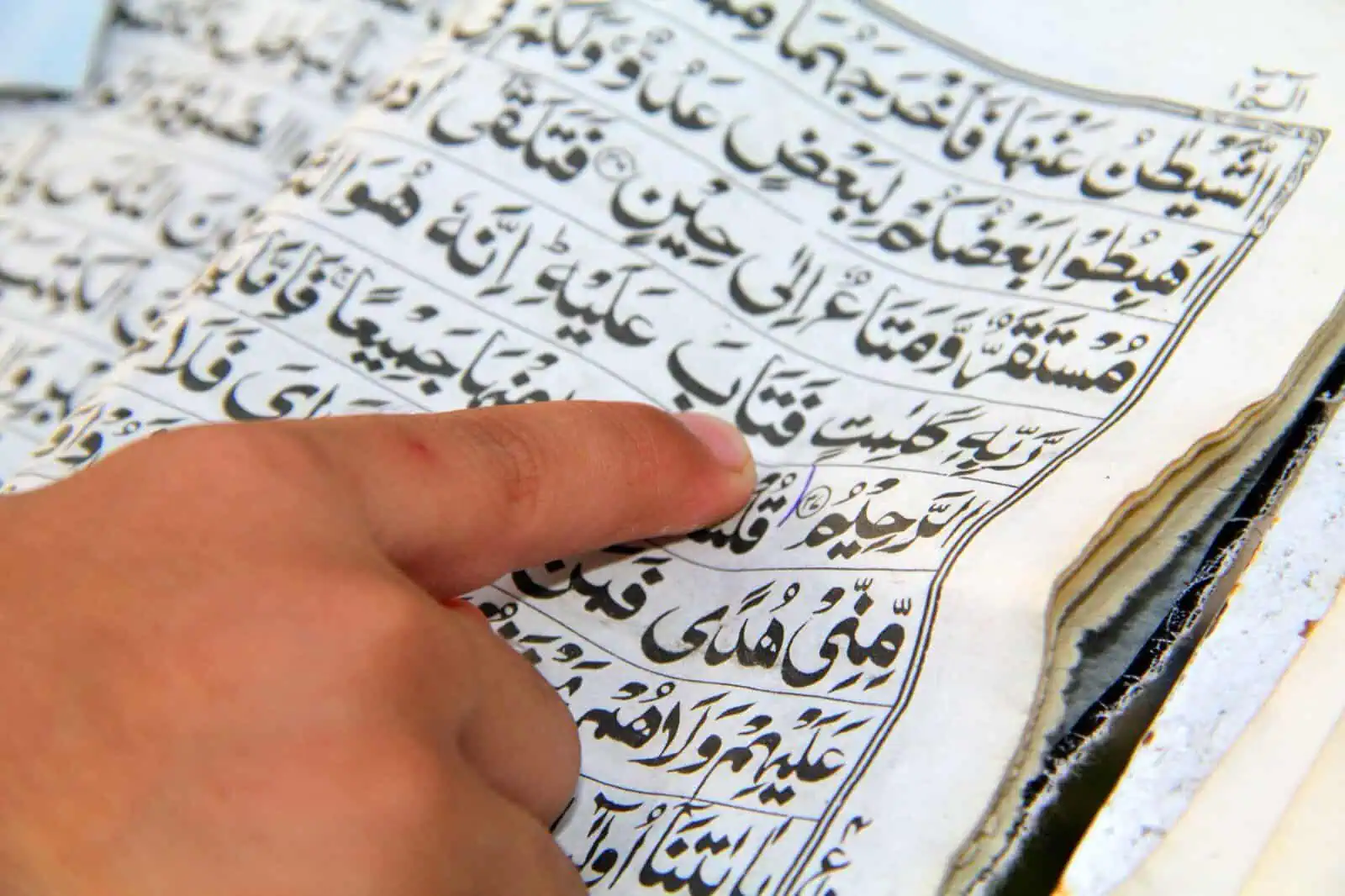
People are often sceptical that pronunciation can be taught through a screen. In practice, a live video lesson is well suited to it, sometimes better than a crowded classroom where one teacher cannot hear each child clearly.
In a one-to-one online lesson, the tutor hears only your voice. You read a line, the tutor listens, and any mistake is corrected on the spot before it becomes a habit. The tutor can model a difficult letter, ask you to repeat it, and keep going until the sound is right. Because the session is recorded or the page is shared on screen, you can see exactly which word you are on. This immediate, private feedback loop is a key reason online reading lessons work.
This is the same method used in our Qaida Noorani course, which builds reading from individual letters upward, and in our broader Quran reading and recitation programme for students who are ready to read from the Mushaf directly.
There is also a comfort factor that is easy to overlook. An adult who feels shy reading aloud in front of a room often reads freely in a private one-to-one session at home, which is how our online Quran classes for adults run. There is no class to keep pace with and no embarrassment over mistakes. That sense of safety is exactly what lets a hesitant beginner relax enough to actually improve, and it is one of the quiet advantages of learning online rather than in a group.
What you need to get started
The practical barrier to entry is genuinely low. You need a phone, tablet, or computer with a camera and microphone, a stable internet connection, and a quiet corner where you can hear and be heard. A beginner’s Qaida and a Mushaf are useful, but many tutors share the page on screen, so you can sit your very first lesson with nothing more than a device. No prior knowledge of Arabic is assumed, and no expensive materials are required.
The path from the alphabet to fluent reading
Learning to read follows a natural order. Skipping a step is the fastest way to get stuck, so good tutors hold students to the sequence even when they are eager to rush ahead.
Recognising the letters and their sounds
You begin with the twenty-eight Arabic letters, learning the correct sound and articulation point of each. This is where the foundation is laid. A letter pronounced from the wrong part of the mouth will sound wrong in every word it ever appears in, so tutors spend real time here.
Adding the short and long vowels
Next come the vowel marks that sit above and below the letters: the fatha, kasra, and damma, followed by the longer vowel sounds. At this stage a learner can sound out simple two and three letter combinations. Progress suddenly feels fast, because the letters you already know start forming real syllables.
Joining letters into words
Arabic letters change shape depending on whether they sit at the start, middle, or end of a word. Learning these connected forms is the step that turns letter recognition into actual reading. Once it clicks, a page of the Qur’an stops looking like a wall of symbols and starts looking like words.
Reading from the Mushaf with Tajweed
Finally you move to reading directly from the Mushaf, applying the rules of Tajweed as you go. This is the stage most beginners imagine when they picture “reading the Qur’an,” but it is the last step, not the first. Reaching it is a milestone worth celebrating.
What makes learning to read online actually work
Not every online setup produces results. The lessons that succeed share four features, shown below.
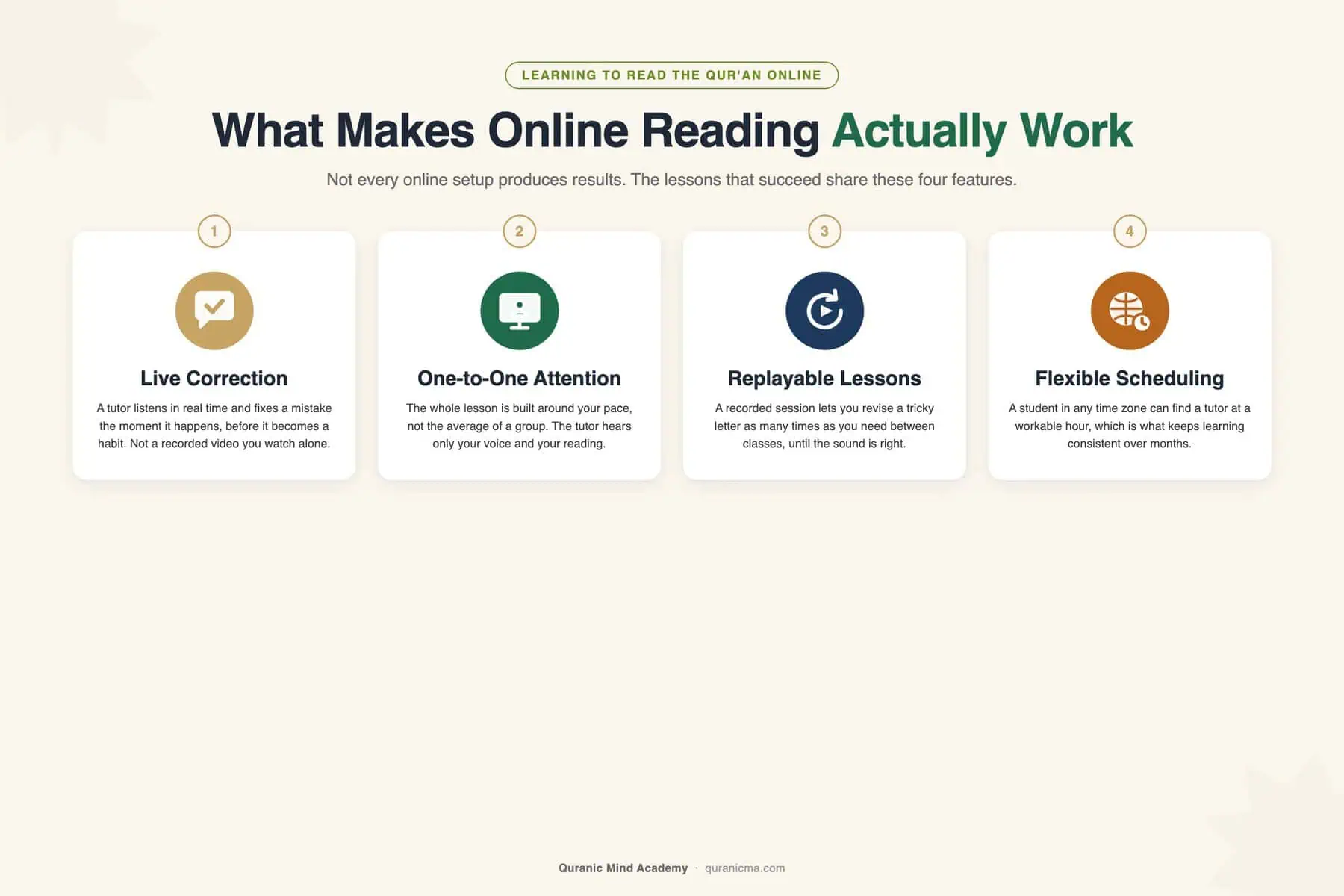
Live correction means a tutor is listening in real time, not a pre-recorded video you watch alone. One-to-one attention means the entire lesson is built around your pace, not the average of a group. Replayable lessons let you revise a tricky letter as many times as you need between classes. And flexible scheduling means a student in any time zone can find a tutor at a workable hour, which is what keeps learning consistent over months rather than fizzling out after a few weeks.
When all four come together, the result is a system that adapts to a working parent, a busy student, or a retiree starting late, without forcing any of them into the same fixed timetable. That flexibility is not a luxury. It is often the deciding factor between a learner who finishes and one who quietly drops out. Our online Quran classes are built around exactly these four principles for students learning from home.
Common mistakes that slow beginners down
Most people who stall do so for predictable reasons. Knowing them in advance helps you avoid them.
Rushing past the letters. The urge to “get to the real Qur’an” quickly is strong, but a shaky grasp of the alphabet undermines everything that follows. Time spent on the foundation is never wasted.
Learning Tajweed before reading is solid. Tajweed rules only make sense once you can read fluently. Introduced too early, they pile complexity on top of an unstable base and discourage the learner.
Practising without correction. Reading alone between lessons is good, but reading wrong alone simply rehearses the mistake. This is why a regular tutor who catches errors early matters so much.
Inconsistency. Three short sessions a week beat one long session every fortnight. The script fades from memory quickly at the start, and steady contact is what keeps it fresh.
How long does it take to learn to read the Qur’an?
Almost every beginner asks this question, and the honest answer is that it depends on your starting point and your consistency, not on any fixed timetable.
In our teachers’ experience, a committed adult taking two or three lessons a week, starting from zero, can usually read simple Mushaf text within four to six months and read comfortably with basic Tajweed within a year. Children often take a little longer to reach independence but absorb pronunciation more flexibly. Someone who already recognises some letters from childhood may move considerably faster. The variable that matters most is not age or talent. It is showing up regularly.
Remember the encouragement from earlier: the learner who stumbles is rewarded twice. Slow progress is still progress, and in this particular act of worship, the struggle counts in your favour.
Frequently asked questions
Can I learn to read the Qur’an if I do not speak Arabic?
Yes. Reading the Qur’an and speaking Arabic are separate skills. Reading requires recognising the letters and their sounds, which any committed learner can do regardless of whether they understand the meaning. Understanding comes later, through translation and study.
Is it harder to learn as an adult?
Adults sometimes feel self-conscious starting from the alphabet, but they bring focus, patience, and self-motivation that children do not. Many adults are surprised by how quickly they progress once they begin. You can read more about this in our guide on learning the Quran for beginners.
Do I need to buy any books?
Most online programmes provide digital materials, and a beginner’s Qaida along with a standard Mushaf is all that is needed at first. Many lessons share the page directly on screen, so you can start with nothing more than a device and an internet connection.
Should I learn reading and Tajweed at the same time?
It is best to get reading reasonably fluent first, then layer Tajweed on top. A good tutor will introduce the most basic rules naturally as you read, so you are never building bad habits, but the heavy Tajweed theory works best once the letters and words come easily. Front-loading too many rules onto a fragile reading base tends to overwhelm rather than help.
Can children and adults both learn this way?
Yes. Lessons are matched to the student, with patient, playful pacing for younger learners and a faster, more structured approach for adults. Families often arrange lessons for children and parents alike.
Begin reading the Qur’an with confidence
Learning to read the Qur’an is one of the most rewarding things a Muslim can undertake, and it is far more achievable than it looks from the outside. With the right teacher, an honest sequence, and steady practice, the script that once seemed impenetrable becomes a page you can read with confidence.
If you are ready to start, you can book a free trial lesson and meet a qualified tutor who will assess your level and map out your path from wherever you are today. Reading the words of Allah for yourself is closer than you think.