
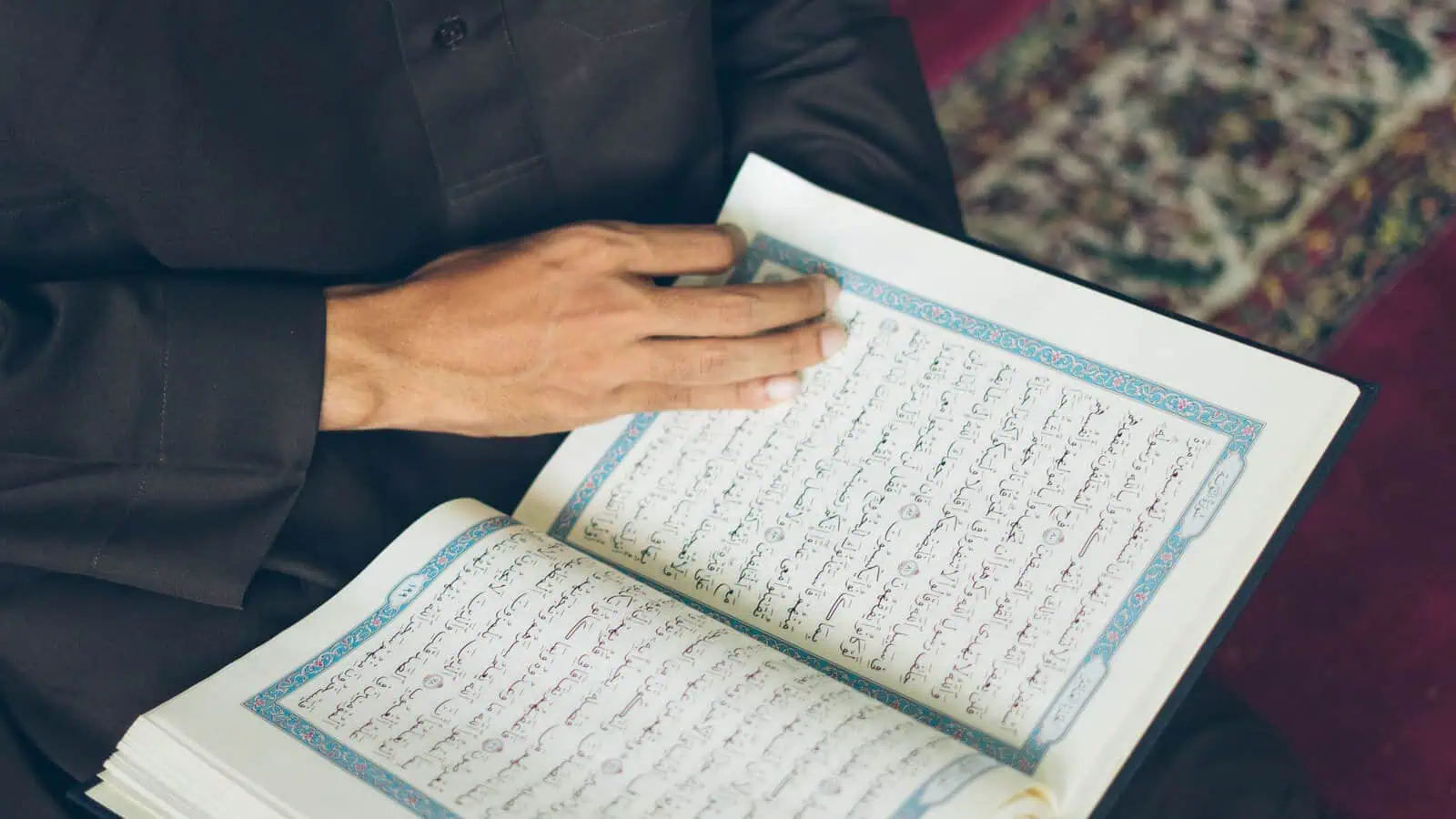
Most adult Muslims who never learned to read the Qur’an as children believe the window has closed. They watch their kids breeze through the Noorani Qa’ida, sit through Tarawih unable to follow the recitation, and quietly conclude that this is just how it is. It is not.
Every year, thousands of adult beginners, including many in their fifties and sixties, learn to read the Mushaf for the first time. The path is shorter and more practical than most people expect, and the only real requirement is starting in the right order with a real teacher. Our online Quran classes for adults begin with two free trial lessons so you can find one. This guide walks through exactly what a beginner needs, what a first lesson looks like, what to avoid, and how the first three months realistically unfold.
Who This Guide Is For
“Beginner” covers four very different starting points, and the right plan depends on which one matches you:
- Complete beginner. You cannot recognise the Arabic letters. You may know al-hamdulillah and bismillah by sound, but the Mushaf looks like a closed book. Start with Stage 1 below.
- Letter recogniser. You know the alphabet and can sound out some letters, but cannot read short surahs fluently. Start with Stage 2.
- Reader without tajweed. You can read the Mushaf, but you were never taught the rules of madd, ghunnah, qalqalah, or the proper points of articulation. Start with Stage 4 or take the dedicated Tajweed Course.
- Returning learner. You learned as a child, stopped for ten years, and have forgotten most of it. In our teachers’ experience, a two-week refresher placement usually drops you straight into Stage 3 or Stage 4.
The four stages below are sequential. Each one builds on the last, and skipping a stage almost always backfires within a few months.
The Four Stages of Beginner Qur’an Learning

Stage 1: The 28 Letters and Their Sounds
The Arabic alphabet has 28 letters. Most of them have shapes that change depending on whether they appear at the start, middle, or end of a word. This is the single most disorienting feature for new learners, because the same letter can look like four different things.
What you actually do in Stage 1: learn each letter’s isolated form, its sound, and its four positional shapes. A good teacher works through the Noorani Qa’ida, a primer by Shaykh Noor Muhammad Haqqani of Ludhiana that has since been translated into Arabic and is taught to children and adults in Arab countries (its history), for exactly this stage. In our teachers’ experience, twenty to thirty minutes a day, three lessons a week, brings most adult learners through Stage 1 in four to six weeks. Children often get through the letters faster.
A common Stage 1 mistake is learning from a YouTube video without a teacher. The sounds of letters like dad (ض), ha (ح), qaf (ق), and ‘ayn (ع) have no English equivalent. If you embed a wrong sound early, you will recite that wrong sound for years before someone hears you and corrects it.
Stage 2: Joining Letters into Words
Once you recognise the letters, you learn how they connect. Arabic is a connected script, and certain letters refuse to connect on their left side (alif, dal, dhal, ra, zay, waw). The Noorani Qa’ida walks through letter combinations methodically, starting with two-letter words, then three, then four, until you are reading short fluent sequences.
You also learn the three short vowel marks (fatha, kasra, damma), the long vowels (the elongation rule of madd), and the sukun (silence mark). By the end of Stage 2 you can read any fully voweled Arabic word aloud, even if you do not yet understand what it means.
Stage 2 is where many learners get impatient. They want to start reading surahs. The teacher’s job is to hold the pace, because rushing past letter combinations creates reading habits that have to be unlearned later. Trust the order.
Stage 3: Reading Short Surahs
Stage 3 begins the moment you can read voweled Arabic words confidently. The teacher starts with al-Fatihah, then picks short, well-known surahs from the end of the Mushaf: al-Ikhlas, al-Falaq, an-Nas, then gradually al-Kawthar, Quraysh, al-Ma’un, and so on.
You read the surah aloud, the teacher corrects each slip, and by the end of the lesson you can recite that surah with reasonable fluency. The repetition is where the magic happens. By the time you have read al-Fatihah aloud thirty times under correction, your salah will never sound the same again.
In our teachers’ experience, most adult beginners reach the end of Stage 3 between three and five months from the day they started. By that point you are reading short surahs comfortably and have the foundation to attempt any page of the Mushaf with light effort.
Stage 4: Adding Tajweed
Tajweed is the set of rules governing how Qur’an is recited correctly. Allah ﷻ commanded:
“…recite the Quran slowly and distinctly…”
(Surah al-Muzzammil 73:4, trans. Abdel Haleem)
The Prophet ﷺ recited slowly and in measured tones (Sahih Muslim 733), prolonging certain sounds (Sahih al-Bukhari 5046). Scholars later defined tajweed as giving every letter its right (haqq) and its due (mustahaqq), as Ibn al-Jazari puts it in his al-Muqaddimah. Tajweed is the systematic preservation of that recitation. The core rules cover the points of articulation (makharij), the characteristics of letters (sifat), the rules of madd (lengthening), ghunnah (nasalisation), qalqalah (echo), ikhfa (concealment), idgham (merging), and izhar (clarity).
You do not need to memorise all the rules before applying them. The Egyptian method introduces each rule the moment a surah requires it. By the time you have read juz ‘Amma (the 30th juz) with a teacher, you will have absorbed the most common rules through repetition.
What a First Lesson Actually Looks Like
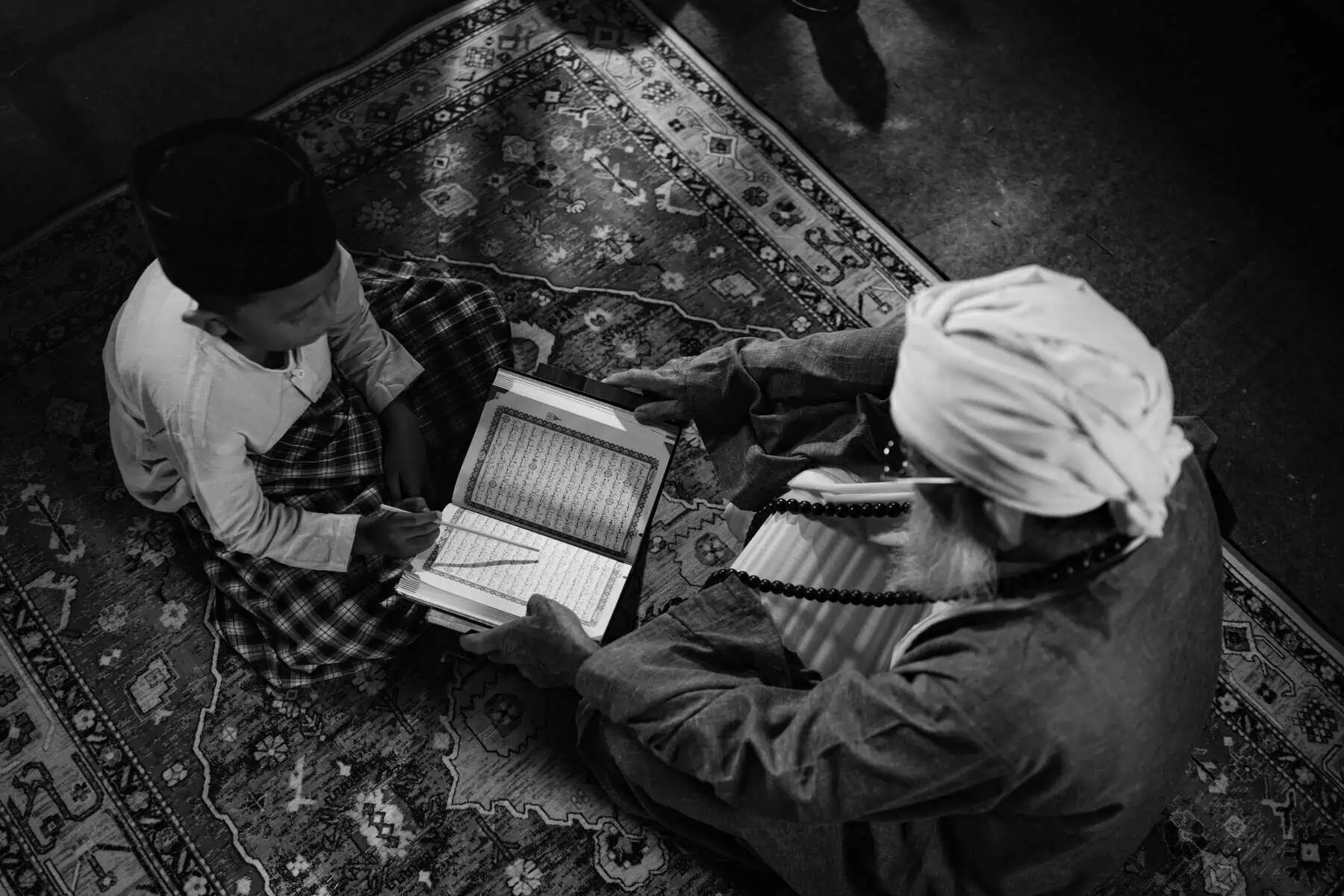
If you have never taken a one-to-one Qur’an lesson, the format is simpler than it sounds. A typical first thirty-minute session runs like this:
- Minutes 0–3. Salam, brief introduction, the teacher asks what you know already and what you have studied before.
- Minutes 3–8. Assessment. The teacher asks you to read a few letters or a short ayah and listens carefully to determine your real starting point. This is not a test; it is calibration.
- Minutes 8–22. The first lesson. If you are a complete beginner, this is typically the first page of the Noorani Qa’ida (the isolated forms of the first six letters). The teacher pronounces each letter, you repeat, the teacher corrects, you repeat again until the sound is locked in.
- Minutes 22–27. Practice combining the letters you just learned. Light Q&A on anything that came up.
- Minutes 27–30. Assignment for the next lesson (which letters or pages to practice), du’a, salam.
The screen disappears within the first ten minutes. The lesson becomes the teacher and the student and the Mushaf, exactly as it has been for fourteen centuries.
What You Need (and What You Do Not)
The setup for beginner lessons is deliberately minimal.
Essentials:
- A laptop, tablet, or smartphone with a working camera and microphone.
- Reasonably stable home internet (anything that supports a video call works).
- A printed Noorani Qa’ida (the teacher will tell you which edition).
- A printed Mushaf for later stages, such as the Madinah Mushaf in Uthmani script. Ask your teacher which Mushaf they read from and use the same edition.
- A quiet corner for thirty minutes.
Nice to have:
- A simple wooden rehal (book stand).
- Headphones for noisy households.
- A notebook to write down corrections.
You do not need:
- An app subscription. Apps drill vocabulary; they do not replace a teacher.
- An expensive computer. A five-year-old laptop is fine.
- Any prior Arabic knowledge whatsoever.
Realistic Timelines for Adult Beginners
The most common question from new students is “how long until I can read the Qur’an?” The honest answer depends on starting point, age, and consistency. The numbers below come from our teachers’ experience with adult complete beginners studying three thirty-minute lessons per week plus ten minutes of daily review.
| Milestone | Realistic timeline |
|---|---|
| Recognise all 28 letters confidently | 4 to 6 weeks |
| Read voweled words and short combinations | 2 to 3 months |
| Read al-Fatihah and the short surahs | 3 to 5 months |
| Read any page of the Mushaf with light effort | 6 to 9 months |
| Recite comfortably with full tajweed application | 12 to 18 months |
In our experience, children usually reach the first three milestones faster than adults, and adults often catch up on the later stages because they retain rules and explanations well.
What Stops Adult Beginners (and How to Avoid Each Trap)
After teaching thousands of adult beginners, the same four obstacles come up repeatedly. None of them are about ability.
1. Embarrassment about the starting point. Many adults delay starting because they feel they should already know this. The solution is a private one-to-one lesson where no one is watching. In our teachers’ experience, the embarrassment fades within about two weeks and the focus shifts to the work.
2. Skipping the daily ten-minute review. The lesson teaches you the new letters; the daily review embeds them. Without it, much of what the lesson covered fades before the next class. Ten minutes after Fajr or before bed is enough.
3. Trying to read surahs before mastering the letters. Adults often pressure the teacher to skip ahead to the surahs they know by heart in salah. This sets a ceiling on every later stage, because the wrong letter habits get embedded with each repetition. Trust the Egyptian sequence: letters first, words second, surahs third.
4. Inconsistency. Three short sessions a week beat one long weekend session. The Prophet ﷺ said:
“The most beloved deeds to Allah are those done consistently, even if small.”
(Sahih al-Bukhari 6464)
Two consistent lessons a week for six months beats six lessons a week for one month and then nothing.
Choosing the Right Teacher
The teacher matters more than anything else. Five questions to ask before signing up:
1. Where did the teacher study? Strong answers name institutions and named scholars (Al-Azhar in Cairo, the Islamic University of Madinah, recognised sanad chains). Vague answers like “ten years of experience” without an institutional anchor are a warning sign.
2. Does the teacher hold an ijazah? An ijazah is a formal certification that the teacher has recited the Qur’an correctly to their own teacher in a recognised recitation (most commonly Hafs ‘an ‘Asim). For beginners this matters less than for Hifz students, but it indicates a teacher who has been formally tested.
3. Is the teaching one-to-one? For beginner Qur’an recitation, this is non-negotiable. Group lessons work for Islamic Studies, but tajweed correction needs the teacher to hear every individual letter.
4. Can you sit a free trial? Any serious academy lets you trial a real lesson with the actual teacher before paying. The trial should be teaching, not selling. If the “trial” is a sales call with a coordinator, walk away.
5. Is a female teacher available? For sisters and daughters who prefer female teachers, confirm availability before signing up rather than discovering after.
Learning Together: Beginners with Their Children
One of the unexpected benefits of online beginner lessons is that adults often learn alongside their children. The parent takes their own lesson at one time, the child takes theirs at another, and they revise together at the dinner table. The Prophet ﷺ said:
“The best of you are those who learn the Qur’an and teach it.”
(Sahih al-Bukhari 5027)
When a parent begins learning at the same time as their child, the household atmosphere changes. The child sees the parent struggling with the same letters they are struggling with. The parent gains both Qur’an skill and a fresh authority on the topic at home. Many families report it as the single best decision they made.
Your First Three Weeks
If you want to start this week, here is the simplest path that actually works.
Week 1. Book a free trial lesson with a real teacher. The trial assesses your current level and assigns the right Noorani Qa’ida starting page. Set up your study corner (a quiet spot, a printed Qa’ida, a notebook).
Week 2. Begin two thirty-minute lessons a week at a fixed time you will not move (after Fajr, after Maghrib, or after the kids are in bed). Treat the appointment as fixed. Do ten minutes of review on every non-lesson day.
Week 3. Add the third weekly lesson if the schedule allows. By the end of week three, the routine should feel like part of the week rather than an experiment. In our teachers’ experience, the first satisfying moment, the first time you read an unfamiliar Arabic word aloud unaided, usually arrives within the first month.
Related Guides
- Noorani Qa’ida Course: The Standard Beginner Path
- Learn Qur’an from Home: A Complete Guide
- Learn to Read the Qur’an Online
- Learn Qur’an for Adults
- Reciting the Holy Qur’an: A Beginner’s Guide
- Qur’an Classes for Kids
- Tajweed Rules: Every Rule Explained
Frequently Asked Questions
Can I really learn the Qur’an as a complete beginner adult?
Yes. Adults learn beginner Qur’an every day, in their thirties, forties, fifties, and sixties. The path is the same step-by-step Noorani Qa’ida sequence that countless beginners, children and adults, have followed. In our teachers’ experience, the honest expectation is three to five months from zero to reading short surahs, then progressing into the rest of the Mushaf from there.
How long does it take to learn to read the Qur’an?
In our teachers’ experience, an adult complete beginner studying three thirty-minute lessons per week plus ten minutes of daily review reads the short surahs within three to five months and any page of the Mushaf with light effort within six to nine months. Children of school age reach the same milestones a little faster on the recitation side.
Do I need to know Arabic to start?
No. Learning to read the Mushaf (decode the script) is a separate skill from understanding the Arabic words. Most beginners learn to read first so they can recite correctly, and later add Arabic vocabulary to understand what they are reciting. The Arabic Language course is the natural next step after reading is fluent.
Can I request a female teacher?
Yes. Female teachers are available for sisters, daughters, and family classes. Confirm at the trial-booking stage and the assignment will respect it.
Is tajweed included in beginner lessons?
The basic rules (madd, ghunnah, qalqalah) are introduced naturally as soon as the relevant surahs come up in Stage 3 and 4. A dedicated full tajweed treatment is the next course after Mushaf reading is fluent. The structured curriculum lives in the Tajweed Course.
What if I miss a lesson?
Reputable academies allow rescheduling with 24 hours notice. The lesson is not lost. What matters is not the individual missed session but the overall weekly rhythm, which you protect by not letting one missed lesson become a missed week.
Do I get a certificate after beginner lessons?
Many academies issue an internal completion certificate after the Noorani Qa’ida and after first juz of Mushaf reading. The traditional certificate that matters most, the ijazah, applies later, when a student has completed a full recitation of the Mushaf with full tajweed under an authorised teacher.
The First Step
The hardest part of beginner Qur’an study is starting. Once the first lesson happens, every subsequent lesson is easier. Book the trial, find the teacher, set the fixed time, and let the routine carry you for six months. Allah ﷻ rewards the consistent step over the dramatic one. The Mushaf is waiting on your shelf. Take the first step toward opening it this week.

One Response