Most people asking about the benefits of reading Quran daily have already tried it. They managed a week, perhaps a month, and then the habit quietly died without much seeming to have changed. That experience is worth taking seriously, because the sources are specific about what daily recitation gives you, and just as specific about the conditions attached.
What follows is twelve benefits, each tied to a verse or a hadith you can check yourself, plus an honest look at what published research does and does not support.
What the Quran promises those who read it regularly
The clearest statement comes in Surah Fatir:
Those who recite God’s scripture, keep up the prayer, give secretly and openly from what We have provided for them, may hope for a trade that will never decline: He will repay them in full, and give them extra from His bounty. He is most forgiving, most appreciative.
Quran 35:29-30, Abdel Haleem translation
Shaykh Muhammad Sayyid Tantawi, in his tafsir al-Wasit, glosses the opening as praise for those who read the Book often and keep it up, reciting with reflection on its meanings and acting on its directions. He identifies the “trade” as Allah’s reward and forgiveness, and the verb rendered “decline” as meaning to go slack and perish.
That gloss sets the terms for everything below. The promise attaches to a particular kind of daily reading, not to a page count.
Spiritual benefits of reading Quran daily
1. Every single letter is counted
Ibn Mas’ud reported that the Prophet ﷺ said: “Whoever recites a letter from Allah’s Book, then he receives the reward from it, and the reward of ten the like of it. I do not say that Alif Lam Mim is a letter, but Alif is a letter, Lam is a letter and Mim is a letter” (Jami’ at-Tirmidhi 2910, graded hasan in the Darussalam edition; at-Tirmidhi himself called it hasan sahih gharib through this chain).
The reward is counted per letter, not per completed page or juz. This is why “I only managed four lines today” is not the failure it feels like. Four lines read is four lines rewarded.
2. It comes as an intercessor on the Day of Resurrection
Abu Umamah heard the Prophet ﷺ say: “Recite the Qur’an, for on the Day of Resurrection it will come as an intercessor for those who recite It” (Sahih Muslim 804a). The same narration singles out al-Baqarah and Al ‘Imran, describing them coming as two clouds, or two shades, or two flocks of birds in ranks, pleading for those who recited them.
3. It raises the standing of the people who carry it
The context of this one is worth having. Nafi’ ibn Abd al-Harith met ‘Umar at ‘Usfan, and ‘Umar asked whom he had left in charge of the people of the valley in Mecca. Nafi’ named Ibn Abza, one of their freed slaves. ‘Umar questioned the choice, and Nafi’ answered that the man was well versed in the Book of Allah and in the rulings. ‘Umar then quoted the Prophet ﷺ: “By this Book, Allah would exalt some peoples and degrade others” (Sahih Muslim 817a).
A freed slave was put in authority over Mecca because of his relationship with the Quran. Social position followed from it rather than the other way round.
4. You are counted among the people of the Quran
Anas ibn Malik reported that the Prophet ﷺ said: “Allah has His own people among mankind.” When asked who they were, he answered: “The people of the Qur’an, the people of Allah and those who are closest to Him” (Sunan Ibn Majah 215, graded hasan in the Darussalam edition).
5. Struggling with it earns you more, not less
A’ishah reported that the Prophet ﷺ said: “One who is proficient in the Qur’an is associated with the noble, upright, recording angels; and he who falters in it, and finds it difficult for him, will have two rewards” (Sahih Muslim 798a).
Read that carefully if you are a beginner. The person stumbling over every word is not receiving a consolation prize. Difficulty is itself rewarded, on top of the reward for reciting. If you are still finding the letters slow, our guide to reciting the Holy Quran and our Quran lessons for beginners both start from that point.
What daily reading does to the heart and mind
6. A settled heart, renewed each time
Surah ar-Ra’d states: “those who have faith and whose hearts find peace in the remembrance of God, truly it is in the remembrance of God that hearts find peace” (Quran 13:28, Abdel Haleem).
Tantawi’s al-Wasit holds that the “remembrance” meant here is most apparently the Quran itself, and that the hearts settle through their reflection on Allah’s inimitable speech. He also draws attention to a grammatical detail: the present tense verb is used twice in the one verse, which he takes as indicating that this settling is renewed and ongoing rather than a single event.
That is an argument for frequency over volume. A heart that settles gets unsettled again as the week wears on, which is precisely why the reading is meant to recur.
7. Relief from anxiety, doubt and intrusive thoughts
Surah al-Isra says: “We send down the Quran as healing and mercy to those who believe; as for those who disbelieve, it only increases their loss” (Quran 17:82, Abdel Haleem).
Tantawi writes that reciting the Quran and acting on its guidance is a healing for the soul from waswasa (intrusive whispering), anxiety, bewilderment, hypocrisy and various vices, and a mercy for the believers. He also quotes ar-Razi’s point that the “min” in this verse indicates kind rather than portion, so the whole of the Quran is healing and mercy, not merely part of it.
On what kind of healing is meant, the scholars did not agree, and al-Wasit reports the difference rather than smoothing it over. Quoting al-Qurtubi, it records two positions: that the Quran is a healing for hearts, by removing ignorance and lifting doubt; and that it is a healing from outward illness through ruqya, citing the report of Abu Sa’id al-Khudri reciting al-Fatihah over a man who had been stung. Tantawi’s own settled view is that reciting the Quran and acting on it leads, by Allah’s leave, to healing from the diseases of hearts and of bodies both.
8. Clearer thinking about your own decisions
Surah Sad describes the purpose directly: “This is a blessed Scripture which We sent down to you [Muhammad], for people to think about its messages, and for those with understanding to take heed” (Quran 38:29, Abdel Haleem).
Reflection is named as the reason the Book was sent down. Someone reading daily with attention is repeatedly measuring their own choices against something outside themselves, which is a different mental habit from reacting to whatever the day brings. Our article on the impact of the Quran follows that thread through the lives of the Companions and later converts.
What the research does and does not show
Daily Quran reading is often promoted with confident health claims. The honest position is that some real research exists, that it is genuinely suggestive, and that it is not yet strong enough to carry the weight people put on it.
Two systematic reviews are worth knowing about. Ghiasi and Keramat screened 973 articles and reviewed 28 randomised controlled trials and quasi-experiments, finding a positive effect of listening to Quran recitation on anxiety across a range of settings. Their own conclusion is careful: recitation can be used as a useful non-pharmacological treatment to reduce anxiety, “however, methodologically strong randomized controlled trials are needed in this area” (Iranian Journal of Nursing and Midwifery Research, 2018, 23(6):411-420).
A later review by Che Wan Mohd Rozali and colleagues included 20 studies out of 230 screened, covering listening, reciting and memorisation, and reported favourable effects on depression, anxiety, physiological measures, quality of life, sleep quality and IQ. Its conclusion is hedged in the same way: the current evidence suggests these practices “may be useful” as an intervention (International Journal of Public Health, 2022, 67:1604998).
Three limits are worth stating plainly. Most of the underlying studies measure listening to recitation rather than a personal daily reading habit. Sample sizes are generally small, and the reviewers themselves flag the quality of the trials as the weak point. And none of this is a treatment plan: if you are dealing with anxiety or depression, this is an addition to medical care, not a replacement for it.
The reasons to read daily are the eight above. Treat the research as encouraging company, not as the argument.
Practical benefits you will notice within a few weeks
9. The Arabic slowly stops being a wall
Daily exposure does something that studying in bursts does not. High frequency words start being recognised before they are formally learned, and the shape of the grammar becomes familiar well before you could explain it. This does not replace study, and it will not by itself make you understand what you recite, but it removes a great deal of the friction from actually learning. Our roadmap on how to learn Arabic for Quran covers the structured half, and Arabic as your key to understanding Islam covers why it repays the effort.
10. Your recitation stops sliding backwards
Abdullah ibn Mas’ud reported the Prophet ﷺ warning against saying “I have forgotten such and such verse”, and instructing: “So you must keep on reciting the Qur’an because it escapes from the hearts of men faster than camel do” (Sahih al-Bukhari 5032).
This applies to fluency as much as to memorisation. Recitation left alone for a fortnight comes back rusty. Daily contact is what keeps the letters, the rules and the pace where you left them, which is the quiet argument for a small daily portion over a large weekly one. If you are memorising, our guide to effective methods to memorise the Quran and our explanation of what hifz involves go further into revision.
11. The habit anchors the rest of the day
A’ishah reported that the Prophet ﷺ said: “Do good deeds properly, sincerely and moderately and know that your deeds will not make you enter Paradise, and that the most beloved deed to Allah is the most regular and constant even if it were little” (Sahih al-Bukhari 6464).
Small and constant is stated as the preferred shape of a deed. A fixed portion at a fixed time survives a bad week in a way that an ambitious plan does not, and it gives the day a point it has to pass through. Holistic Islam sets that within the wider balance of spiritual, physical and social life.
12. Reading with others multiplies it
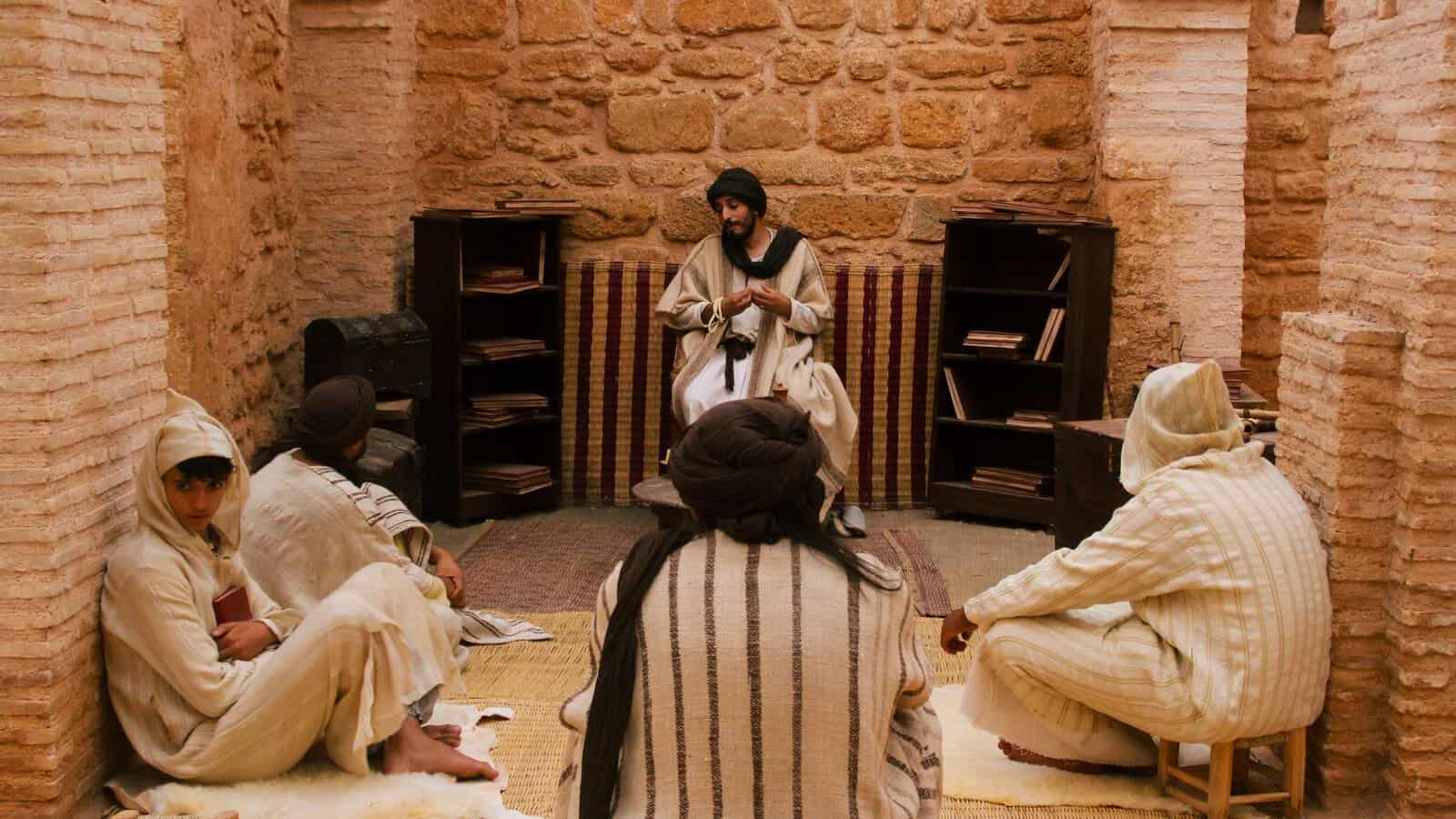
Abu Hurayrah reported a long hadith in which the Prophet ﷺ described the reward of easing others’ hardship and seeking knowledge, and then said of those “who assemble in the house among the houses of Allah (mosques) and recite the Book of Allah and they learn and teach the Qur’an (among themselves)” that “there would descend upon them tranquility and mercy would cover them and the angels would surround them and Allah mentions them in the presence of those near Him” (Sahih Muslim 2699a).
Note what the reward is attached to here. It is a gathering, and the gathering both recites and studies. Reading alone is good and is the subject of most of this article. Reading in company, with someone who can correct you, is described in stronger terms than reading alone.

The reward described in Sahih Muslim 2699a attaches to gathering to recite and study together, not to solitary reading alone.
Why some people read every day and feel nothing
This is the common complaint, and the answer is usually in the manner rather than the amount.
- Reading as a task to clear. Racing to finish a set portion trains speed and nothing else. Tantawi’s gloss on Surah Fatir tied the promise to reflection on the meanings and action on the guidance, which a race does not allow.
- Never reading the meaning. If you do not yet understand Arabic and never open a translation, the words cannot work on you. Recite the Arabic, then read the same passage in a translation you trust.
- Choosing the wrong time. Reading at the point in the day when you are least able to concentrate makes attention impossible by design. Move it rather than abandoning it.
- Uncorrected errors. Mistakes that nobody has pointed out make reading effortful in an unproductive way, and they harden with repetition. This is the part self study handles worst, as our guide to learning tajweed at home sets out honestly.
How much should you read each day?
The Quran itself sets an accommodating standard. Surah al-Muzzammil, after describing the long night prayers, says “so recite as much of the Quran as is easy for you”, and repeats the instruction a second time in the same verse for those who are ill, travelling or occupied (Quran 73:20, Abdel Haleem).
Combined with the hadith on constancy above, that points to a portion you can hold every day rather than the largest one you can manage once. The plan below is a practical suggestion, not something the sources prescribe.
| Time you have | A realistic daily portion | What to add once it is steady |
|---|---|---|
| 5 minutes | Half a page, read slowly and correctly | Read the translation of the same half page |
| 15 minutes | One to two pages | Listen to a reciter read the same pages first |
| 30 minutes | Three to four pages | Record yourself once a week and compare |
| 45 minutes or more | Half a juz, split into two sittings | Add a weekly session with a teacher for correction |
Whichever row applies, keep the time of day fixed. The portion is easier to protect than the intention.
Build the habit with someone listening
Almost everything above compounds faster when a teacher hears you read. Errors get corrected before they set, the portion gets kept because someone is expecting it, and the reading becomes the kind described in Sahih Muslim 2699a rather than a private routine that quietly lapses.
Our Quran reading and recitation course is built around exactly that, with Al-Azhar trained teachers working one to one with students. If you would rather see how it works before deciding, you can book a free trial lesson and read for a teacher yourself. Our comparison of online and in person classes may help if you are weighing up the format, and learning Quran from home covers the practical side of setting it up.
Frequently asked questions
What are the benefits of reading Quran daily?
The sources describe reward for every letter recited (Jami’ at-Tirmidhi 2910), intercession on the Day of Resurrection (Sahih Muslim 804a), raised standing (Sahih Muslim 817a), and a heart that settles through remembrance (Quran 13:28). Practically, daily reading keeps your fluency from sliding backwards, builds familiarity with Arabic, and is the shape of deed described as most beloved to Allah because it is constant (Sahih al-Bukhari 6464).
How much Quran should I read every day?
Quran 73:20 twice instructs believers to recite as much of the Quran as is easy for them, and Sahih al-Bukhari 6464 states that the most beloved deed to Allah is the most regular and constant even if it is little. Together these favour a small portion you can sustain daily over a large one you manage occasionally. Half a page read carefully every day is a sound starting point.
Do I still get reward if I make mistakes while reading?
Yes. Sahih Muslim 798a states that the one proficient in the Quran is with the noble recording angels, and the one who falters in it and finds it difficult has two rewards. Difficulty is rewarded rather than penalised. That said, the hadith is not an argument for leaving errors uncorrected, since mistakes harden with repetition and are best fixed by someone listening.
Is it better to read a lot quickly or a little with reflection?
Tantawi’s tafsir al-Wasit ties the promise in Quran 35:29-30 to reading that comes with reflection on the meanings and action on the guidance, which points towards depth. Quran 38:29 states that the Book was sent down for people to think about its messages. A smaller portion read with attention fits the sources better than a large portion raced through.
Does reading the Quran in translation count?
The reward described in Jami’ at-Tirmidhi 2910 is tied to reciting the letters of the Arabic text, so a translation does not stand in for recitation. Translations do the other essential job, which is giving you the meaning. The two work together: recite the Arabic, then read the same passage in a translation you trust.
Can reading the Quran daily help with anxiety?
Quran 17:82 describes the Quran as healing and mercy for believers, and Tantawi’s al-Wasit names anxiety and intrusive whispering among what it heals, though scholars differed over whether the healing described is of the heart, the body, or both. Published research on recitation and anxiety is suggestive but limited, and its own authors call for stronger trials. If you are dealing with a diagnosed condition, treat daily reading as something alongside medical care rather than instead of it.