
Memorising the Qur’an without correct Tajweed is like learning a piece of music with the wrong notes locked in. Once the pronunciation is embedded, undoing it takes longer than learning it properly the first time. This guide is for the student who wants both, in the right order: every line memorised with the Tajweed already correct, taught one-to-one by an Al-Azhar-trained teacher over video call.
This is the same classical method used in Egyptian Hifz schools for centuries, conducted online so that students anywhere can sit with a qualified teacher at a time that fits their day. The Prophet ﷺ said:
“The best of you are those who learn the Qur’an and teach it.” (Bukhari 5027)
This page walks through what online Tajweed-based Hifz actually looks like, the method we use, how children, teens, and adults are taught differently, and the realistic timelines for finishing the Mushaf or a specific section of it.
Why Tajweed Is Not Optional in Hifz
Tajweed is the set of rules that govern how each letter of the Qur’an is pronounced, the length of each vowel, how letters interact at word boundaries, and the rhythm of recitation. Allah commands measured, careful recitation:
“…recite the Quran slowly and distinctly” (Qur’an 73:4, trans. Abdel Haleem)
The word in that verse is tarteel, slow and measured recitation with each letter given its due. Many scholars of recitation take this verse as the basis for Tajweed. Every Muslim must at least recite the words without errors that change them; beyond that, Ibn al-Jazari and the tajweed scholars hold that applying the full rules is also obligatory, while Dar al-Ifta al-Misriyyah treats the finer rules as recommended rather than individually binding (Dar al-Ifta research 103). Memorising at speed without Tajweed produces fluent-sounding recitation that is full of small mispronunciations. Each one is then locked into the student’s memory and revised hundreds of times over the years, which is precisely why it is so hard to correct later.
The Prophet ﷺ also reminded us:
“Whoever recites a letter from the Book of Allah will have a good deed, and good deeds are multiplied by ten.” (Tirmidhi 2910, graded hasan by Darussalam; al-Tirmidhi called it hasan sahih gharib)
The reward is counted by the letter, and each letter deserves its due. Ibn al-Jazari quotes with approval the view that the reward of careful, reflective recitation is greater in worth, while the reward of reciting more is greater in number (al-Nashr fi al-Qira’at al-‘Ashr).
How Online Hifz With Tajweed Works in Practice
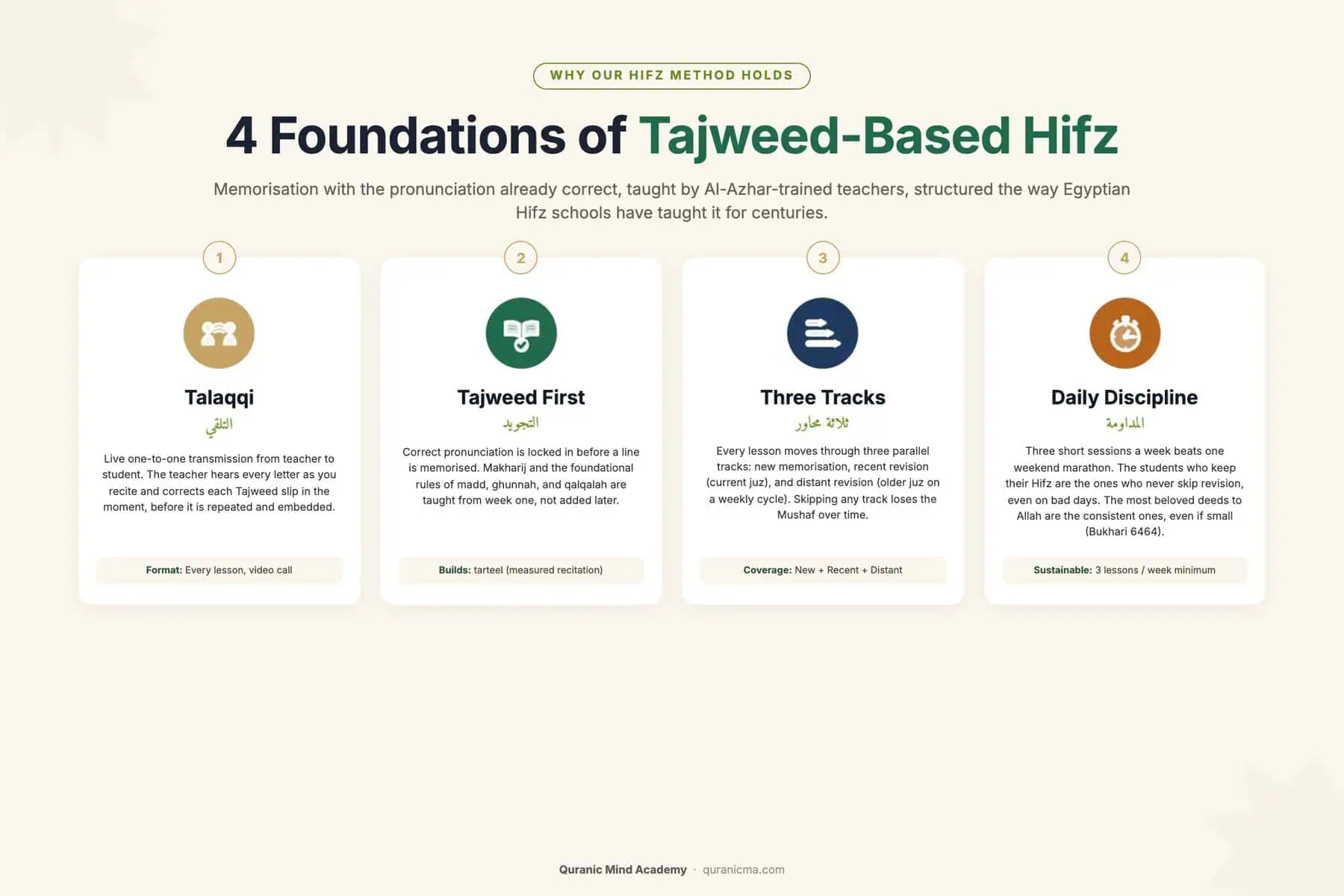
The classical method is called talaqqi: the student recites aloud to a teacher who corrects every letter as it is recited. Online Hifz preserves the method completely. The only thing that changes is the medium.
- Live correction. The teacher hears every letter and corrects each Tajweed slip before it is repeated and embedded.
- One-to-one attention. Every lesson is private. The teacher tracks your specific weaknesses and re-drills them in the next session.
- Written tracking. Each lesson ends with a note recording what was memorised, what needs revision, and what the next session covers.
- The student’s own Mushaf. The 15-line Madinah Mushaf, a layout used in many Hifz programmes, anchors visual memory to the page layout.
What you do not need: a special app, a tablet, or any classroom equipment. A phone or laptop with a stable internet connection is enough. The teacher is on the other side of the screen, and the Mushaf is in front of you.
The Three-Track Method Every Lesson Touches
Our framework follows the classical Egyptian Hifz tradition taught at Al-Azhar. Every lesson moves through three parallel tracks. Miss any one of them and the Mushaf escapes the student over time, exactly as the Prophet ﷺ warned:
“Commit yourself to the Qur’an, for by Him in whose Hand is my soul, it is surely more prone to break away than a camel in its bind.” (Bukhari 5033)
- New memorisation. The new portion memorised in this session. Usually one to ten lines depending on age and stage, taught slowly with letter-by-letter Tajweed correction before it is locked in.
- Recent revision. The juz the student is currently strengthening, recited from start to end every lesson until rock-solid. Weak ayat get flagged and re-drilled.
- Distant revision. The juz memorised more than a month ago, cycled on a fixed weekly schedule so nothing is lost for long. This is the discipline many students skip, and skipping it is how Hifz is lost.
The difference between a student who keeps their Hifz for life and one who loses half within a year is rarely talent or speed. It is whether they kept revising the older portions.
How a 45-Minute Lesson Runs
A typical intermediate Hifz lesson with Tajweed integrated looks like this:
- Minutes 0 to 5: Greeting, du’a before starting, quick recap of the last lesson’s homework.
- Minutes 5 to 15: Recital of the new portion the student prepared since last lesson. Teacher corrects Tajweed letter by letter.
- Minutes 15 to 25: Recent revision juz. The student recites from start to end. Teacher flags weak ayat for extra repetition next session.
- Minutes 25 to 35: New material. Teacher reads the next portion slowly with full Tajweed, student repeats line by line, then student reads alone with corrections.
- Minutes 35 to 42: Distant revision. Random recall from older juz to confirm retention.
- Minutes 42 to 45: Homework written down, brief du’a to close.
Children’s lessons follow the same structure compressed into 30 minutes with shorter new portions; the format is set out on our online Quran classes for kids page. Adults often prefer 60-minute lessons with longer revision blocks at either end.
Programme by Age
Children (ages 5 to 11)
Short lessons, frequent repetition, age-appropriate teachers. New portions are usually three to five lines per session. Tajweed is introduced gradually, starting with the makharij (articulation points of the letters) and the basic rules of madd, ghunnah, and qalqalah. Parents are welcome to sit in for the first few sessions and stay involved in homework. The aim in the early years is the habit and the love of the Mushaf as much as the lines memorised.
Teens (ages 12 to 17)
Longer new portions, more independence in homework, and the introduction of meaning. Teenagers retain better when they understand what they are memorising, so each new juz is paired with brief tafsir notes. The full Tajweed curriculum (idgham, ikhfa, izhar, qalqalah, all variants of madd, rules of ra and lam) is covered through the first two years of regular study. Lessons run 45 minutes.
Adults
Adult Hifz operates on different assumptions. Less time per day, less elastic memory than a child, but greater concentration in shorter bursts and a strong appetite for understanding the meaning. Adults typically work with two to four 60-minute lessons per week, with slower but steadier new memorisation and a larger emphasis on distant revision from day one. In our teachers’ experience, most adult students finish a juz every two to three months. Adults who cannot yet read fluently start with the reading track in our adult Quran classes first.
Allah Himself reassured every memoriser. Al-Qurtubi explains the verse as meaning that Allah made the Quran easy to memorise and helps whoever sets out to memorise it:
“We have made it easy to learn lessons from the Quran: will anyone take heed?” (Qur’an 54:17, trans. Abdel Haleem)
Realistic Timelines
Numbers depend on age, prior background, and consistency, not on talent. Rough averages for our students:
- Child starting at age six with daily 30-minute lessons: full Mushaf in about four to five years with Tajweed fully integrated. Most graduate by age 11 or 12.
- Teenager starting at fourteen with three 45-minute lessons a week plus daily self-study: full Mushaf in about four to six years.
- Adult starting at thirty with three 60-minute lessons a week plus 45 minutes of daily self-study: full Mushaf in about seven to ten years. Many adults aim for half the Mushaf or specific juz they value first, which is equally rewarding.
- Adult aiming only for the small surahs (Juz Amma plus Juz Tabarak): one to two years at three lessons a week. A reachable and meaningful goal for many working professionals.
The slowest honest path is still better than the path not started, and the rewards are tied to the recitation itself, not the pace at which it was reached:
“It will be said to the companion of the Qur’an: Recite, ascend, and recite carefully as you used to recite carefully in the world, for your rank will be at the last verse you recite.” (Abu Dawud 1464, graded hasan sahih by al-Albani)
Tools and Apps Worth Using
The platform is incidental. What matters is the teacher and the method. A few tools genuinely help.
- A physical 15-line Madinah Mushaf. A widely used layout; whichever Mushaf you choose, keep to it. Reading from the same page anchors visual memory more than any digital tool.
- Recordings of trusted reciters. Mishary al-Afasy, Mahmoud Khalil al-Husary, and Abdul Basit Abdul Samad for Tajweed reference. Listen to the new portion repeatedly before each lesson, then bring questions to your teacher.
- A simple recording device. A phone is fine. Recording your own recitation once a week, listening back, and bringing the recording to your teacher accelerates correction faster than any app.
- A written tracker. A simple notebook or printed Juz chart on the wall is more useful than any Hifz app. Tick each surah as the teacher confirms it is solid.
What does not move the needle: gamified apps that promise to teach you Tajweed alone, AI recitation checkers that flag pronunciation without explaining the rule, and automated quizzes. None of them replace a teacher who hears your specific mistakes and knows why each one is happening.
Common Mistakes That Stall Tajweed-Based Hifz
- Memorising without correcting Tajweed first. Wrong pronunciation memorised today is wrong pronunciation revised next year. Tajweed comes first, always, even if the pace looks slower in month one.
- Skipping distant revision. A common reason memorised juz are lost. New memorisation feels productive; revision feels boring. The students who keep their Hifz are the ones who never skip revision, even on bad days.
- Switching between different Mushaf layouts. The visual memory of one page does more work than students realise. Stick to one Mushaf throughout the journey.
- Treating Tajweed as a separate course to do later. Tajweed and Hifz belong in the same lesson, from day one. Treating them as separate tracks lengthens the timeline and corrupts the memorisation.
- Inconsistent practice. Three short sessions a week beats one marathon weekend. The most beloved deeds are the consistent ones, even if small (Bukhari 6464).
- No teacher, just an app. Apps cannot hear your mistakes the way a human can. They miss subtle Tajweed errors (light ra vs heavy ra, hidden ghunnah, qalqalah strength) that compound over months.
How to Begin with Quranic Mind Academy
The Hifz course at Quranic Mind Academy is one-to-one with Al-Azhar-trained teachers. Tajweed is integrated into every Hifz lesson from the first session, not taught as a separate track. The free trial is a real 30-minute teaching session in which a teacher assesses your current recitation, identifies your Tajweed weak points, and proposes a programme. No card is required to book it. After the trial you receive a recommendation on which level suits you, a suggested teacher to continue with, and a suggested lesson frequency.
Three steps to begin:
- Book the free trial at quranicma.com/book-free-trial/ and tell us your age (or your child’s), prior Hifz or Tajweed background, preferred timing, and whether you want a male or female teacher.
- Take the trial lesson. The teacher will assess your recitation, confirm your level, and propose a tailored programme.
- Choose your package. Lessons begin the following week with your assigned teacher.
Related Guides
- Quran Memorisation (Hifz) course: the full programme details.
- Interactive Qur’an memorisation classes: how a live one-to-one Hifz lesson actually runs.
- Tajweed course online: the dedicated Tajweed track for students who want it as a standalone study.
- Tajweed rules: the foundational rules every Hifz student covers.
- Effective methods to memorise the Qur’an: a deeper guide to the memorisation technique.
Frequently Asked Questions
Do I learn Tajweed first and then start Hifz?
No. The two are taught together in every lesson. The foundational makharij and basic rules are introduced in the first few weeks, and the full Tajweed curriculum is covered over the first two years of regular study while memorisation runs in parallel. Holding off Hifz until Tajweed is “finished” loses years of progress and is not how Egyptian Hifz schools actually train.
Can adults realistically memorise the whole Qur’an with Tajweed?
Yes, with the right method and consistent commitment. Adult memorisation is slower than child memorisation but more deliberate, and adult retention is often stronger because adults engage with the meaning alongside the words. The realistic timeline is seven to ten years at three lessons a week. Many adults aim for portions rather than the whole, which is equally valuable.
What if my Tajweed is already weak from years of self-study?
The first few lessons will involve some unlearning. Your teacher will identify which letters and rules are mispronounced, drill the corrections in isolation, and then re-apply them to short surahs you already know before moving into new memorisation. In our teachers’ experience, most students settle into the corrected pronunciation within four to eight weeks.
Do you teach a specific qiraat or recitation style?
The default is Hafs an Asim, the recitation read by the vast majority of Muslims worldwide and printed in the standard Madinah Mushaf. Students who specifically want to study Warsh, Qalun, or the ten qiraat can be matched with a teacher qualified in those after they have completed a solid foundation in Hafs.
How many lessons per week does Tajweed-based Hifz need?
Three weekly lessons is the sustainable minimum for steady progress, with daily self-study between them. Five lessons a week is standard for traditional full-time Hifz programmes (mostly for children). Two lessons a week works for adults with limited time but stretches the timeline considerably.
How is online Hifz different from a local masjid Hifz school?
Online lessons are one-to-one with the same teacher every session, scheduled around your life; our online Quran classes in the UK page shows how that works for a UK week. Masjid Hifz schools are typically group classes with fixed timing and a single curriculum for all students. The online format produces faster individual progress and tighter Tajweed correction; the masjid format produces a stronger Hifz community. Many of our students do both.
Where do I begin?
The Quranic Mind Academy Hifz course is one-to-one with Al-Azhar-trained teachers in flexible timings. Book a free trial and you will know within the first 30-minute lesson whether the teacher and method are right for you.