
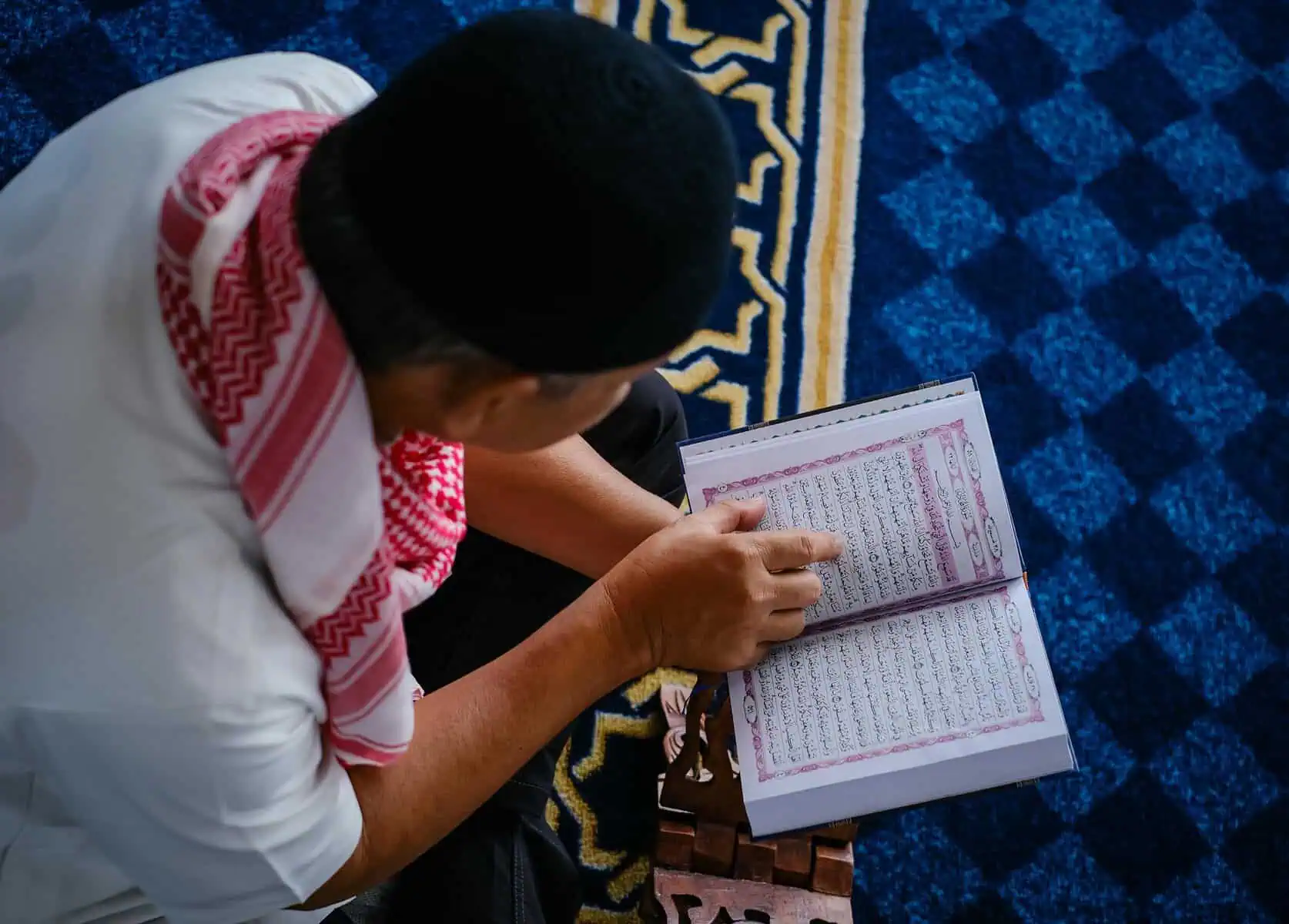
Reciting the Qur’an is the simplest act of worship and one of the hardest to do well. The mechanics are taught in childhood across the Muslim world: open the Mushaf, read the letters, make the sounds. The depth of it is a lifetime’s work. Allah Himself directed the Prophet ﷺ:
“… recite the Quran slowly and distinctly” (Qur’an 73:4, trans. Abdel Haleem)
This guide is for the beginner who can read but wants to read correctly, and for the returner who memorised half the Mushaf as a child and wants the recitation back. Five steps, the rules behind them, and the daily practice that turns rehearsal into fluency.
Why Recitation Is Worship in Itself
The Qur’an is the only book whose reading is worship even when the reader does not understand the words. The reward is letter by letter:
“Whoever reads a letter from the Book of Allah will have a reward, and that reward will be multiplied by ten. I do not say that Alif-Lam-Mim is one letter, but Alif is a letter, Lam is a letter, and Mim is a letter.” (Tirmidhi 2910, graded hasan by Darussalam; al-Tirmidhi called it hasan sahih gharib)
That single hadith reframes the work. Every correct letter is recorded. Every mistake corrected is one more letter restored. The student who reads slowly and accurately is rewarded more than the student who rushes through pages without understanding what their tongue is doing.
The Prophet ﷺ also said that the one devoted to the Qur’an will be told to “recite, ascend and recite carefully as he recited carefully when he was in the world, for he will reach his abode when he comes to the last verse he recites” (Abu Dawud 1464, graded hasan sahih by al-Albani). The motivation is not academic.
The Three Levels of Recitation
Classical scholars such as Ibn al-Jazari name three legitimate paces for recitation, and all three count as correct tajweed when the rules are kept (islamweb fatwa 47409). The Qur’an commands tarteel in 73:4: to recite “slowly and distinctly” (trans. Abdel Haleem).
- Tahqiq: The slowest pace, used for teaching and practice. The reciter takes time on each letter to demonstrate articulation. This is what your teacher will model in lessons. Some scholars also use the word tarteel for this pace.
- Tadwir: The middle pace between tahqiq and hadr, and the usual pace for daily reading and prayer. Most beginners aim here. Every letter gets its full right.
- Hadr: A faster pace used by advanced reciters who have already mastered the rules. Every letter is still correct; nothing is dropped, and no elongation is cut below the minimum the rules allow. Hadr is not “rushing.” It is the same accuracy at a higher speed.
Skipping levels does not work. A beginner who tries to recite at hadr speed before mastering tahqiq will compress letters, drop the elongations, and lose the qualities (sifat) that distinguish similar-sounding letters. The path is slow first, fast last.
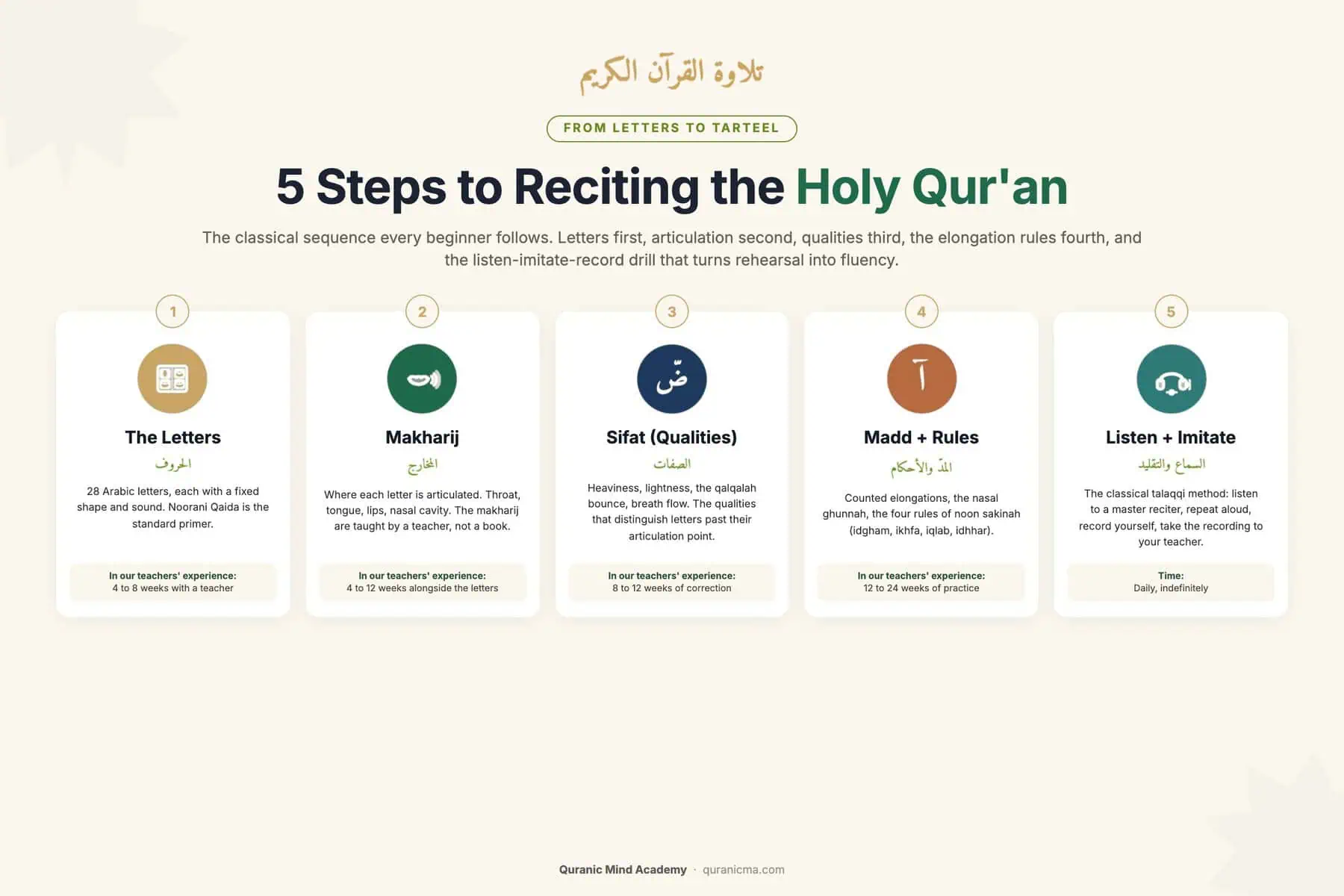
Step 1: Master the Letters and Their Sounds
Twenty-eight Arabic letters, each with a fixed shape, sound, and articulation point. In our teachers’ experience, many beginners recognise the letters within a few weeks and start reading short words within about two months with a teacher; self-study usually takes longer.
The Noorani Qaida is the standard primer used across the Muslim world for exactly this step. It introduces the letters in order, then in combinations, then with diacritical marks, before the student reads continuous text. It is not optional in our recommended path; it is how the foundation gets built.
The Qur’an’s own Arabic register is covered in depth on the Learn Arabic page for students who want to understand what they are reading. The two streams (recitation and comprehension) are different skills and can be learned in parallel.
Step 2: Learn the Makharij (Where Each Letter Comes From)
This is where most untutored reciters quietly fail. Arabic has letters that sound similar in English ears (ﺱ and ﺙ, ﺩ and ض, ﺡ and ه) but come from completely different places in the throat or mouth. Reciting ﻗَﻠْﺐ as ﻛَﻠْﺐ does not just sound wrong; it changes the word from “heart” to “dog.”
Scholars divide the makharij (articulation points) into five major zones:
- The empty space of the mouth and throat (Jawf): The three madd letters: alif, waw and ya when they are long vowels (Hidayat al-Qari).
- The throat (Halq): Six letters arranged from deepest to shallowest: ء ه ع ح غ خ. A group many English speakers find hard at first.
- The tongue (Lisan): The largest zone, with eighteen letters articulated by different parts of the tongue meeting different teeth or the roof of the mouth.
- The lips (Shafatan): Four letters: ف ب م و.
- The nasal cavity (Khayshum): The source of the nasal hum (ghunnah) heard in noon and meem with shaddah.
You cannot learn the makharij from a book. You need a teacher who can hear your mistakes and correct them as you make them.
Step 3: Learn the Sifat (Qualities of Letters)
Each letter also has qualities (sifat) that distinguish it beyond just its articulation point. The main ones to learn in the first six months:
- Tafkhim and Tarqiq: Heaviness and lightness. Letters like خ ص ض ط ظ غ ق are pronounced with a heavy, full-mouth sound. Most other letters are light.
- Qalqalah: A “bouncing” sound on five letters (ق ط ب ج د) when they appear without a vowel.
- Hams and Jahr: Letters where the breath continues to flow versus letters where it stops.
- Shiddah and Rakhawa: Letters where the sound stops abruptly versus letters where it continues.
The full system covered on the Tajweed Rules page is exhaustive, but in our teachers’ experience a beginner working with a teacher can apply the rules above within the first three months.
Step 4: Add the Rules of Madd, Ghunnah, and the Noon-Meem Family
Once letters are sound, the rules that govern how they interact come next.
- Madd (elongation): Every long vowel is held for two counts (the natural madd). When it is followed by a hamza, it is held for four or five counts when reading on in Hafs (madd muttasil and munfasil); when it is followed by a permanent sukun, it is held for six (madd lazim). Getting the count right turns recitation from flat reading into proper tarteel.
- Ghunnah (nasalisation): The hum from the nose that accompanies noon and meem in specific positions.
- Idgham, Ikhfa, Iqlab, Idhhar: The four rules of noon sakinah and tanwin. They govern what happens when a noon with no vowel is followed by another letter. In our teachers’ experience, most beginners learn these within the first six months.
The structured Tajweed Course covers all of these with worked examples and live correction.
Step 5: Listen, Imitate, Record
Recitation is an oral tradition. You do not learn it from text. The classical method is talaqqi: a student sits with a teacher, listens to a passage, repeats it, and is corrected. The modern equivalent is the same teacher on a one-to-one video call, plus three extra tools:
- Listen to a master reciter daily. Shaykh Mahmoud Khalil al-Husary, Shaykh Mishary Rashid Alafasy, and Shaykh Muhammad Siddiq al-Minshawi are often recommended to beginners learning to recite at a measured pace. Pick one and stay with them.
- Imitate, do not just listen. Pause after every verse and recite it aloud yourself before continuing. Passive listening builds appreciation; active imitation builds the skill.
- Record yourself. A short phone recording each week reveals errors your ear missed in real time. Bring those recordings to your next lesson.
The Daily Practice That Builds Fluency in Six Months
The plan that works for a beginner with thirty minutes a day:
- Ten minutes of Noorani Qaida or letter drills. Same pages each week until letters are automatic, then move forward.
- Ten minutes of recitation from the Mushaf. Start with Al-Fatiha, then the short surahs at the end of the Mushaf (Al-Ikhlas, Al-Falaq, An-Nas, then the rest of Juz Amma). Read slowly, applying every Tajweed rule you have learned so far.
- Ten minutes of listening and imitating. One ayah from a master reciter, then your repeat, then theirs again, then yours. Cover one new ayah per session.
In our teachers’ experience, three sessions per week with a teacher and four self-study sessions in between, sustained for six months, take many beginners from struggling with letters to reading much of Juz Amma with correct Tajweed. The bottleneck is not talent. It is consistency.
Common Mistakes That Beginners Make
- Reading without a teacher. A teacher catches mistakes you cannot hear yourself. Apps and YouTube are useful but cannot replace correction.
- Reading too fast. Beginners who rush sound like they are speaking Arabic. They are actually missing letters. Slow down until every letter has its full right.
- Skipping the rules of madd. Most beginner-sounding recitations are flat because they ignore the elongations. Counting the madd properly transforms how your recitation sounds within a single lesson.
- Confusing similar letters. ﻙ vs ﻕ, ﺱ vs ص, ﺩ vs ض, ﺯ vs ظ. These mistakes change meanings. They have to be corrected by a teacher and drilled separately.
- Ignoring the meaning. Recitation is worship even without comprehension, but the reward and the impact deepen when you understand what you are reading. Pair a tafsir for the surahs you are practising.
- Inconsistent practice. Three short sessions a week beats one long session per fortnight. The Prophet ﷺ said the most beloved deeds to Allah are the consistent ones, even if small (Bukhari 6464).
Where to Begin in Your First Two Weeks
- Book a free trial with a teacher. They will assess your current level, recommend a starting point (Noorani Qaida vs starting straight in the Mushaf), and assign a teacher who suits your timing and goals.
- Buy a colour-coded Tajweed Mushaf. The colours mark where each rule applies, which makes self-study far easier in the first few months.
- Pick one master reciter and download Juz Amma audio from them. Listen on commute, in the kitchen, while folding laundry. Familiarity with the sound is half the battle.
- Block thirty minutes a day at a fixed time. After Fajr is the classical hour. After Maghrib is the practical alternative for working adults.
- Track your progress. A printed Juz Amma checklist on the wall. Tick each surah when your teacher confirms your recitation is correct. Visible progress is its own motivation.
Related Guides
- Tajweed rules: the complete reference for the rules introduced above.
- Quran lessons for beginners: the structured beginner programme.
- Learn to read Quran online: how the online format works in practice.
- Virtue of reading the Quran: the deeper reward and the hadith behind it.
- Noorani Qaida course: the foundational primer.
Frequently Asked Questions
Can I learn to recite the Qur’an without learning Arabic first?
Yes. Recitation (reading the Arabic letters correctly) and comprehension (understanding the meaning) are separate skills. Most adult beginners learn to recite first and add Arabic vocabulary and grammar afterwards. The reward for correct recitation is granted whether or not the reader understands the words, as the hadith of Tirmidhi 2910 (graded hasan by Darussalam) makes explicit.
How long until I can recite a short surah correctly?
In our teachers’ experience, a complete beginner working with a teacher for thirty minutes a day, three days a week, can usually recite Surah Al-Fatiha correctly within four to six weeks, the rest of Juz Amma within six to nine months, and read any page of the Mushaf with reasonable Tajweed within twelve to eighteen months. Slower if you are self-studying. Faster if you are coming back to it after learning as a child.
What is the best age to start a child on recitation?
In our teachers’ experience, letter recognition can begin at around four, and structured recitation lessons usually begin around six or seven. The Prophet ﷺ said the best of you are those who learn the Qur’an and teach it (Bukhari 5027); for children, the goal in the first years is the love of the Qur’an and the habit, not the syllabus.
Do I have to perform wudu to recite the Qur’an?
The majority opinion is that wudu is required to physically touch the Mushaf, but is not required to recite from memory or from a digital screen. Scholars differ on the details. A teacher can give you the position of the school you follow.
How do I handle Arabic letters that have no English equivalent?
Letters like ع, ح, خ, ض, ظ, ق, ص have no direct English counterpart and cannot be learned from text alone. The only path is hearing them produced by a teacher and being corrected as you imitate. This is the single strongest argument for learning recitation with a live teacher rather than only from apps.
Is online recitation learning as effective as in-person?
For one-to-one Tajweed lessons, online matches in-person closely. The teacher hears every letter at the same fidelity. What online cannot fully replace is the community of a halaqah, which is why we recommend keeping some connection to a local masjid even while doing the lesson work online.
Where do I begin with a teacher?
The Quranic Mind Academy Quran Reading and Recitation course begins from absolute zero with Al-Azhar-trained teachers in one-to-one lessons. The free trial is a real 30-minute teaching session, not a sales call, so you can hear the teacher and judge the method before committing.


One Response