The Ihram dress for women is simpler than the men’s, but its simplicity hides a few important rulings that many sisters only discover after they have already arrived at the Miqat. This guide covers what the Shariah actually requires for a woman’s Ihram, what the Prophet ﷺ specifically prohibited during the state of Ihram, and how to dress practically for the heat of Makkah without breaking any of those rulings.
The Two Layers of Rules: General Hijab + Ihram-Specific
A sister performing Umrah needs to follow two sets of rules at once.
The first is the general Shariah on women’s dress, which applies in every place and time in front of non-Mahram men. Allah commands:
“And tell believing women that they should lower their glances, guard their private parts, and not display their charms beyond what [it is acceptable] to reveal; they should let their headscarves fall to cover their necklines…”
Surah An-Nur 24:31, trans. Abdel Haleem
And:
“Prophet, tell your wives, your daughters, and women believers to make their outer garments hang low over them…”
Surah Al-Ahzab 33:59, trans. Abdel Haleem
From these verses and the Sunnah, scholars set out the conditions of hijab in any setting: covering the body apart from the face and hands (with some scholars including the face), loose enough not to show the shape, opaque enough not to show the skin, free of perfume that attracts attention, and not resembling the dress of non-Muslims or of men.
The second set of rules is specific to the state of Ihram. These are extra restrictions placed on a pilgrim that would not apply on a normal day. This is the layer that catches most sisters out.
What Is and Is Not Allowed in a Woman’s Ihram
No specific Ihram garment
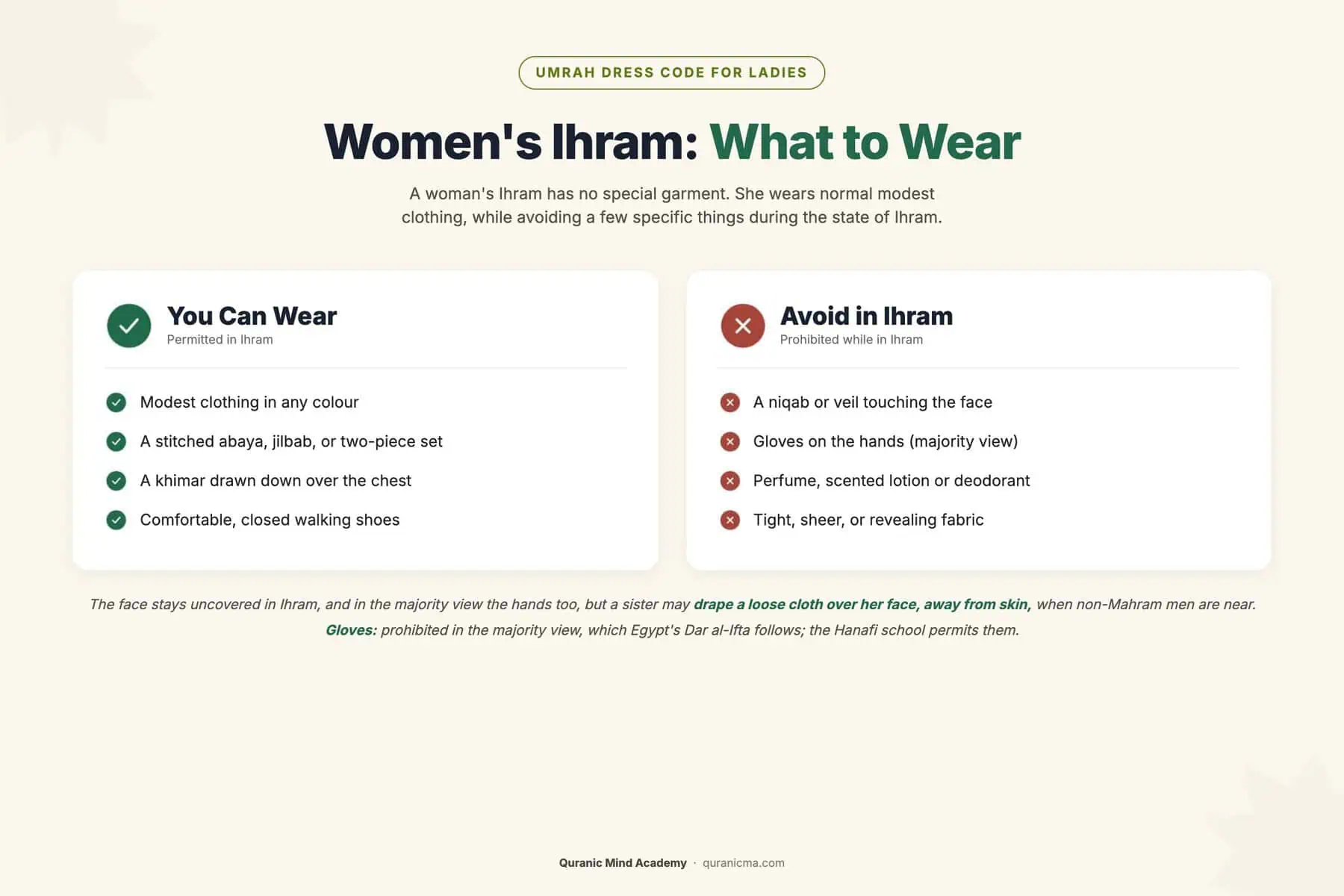
Unlike men, who wear two unstitched cloths (white is recommended, not required), a woman has no set Ihram garment. She may perform Umrah in any modest clothing that satisfies the general hijab conditions. Aisha (RA) wore clothes dyed with safflower while in Ihram (reported by al-Bukhari in the Book of Hajj, chapter 23), and so did Asma bint Abi Bakr (RA) (Muwatta Malik, Book 20, Hadith 11). The one exception is clothing touched by saffron or wars (a fragrant dye), which the Prophet ﷺ forbade (Sahih al-Bukhari 1838).
What this means in practice: a sister may perform Umrah in any modest colour. Some scholars, including Dar al-Ifta al-Misriyyah, say white is preferred (fatwa 7797), but black, navy, beige and grey are all permissible. Choose what is comfortable in heat and not visually attention-drawing.
No niqab and no gloves during Ihram
This is the one Ihram rule almost no online guide explains correctly. The Prophet ﷺ said:
“A woman in the state of Ihram must not wear the niqab nor the gloves.”
Sahih al-Bukhari 1838
The face stays uncovered for the duration of Ihram, and so do the hands in the view of the majority of scholars, which Dar al-Ifta al-Misriyyah follows (fatwa 8403); the Hanafi school permits gloves. This is a specific prohibition tied to Ihram, not a permanent ruling on niqab or gloves outside of pilgrimage.
Screening the face from strangers during Ihram is still possible, but by draping cloth rather than wearing a niqab. Fatima bint al-Mundhir reported:
“We used to veil our faces when we were in Ihram, in the company of Asma bint Abi Bakr as-Siddiq.”
Muwatta Malik, Book 20, Hadith 16; graded sahih by al-Albani (Irwa’ al-Ghalil 4/212)
Egypt’s Dar al-Ifta explains how this fits with the prohibition: a woman in Ihram may not cover her face with a niqab or anything like it, but if she wants to screen herself from people, or from heat or cold, she may let her khimar or outer garment hang over her face, held away from the skin. This is the position of the four imams and the majority of scholars (Dar al-Ifta al-Misriyyah, fatwa 4747). In practice: no fitted niqab during Ihram, but you may drape part of your khimar or outer garment loosely over your face when non-Mahram men pass close, lifting it again afterwards. Your hands stay uncovered, although you may use the wide sleeves of your abaya or jilbab to cover them when needed.
Footwear
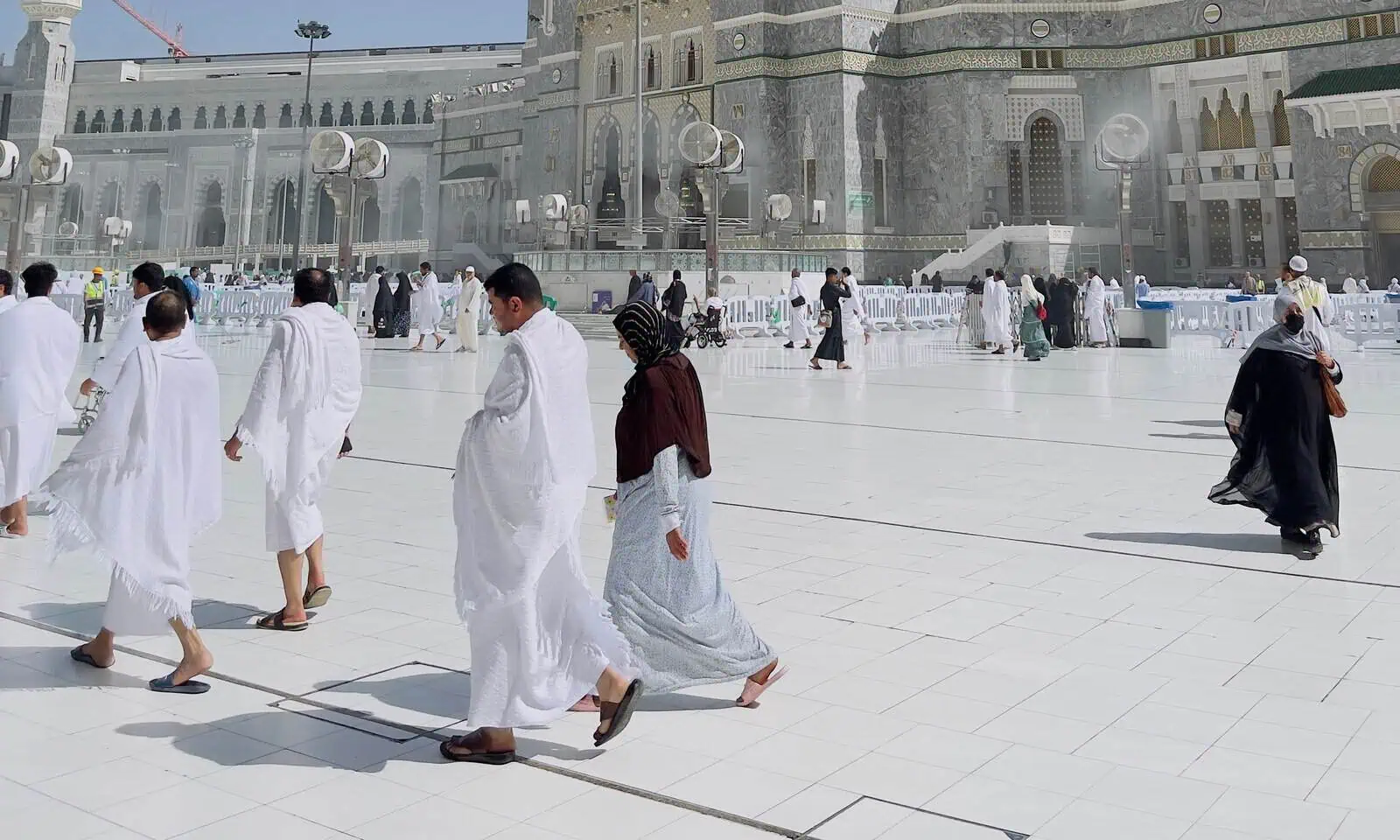
Women in Ihram may wear regular closed shoes. The footwear restriction in the well-known hadith on sandals (Sahih al-Bukhari 1542) refers to the men’s Ihram. Choose shoes you can walk long distances in, that you can slip off easily for prayer, and that will not be lost in the crowds outside the Haram.
Perfume
Both men and women in Ihram are forbidden from applying perfume after entering the state of Ihram. Scented lotion and perfumed deodorant fall under this prohibition. Dar al-Ifta al-Misriyyah allows scented soap or sanitiser used only for cleaning, since the aim is not to perfume yourself (fatwa 7737), though many scholars advise unscented products to be safe. Pack unscented alternatives before you travel.
Practical Clothing Choices
A loose, breathable abaya or jilbab
The most common choice, and for good reason. A long, loose, single-piece outer garment in a light fabric (cotton, lightweight crepe, modal) keeps you covered without trapping heat. Two abayas is the practical minimum. Three is better.
A long khimar or two-piece set
If you prefer a two-piece, choose a long khimar that covers down to mid-thigh or knee, paired with loose trousers or a long skirt. Make sure that when you bend in ruku and sujud, the back of your trousers is not visible.
Hijabs in light, breathable fabric
The synthetic chiffon hijabs that look beautiful in photos are not made for the heat of Makkah. Cotton, viscose-cotton blends, or jersey fabric is what holds up across long days inside a crowded Mataf. Pack two for every day of travel and a couple of small under-caps to keep them in place.
Comfortable, breathable underclothing
Long days walking and praying call for breathable inner layers. Cotton is the standard. Avoid anything tight at the waist that will pinch during sujud.
Walking shoes you have already broken in
The Mataf around the Kaaba and the Sa’i corridor are large, and with Tawaf, Sa’i and the walk to and from your hotel you will cover several kilometres a day. Comfortable, broken-in walking shoes save you from blisters that can ruin a trip. Buying new shoes for the journey is a common mistake.
A Practical Packing Checklist
A working packing list, refined across many sisters’ Umrah trips:
- Two or three loose abayas in light, breathable fabric.
- Six to eight cotton hijabs in neutral colours.
- Two or three under-cap (bonnet) hijabs.
- Loose cotton trousers or long skirts to wear under the abaya.
- Seven to ten pairs of cotton underwear and socks.
- One pair of well-broken-in walking shoes.
- One pair of slip-on shoes for inside the hotel.
- A small drawstring bag for shoes inside the Haram.
- Unscented soap, shampoo, deodorant, and lotion (Ihram-safe).
- A small prayer mat that folds into your handbag.
- A refillable water bottle for Zamzam.
- A small notebook for dua lists and reflections.
Common Mistakes Sisters Make on Umrah
- Wearing a fitted niqab from the moment of Ihram, not realising it is not permitted in the state of Ihram.
- Forgetting to pack unscented hand sanitiser and wipes, and having to rely on scented ones after entering Ihram.
- Buying a beautiful new chiffon abaya for the trip and discovering on day one that it does not breathe.
- Wearing brand-new shoes for the first time in Makkah.
- Packing without a backup hijab and being stuck when the only one gets soaked in Zamzam.
- Wearing tight ankle-length leggings under the abaya, which become uncomfortable during long Sa’i.
Modesty Is the Mindset, Not Just the Outfit
Allah says of women’s dress:
“…they should not stamp their feet so as to draw attention to any hidden charms.”
Surah An-Nur 24:31, trans. Abdel Haleem
The verse is a reminder that hijab is not only the cloth on the body. It is also how you walk, how loud you speak in mixed crowds, where your gaze rests, and what you do with your phone in front of the Kaaba. Sisters who treat the Umrah as worship and not as content for social media usually walk away with the deeper experience.
Frequently Asked Questions
Can I wear coloured abayas during Umrah?
Yes. There is no Shariah requirement to wear white or black. Choose a colour that is not visually attention-drawing.
Do I have to wear gloves to cover my hands during Tawaf?
No. The majority of scholars, and Dar al-Ifta al-Misriyyah (fatwa 8403), hold that gloves are not allowed in Ihram, based on Sahih al-Bukhari 1838 (the Hanafi school permits them). Your hands stay uncovered, and you may use your sleeves.
Can I wear a niqab during Umrah?
A fitted niqab is not permitted during the state of Ihram. You may drape your outer garment loosely over your face when non-Mahram men pass close, then lift it.
Is stitched clothing allowed for women during Ihram?
Yes. The prohibition on stitched clothing applies only to men. Women wear ordinary, modest, stitched clothing throughout Ihram.
What if my menstruation begins after I enter Ihram?
You remain in Ihram. You do not perform Tawaf or pray until you are pure, but you complete every other rite that does not require taharah, and you complete the Tawaf and Sa’i once your period ends. Do not break Ihram.
Can I wear makeup during Umrah?
Avoid scented makeup after entering Ihram, since perfume of any kind is forbidden in the state of Ihram. Beyond that, the same general adab of hijab applies: makeup that draws attention to you in public spaces defeats the purpose of the worship.
Continue the Spiritual Journey at Home
The hardest part of Umrah is not the journey itself. It is keeping the same focus once you are home. If you want to continue the closeness you felt in front of the Kaaba, our Islamic Studies course is built to take that intention and turn it into a structured weekly practice. Many sisters who have just performed Umrah start with our Quran reading and recitation course or our Tajweed course, both of which build directly on the renewed connection to the Quran that Umrah creates.
If you want to come back reciting better than you left, the first two lessons are free and taught by two different teachers, so you can carry on with whichever one suits how you learn. Book a free trial Quran lesson.
Related Guides
- Umrah Meaning and Significance – The full spiritual journey of Umrah, rite by rite.
- Ramadan: Significance in Islam – Spiritual depth of Ramadan, when Umrah carries the reward of a Hajj.
- Islam as a Holistic Way of Life – How worship, character, and habits fit together.
- The Importance of Seeking Knowledge in Islam – The Islamic basis for continuing your learning after pilgrimage.
Summing Up
A sister’s Ihram is not a uniform like the men’s, but it is shaped by clear Shariah rulings: modesty as the baseline, no niqab and no gloves while in Ihram, no perfume, and clothing that lets you walk and pray and worship in heat without distraction. Plan the wardrobe before you fly, leave the showy fabrics at home, and let the simplicity of what you wear match the simplicity of what you came for: to stand before Allah at His House and ask for what your heart needs.