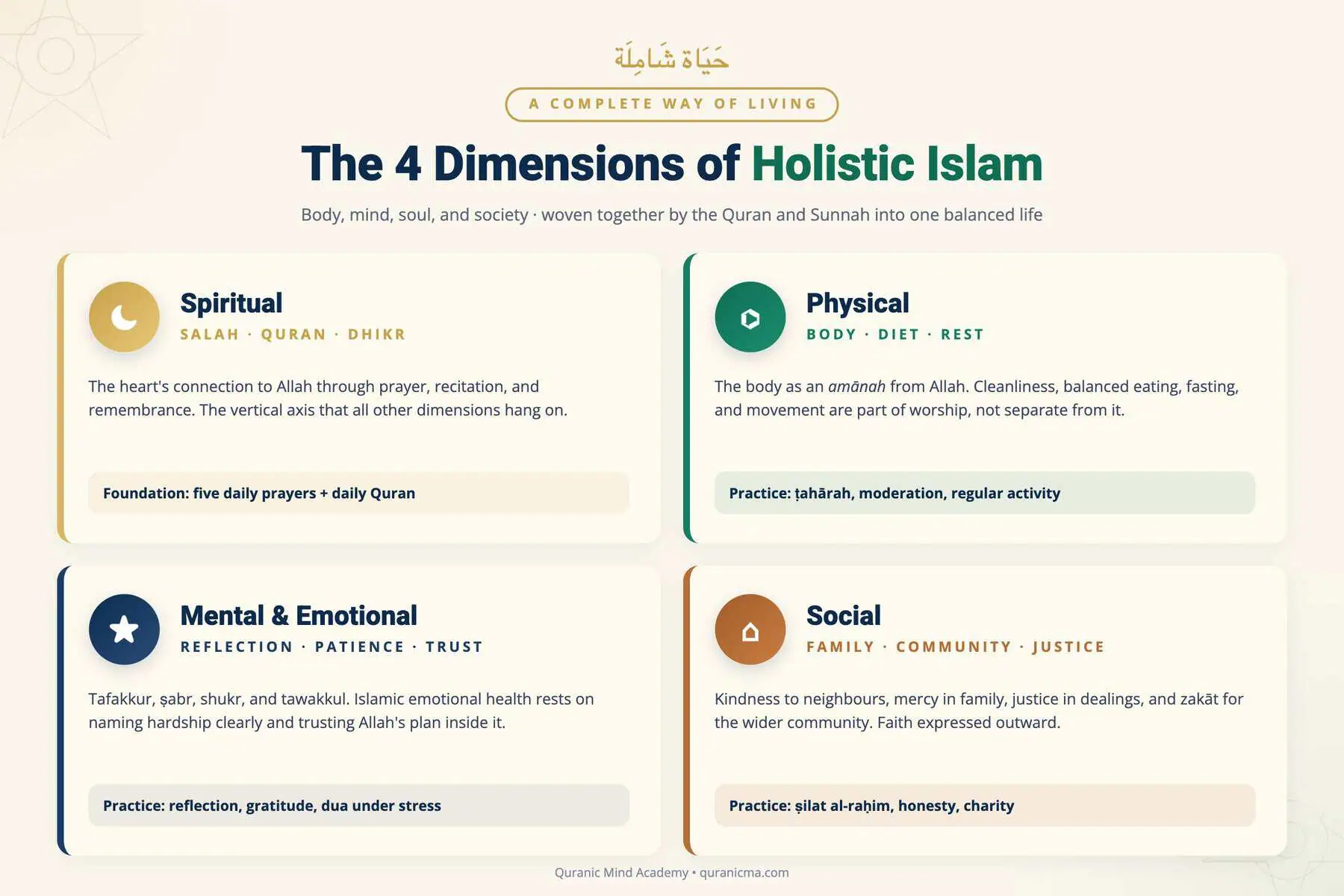
“Holistic” is a word that gets used loosely. In most contexts it just means “everything-at-once,” which is not what Islam actually offers. Islam is more specific. It is a complete framework that organises four distinct dimensions of life — spiritual, physical, mental and emotional, social — into one balanced whole. None of them is optional. None of them dominates. Each one supports the others.
This guide walks through what each dimension looks like in practice, what the Quran and Sunnah say about it, and how a real Muslim life weaves all four together. The aim is to take “Islam is a complete way of life” out of the realm of slogans and into something a person can actually live tomorrow morning.
The Quranic Foundation: Islam as a Complete System
The Quran is explicit that Islam is not a department of life that runs alongside everything else. Allah says:
“You who believe, enter wholeheartedly into submission to God and do not follow in Satan’s footsteps, for he is your sworn enemy.” (Surah Al-Baqarah 2:208, trans. Abdel Haleem)
The verse uses the word kāffah — completely, in entirety — directly contradicting any reading of Islam as a Sunday religion. The Prophet ﷺ embodied the same principle. His own life was a worked example of balance: he prayed, he ate, he slept, he laughed, he mourned, he led a community, he fixed his sandals, he received revelation, and all of it sat on the same plane of meaning. “Whoever turns away from my Sunnah is not from me,” he said when three Companions had committed to extreme worship that excluded marriage, food, and rest (Sahih al-Bukhari 5063). The middle way was the Sunnah; the extreme was a deviation.
The four dimensions below are the practical structure of that middle way.
The 4 Dimensions of Holistic Islam
1. The Spiritual Dimension: The Heart’s Connection to Allah
This is the vertical axis. Every other dimension hangs on it. A Muslim who keeps this strong builds the others naturally; one who neglects it finds the others fraying.
The Five Daily Prayers
Salah is the bone structure of an Islamic day. Five fixed pauses that interrupt work, family, distraction, and reset the heart toward Allah. Allah says: “…prayer restrains outrageous and unacceptable behaviour…” (Surah Al-ʿAnkabūt 29:45, trans. Abdel Haleem) The restraint works because the prayer keeps recurring. The day cannot drift far before the next call to prayer brings the heart back.
Daily Quran Recitation
Even five to ten minutes is enough to anchor the day spiritually. The Prophet ﷺ said: “One who is proficient in the Qur’an is associated with the noble, upright, recording angels; and he who falters in it, and finds it difficult for him, will have two rewards.” (Sahih Muslim 798) For more on the daily reading habit, see our Virtue of Reading the Quran guide.
Dhikr and Duʿāʾ
Surah Ar-Raʿd 13:28, trans. Abdel Haleem, states it directly: “…truly it is in the remembrance of God that hearts find peace…” The morning and evening adhkar take five minutes total and produce something modern productivity tools cannot replicate: a settled heart.
2. The Physical Dimension: The Body as a Trust
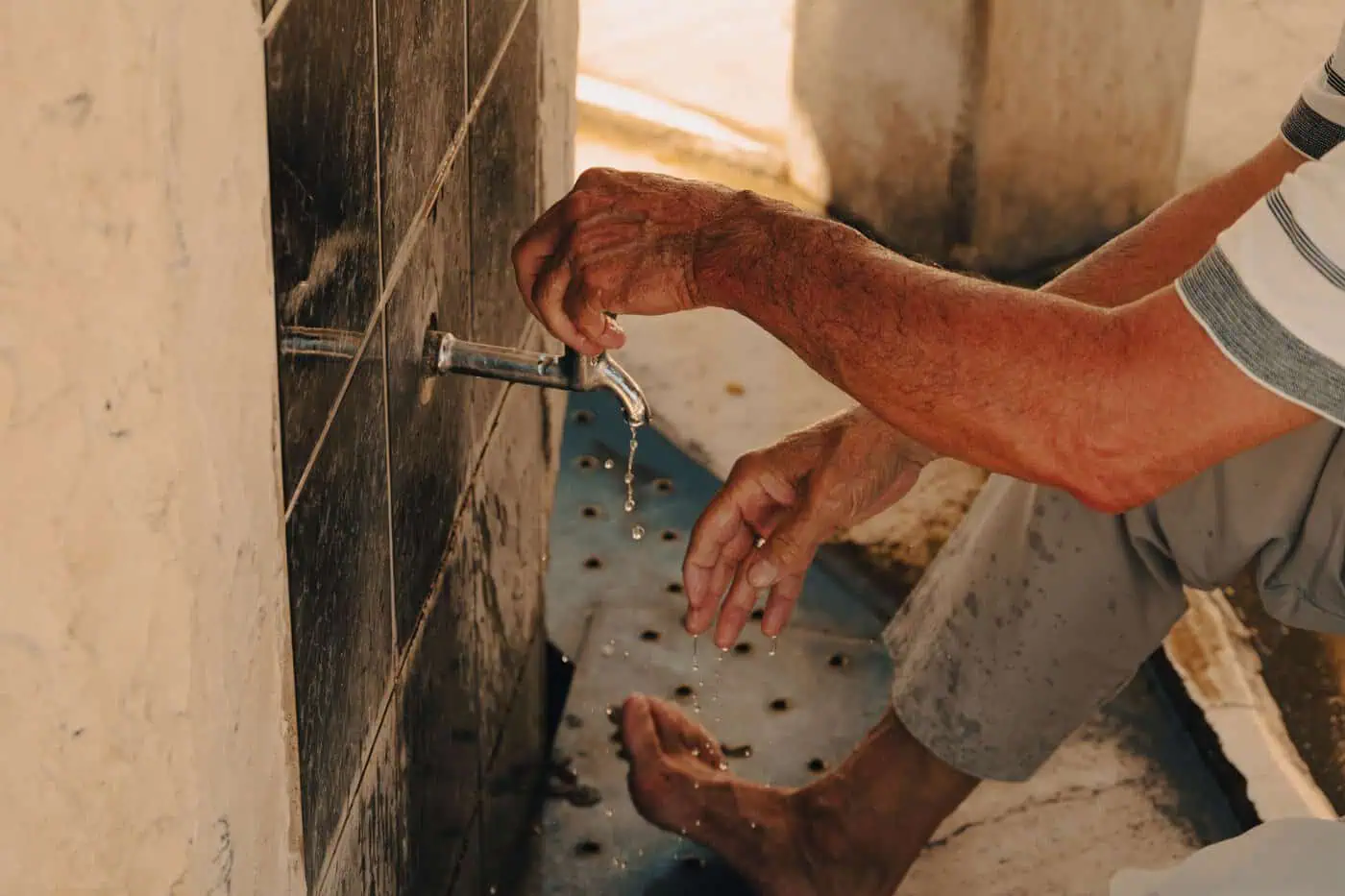
Islam treats the body as an amānah, a trust from Allah. The body is not separate from worship; it is the vehicle through which worship happens. The Prophet ﷺ said: “Your body has a right over you.” (Sahih al-Bukhari 5199) That single sentence is the foundation of Islamic physical ethics.
Cleanliness (Ṭahārah)
Wudu before every prayer, ghusl after major impurity, daily hygiene as a baseline. The Prophet ﷺ described ṭahārah as shaṭr al-īmān — half of faith (Sahih Muslim 223). The framing is striking: cleanliness is not a hygiene preference, it is structurally part of belief.
Balanced Eating
The Quran’s instruction is direct: “…eat and drink [as We have permitted] but do not be extravagant: God does not like extravagant people.” (Surah Al-Aʿrāf 7:31, trans. Abdel Haleem) The Prophet ﷺ said a few mouthfuls to keep a person upright are enough, and if one must eat more, then a third for food, a third for drink and a third for breath (Jami at-Tirmidhi 2380, graded sahih by Darussalam). Eat what is halal and tayyib — permitted and good. Avoid waste. Begin with Bismillāh; end with thanks.
Fasting
Ramadan and the recommended voluntary fasts (Mondays, Thursdays, the three white days) train the body to want less, the heart to want more, and the will to obey before the appetite. Fasting is also one of the few acts whose reward is described in Sahih al-Bukhari 1904 as: “Allah said: ‘Every action of the son of Adam is for him, except fasting; it is for Me, and I will reward it.'”
Movement
The Sunnah consistently encourages physical activity. ʿUmar (RA) wrote to Abū ʿUbaydah: “Teach your children swimming and teach your fighters archery” (Musnad Ahmad 323, graded hasan by Darussalam). The Prophet ﷺ raced ʿĀʾisha (RA) twice (Sunan Abī Dāwūd 2578, graded sahih by al-Albani). Modern equivalents — walking, swimming, structured exercise — fit the same framework. The body that prays better is the body that is well looked after the rest of the day.
3. The Mental and Emotional Dimension: A Settled Mind
Islam takes emotional life seriously. The Quran names grief, fear, anxiety, regret, hope, and joy — not as obstacles to faith, but as part of the human condition that faith reshapes. The discipline has its own vocabulary: tafakkur, ṣabr, shukr, tawakkul, riḍā.
Reflection (Tafakkur)
Allah praises those who reflect: “…who remember God standing, sitting, and lying down, who reflect on the creation of the heavens and earth…” (Surah Āl ʿImrān 3:191, trans. Abdel Haleem) Daily reflection is structured time set aside to think — not scroll, not entertain, not produce. Five quiet minutes asking what am I doing and why changes the texture of the day.
Patience (Ṣabr)
The Quran mentions ṣabr over ninety times. Surah Al-Baqarah 2:153, trans. Abdel Haleem: “You who believe, seek help through steadfastness and prayer, for God is with the steadfast.” Patience here is not passive endurance; it is active steadiness in the face of difficulty, structured by prayer.
Gratitude (Shukr)
Gratitude is the antidote to anxiety. Surah Ibrāhīm 14:7, trans. Abdel Haleem: “If you are thankful, I will give you more…” The discipline of naming what is going right, before asking for more, recalibrates the mind from scarcity toward sufficiency.
Trust in Allah (Tawakkul)
A man asked the Prophet ﷺ whether he should tie his camel and trust in Allah, or leave it loose and trust in Allah. He said: “Tie it and rely (upon Allah).” (Jami at-Tirmidhi 2517, graded hasan by Darussalam) Tawakkul is not passivity. It is doing the work, then handing the outcome back to Allah, where it always belonged. For modern Muslims dealing with chronic stress and anxiety, no productivity hack rivals this.
4. The Social Dimension: Faith Expressed Outward
An Islamic life that is only inward is incomplete. The Quran ties faith to social ethics with no escape clause:
“…The truly good are those who believe in God and the Last Day, in the angels, the Scripture, and the prophets; who give away some of their wealth, however much they cherish it, to their relatives, to orphans, the needy, travellers and beggars, and to liberate those in bondage; those who keep up the prayer and pay the prescribed alms; who keep pledges whenever they make them; who are steadfast in misfortune, adversity, and times of danger. These are the ones who are true, and it is they who are aware of God.” (Surah Al-Baqarah 2:177, trans. Abdel Haleem)
Notice the structure. Belief is named, but the rest of the verse is action: giving, fulfilling promises, patience, charity. Belief without the social outflow is incomplete by the Quran’s own standard.
Family Ties (Ṣilat al-Raḥim)
The Prophet ﷺ said: “Whoever believes in Allah and the Last Day, let him maintain ties with his relatives.” (Sahih al-Bukhari 6138) A holistic Muslim is not someone who reaches spiritual heights while neglecting their parents.
Mercy in Marriage
Surah Ar-Rūm 30:21, trans. Abdel Haleem: “Another of His signs is that He created spouses from among yourselves for you to live with in tranquillity: He ordained love and kindness between you…” The Quran names the marriage relationship as a sign of Allah, comparable in weight to the natural signs in creation. Households shaped by faith trade scoring points for serving each other.
Justice in Dealings
Islam’s social ethics extend to commerce, neighbours, employees, strangers. The Prophet ﷺ said: “None of you truly believes until he loves for his brother what he loves for himself.” (Sahih al-Bukhari 13) The standard is high because the religion is high.
Charity (Zakāt and Ṣadaqah)
Zakāt is one of the five pillars; ṣadaqah is the open-ended habit. Both are wealth turned into solidarity. The Prophet ﷺ described charity in striking terms: “Charity does not decrease wealth.” (Sahih Muslim 2588) The math seems wrong, but anyone who lives by it long enough finds the math is exactly right.
The Prophetic Model: How the Four Dimensions Hold Together
The Prophet ﷺ is the worked example. His life shows how the four dimensions integrate into a single coherent whole.
- He prayed at night until his feet swelled, and he slept enough to be fresh in the morning. Spiritual + physical, no contradiction.
- He fasted regularly, and he ate sweet things when offered. Discipline + simple joy.
- He led wars and visited the sick. Public leadership + personal kindness.
- He consulted his wives in public matters (Umm Salama’s advice at al-Hudaybiyah, Sahih al-Bukhari 2731) and laughed with them at home. Authority + tenderness.
- He recited Quran in the depth of night and played with his grandchildren in the morning. Worship + family.
None of this was theatre. It was the natural expression of a person whose four dimensions were balanced. Three Companions once committed to extreme worship — fasting all day every day, praying all night, abstaining from marriage — and the Prophet ﷺ corrected them sharply: “I fast and I break my fast; I pray and I sleep; and I marry. Whoever turns away from my Sunnah is not of me.” (Sahih al-Bukhari 5063) Imbalance is not piety.
How to Apply Holistic Islam Daily
A practical day that touches all four dimensions:
| Time | Action | Dimensions |
|---|---|---|
| Pre-Fajr | Wudu, two rakʿah, Fajr in jamāʿah, brief Quran | Spiritual + Physical |
| Morning | Morning adhkar, light breakfast, brief walk | Spiritual + Physical + Mental |
| Midday | Dhuhr on time, meal with Bismillāh, family check-in | Spiritual + Physical + Social |
| Afternoon | ʿAṣr on time, focused work, small ṣadaqah | Spiritual + Mental + Social |
| Evening | Maghrib, family dinner, evening adhkar | Spiritual + Social + Mental |
| Night | ʿIshāʾ, Surah Al-Mulk, brief reflection journal, witr if able | Spiritual + Mental |
None of this requires withdrawing from modern life. It requires structuring it.
Common Misunderstandings About Holistic Islam
“Holistic Islam Means Everything Has to Be Balanced All the Time”
No. Different seasons of life emphasise different dimensions. A new parent leans heavily on the social and physical for a few years; a pilgrim emphasises the spiritual during the days of Hajj; a student in exams leans on the mental and spiritual. Balance is sustained over years, not enforced every hour.
“Spiritual Practice Should Override Physical Care”
The Prophet ﷺ explicitly rejected this. Health, sleep, and family time are not competitors with worship; they are part of it. A Muslim who burns out from over-extension and abandons the religion entirely has not won.
“Holistic Islam Is for Scholars or Mystics”
The Quran addresses ordinary believers. “Enter wholeheartedly into submission to God” (Surah Al-Baqarah 2:208, trans. Abdel Haleem) is addressed to every believer. The four dimensions are accessible to a child, a labourer, a parent, a CEO. The depth scales with the person; the structure is the same.
Why Non-Arabic Speakers Especially Benefit From This Framework
Many Muslims raised outside Arabic-speaking environments end up with Islam-as-rituals: prayer, fasting, halal food. The four-dimensional framework reverses that drift. It returns ordinary acts — eating, sleeping, working, parenting, resting — to their place inside the religion. A holistic Muslim does not stop being modern; they stop being fragmented.
If you’d like a structured path through this material, our Islamic Studies course walks through the Quran, Seerah, fiqh, and applied ethics, all framed around how a Muslim actually lives. Two free trial sessions before any commitment.
Related Reading
- Seeking Knowledge in Islam — why learning is a lifelong duty.
- The Virtue of Reading the Quran Daily
- Prophetic Biography — the worked example of holistic Islam.
- Ramadan Significance in Islam
- The 5 Principles of Fiqh
Frequently Asked Questions
What does holistic Islam mean?
It means Islam organises four dimensions of life — spiritual, physical, mental and emotional, social — into one balanced whole. None of them is optional, and the Quran calls believers to “enter wholeheartedly into submission to God” (Surah Al-Baqarah 2:208, trans. Abdel Haleem).
How can I apply holistic Islam to a busy modern life?
Anchor the spiritual dimension first (five daily prayers + brief Quran), then layer in physical care (cleanliness, balanced eating, movement), emotional discipline (reflection, patience, gratitude), and social ethics (family, charity, justice). None of this requires withdrawing from modern life — it requires structuring it.
Is holistic Islam only for scholars?
No. The Quran addresses ordinary believers, and the four dimensions are accessible to a child, a labourer, a parent, or a professional. Depth scales with the person; the structure is the same for everyone.
Does Islam address mental and emotional health?
Yes, extensively. The Quran has a developed vocabulary for emotional life — ṣabr (patience), shukr (gratitude), tawakkul (trust), tafakkur (reflection), riḍā (contentment) — and the Sunnah builds practical disciplines around each. Many of these map closely onto modern cognitive behavioural concepts.
Can non-Arabic speakers practice holistic Islam fully?
Yes. The framework is accessible in any language. Reading translations of the Quran, learning the Sunnah in English, and practising the four dimensions does not require fluent Arabic. Arabic deepens the experience over time but is not a prerequisite.
Does Islam guide physical health too?
Yes. The Quran instructs moderation in eating (“eat and drink [as We have permitted] but do not be extravagant”, Surah Al-Aʿrāf 7:31, trans. Abdel Haleem), the Sunnah encourages cleanliness, fasting, and physical activity, and the Prophet ﷺ said “your body has a right over you.” Health is part of worship, not separate from it.
Begin Living Holistic Islam
The framework is simple. The work is doing it daily, for years, until the four dimensions become one rhythm. If you’d like guidance on where to start, two free trial sessions with one of our Al-Azhar teachers will give you a clear next step.
Start with 2 Free Trial Lessons →
Have questions? Chat with us on WhatsApp.