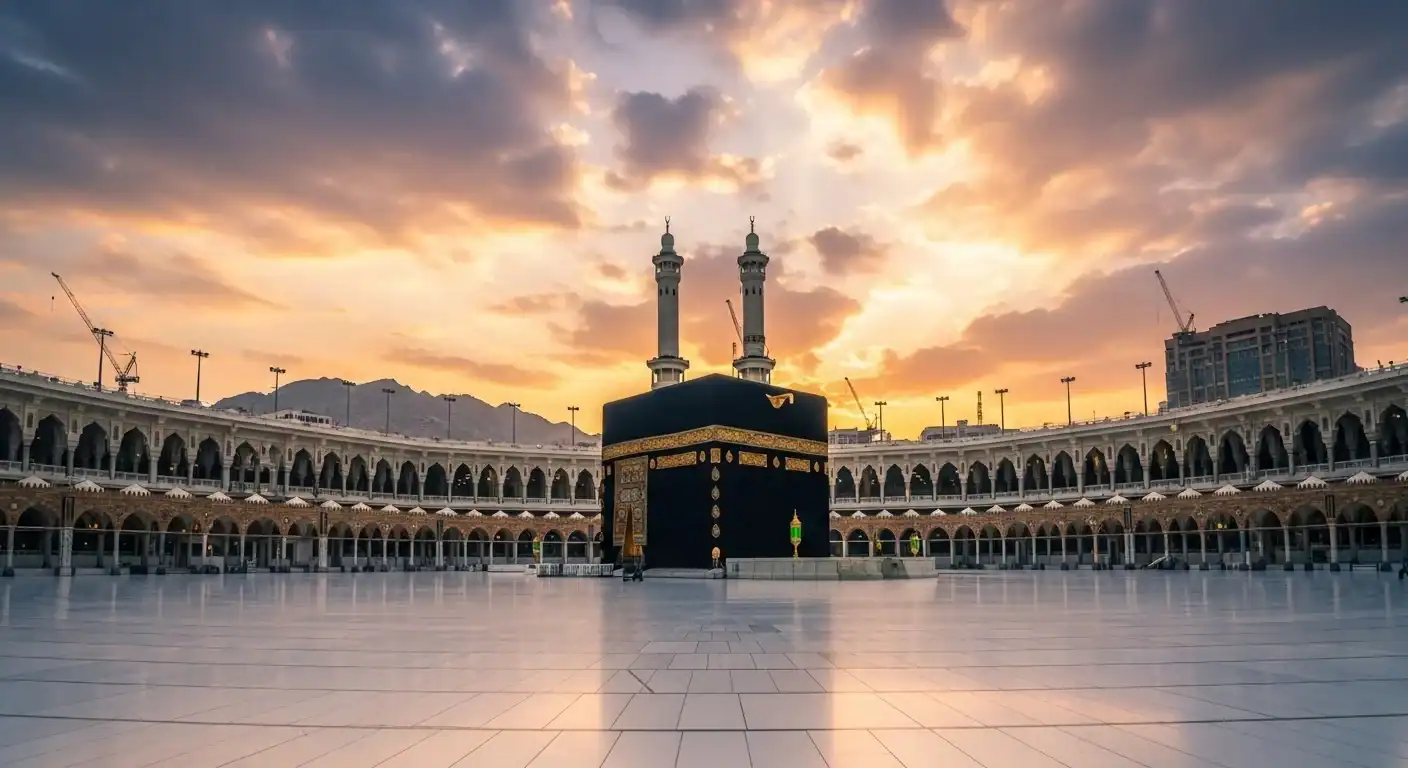
Umrah is the lesser pilgrimage to the Sacred House in Makkah. It is shorter than Hajj, can be performed at any time of the year, and is recommended (mustahabb) according to the majority of scholars and obligatory once in a lifetime according to others. For many believers, Umrah is the first step into the world of pilgrimage and the first time they stand before the Kaaba with their own eyes.
This guide covers what Umrah means in Arabic and in Islamic law, what the Quran and the Sunnah say about it, and what each of its rites is meant to do inside your heart. The aim is for you to walk into Ihram already understanding the worship you are about to perform, not as a tourist following a guide.
What “Umrah” Means in Arabic
The word Umrah comes from the Arabic root ‘-m-r (ع م ر), which carries the sense of visiting an inhabited or honored place. In classical lexicography, i’timar literally means “to visit.” When the Companions used the word about the Sacred House, they meant a deliberate visit for the sake of worship.
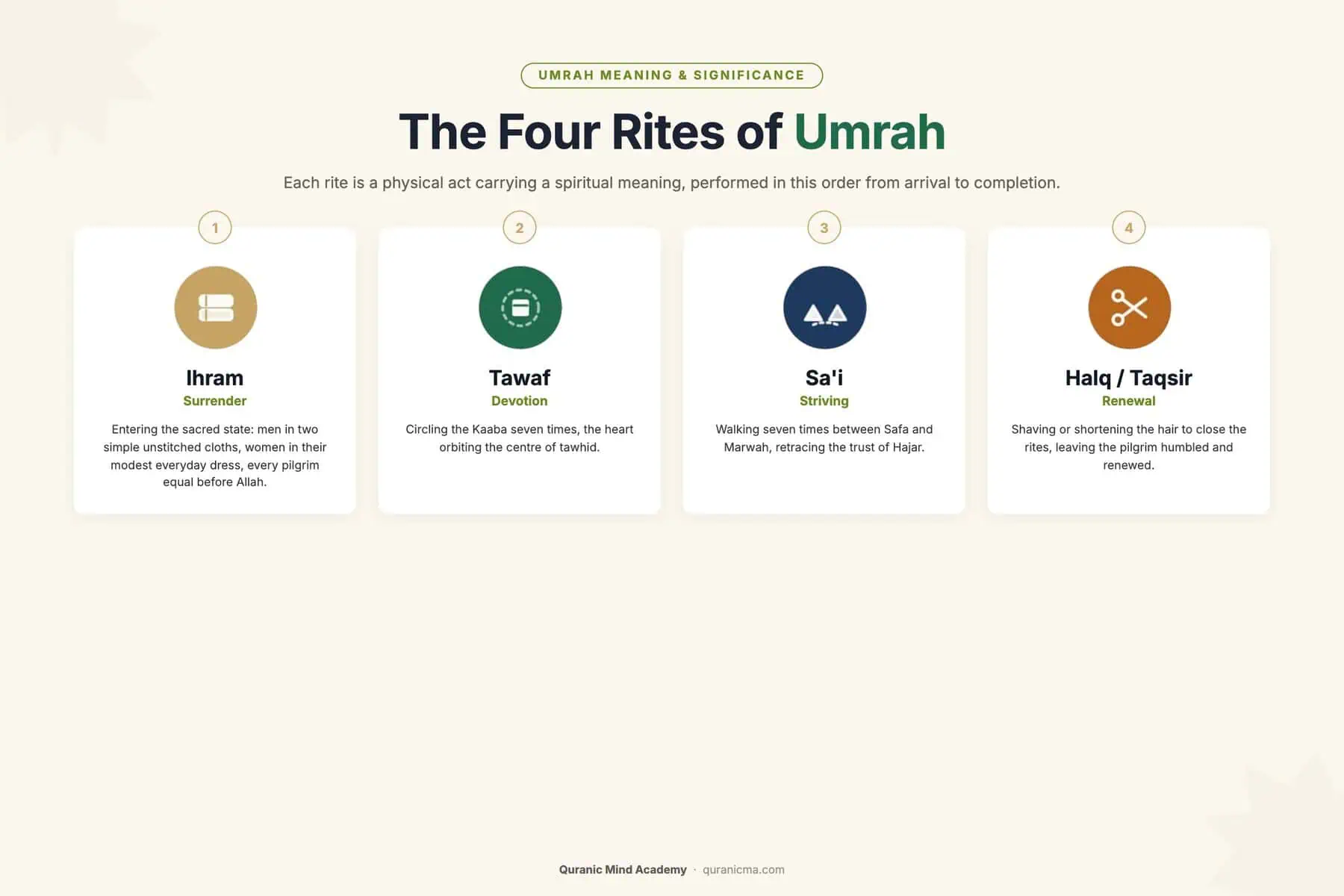
In Shariah, Umrah is defined as: entering the state of Ihram, performing Tawaf around the Kaaba, performing Sa’i between Safa and Marwah, and shaving (halq) or shortening (taqsir) the hair, all with the intention of drawing near to Allah at His Sacred Mosque.
That definition matters. Umrah is not “a trip to Saudi Arabia.” It is a defined act of worship with a beginning, four core actions, and an end. Treating it as travel first and worship second is one of the main reasons people return home without the spiritual change they were hoping for.
Quranic Foundation of Umrah
Allah pairs Umrah directly with Hajj in His command:
“Complete the pilgrimages, major and minor, for the sake of God…”
Surah Al-Baqarah 2:196, trans. Abdel Haleem
The same surah names two of the rites by their station:
“Safa and Marwa are among the rites of God…”
Surah Al-Baqarah 2:158, trans. Abdel Haleem
And in Surah Al-Hajj, Allah describes the call that brings believers from every corner of the earth to His House:
“Proclaim the Pilgrimage to all people. They will come to you on foot and on every kind of swift mount, emerging from every deep mountain pass”
Surah Al-Hajj 22:27, trans. Abdel Haleem
These verses anchor Umrah inside the Quran as a direct command, not a cultural tradition.
What the Prophet ﷺ Said About Umrah
The Messenger of Allah ﷺ tied enormous reward to Umrah while keeping its rites simple:
“An Umrah is an expiation for what is between it and the next Umrah, and the accepted Hajj has no reward except Paradise.”
Sahih al-Bukhari 1773
He ﷺ also encouraged following one with another:
“Follow up between Hajj and Umrah, for they remove poverty and sins as the bellows removes impurities from iron, gold, and silver.”
Jami at-Tirmidhi 810, graded hasan sahih gharib by al-Tirmidhi and hasan by Darussalam
And he placed Umrah in Ramadan in a class of its own:
“An Umrah in Ramadan is equal to a Hajj with me.”
Sahih al-Bukhari 1863
Three short narrations cover what most pilgrims want to know about reward: that Umrah erases sins between visits, that repeating it pulls poverty out of one’s life, and that timing it during Ramadan multiplies its weight enormously.
The Four Rites of Umrah and What Each One Teaches
1. Ihram: surrender before you arrive
Ihram is not just the white cloth. It is the niyyah, the spoken declaration of intent (Labbayk Allahumma ‘umratan), and the moment your old life is paused. The Prophet ﷺ entered Ihram at the Miqat. You must not pass your Miqat without Ihram. Entering Ihram before it is valid by consensus, and pilgrims flying in often do so on the plane or before boarding so they do not miss it; Dar al-Ifta al-Misriyyah considers this better for anyone who fears missing the Miqat and can keep Ihram’s restrictions (Dar al-Ifta fatwa 16108).
What Ihram teaches: equality. Every man wears two unstitched white cloths. Every woman wears modest clothing without face veil or gloves while in the state of Ihram. There is no badge of wealth, no sign of nationality, no marker of status. You stand before Allah as one of the masses, exactly as you will stand on the Day of Judgement. The dress strips away every difference your bank account or your passport ever gave you.
2. Tawaf: orbit around tawhid
Tawaf is seven counter-clockwise circuits around the Kaaba, beginning at the Black Stone. The Prophet ﷺ kissed the stone when he could and pointed to it when he could not. Umar ibn al-Khattab (RA) addressed it openly:
“I know that you are only a stone, you can neither benefit nor harm anyone, and had I not seen the Messenger of Allah ﷺ kiss you, I would not have kissed you.”
Sahih al-Bukhari 1597
What Tawaf teaches: tawhid. Every creature in the universe orbits something. The angels around the Bayt al-Ma’mur. The planets around stars. Electrons around nuclei. Tawaf places you, deliberately, at the centre of that pattern. You move around the House because your life moves around its Lord.
3. Sa’i: the trust of Hajar
After Tawaf you walk seven times between Safa and Marwah, retracing the steps of Hajar (peace be upon her) when she searched for water for her infant Ismail (peace be upon him). The historical event behind Sa’i is reported in Sahih al-Bukhari 3364, where the Prophet ﷺ said: “That is why the people run between them.”
What Sa’i teaches: tawakkul under hardship. Hajar did not sit and wait. She climbed the hill, looked, climbed the other, and looked again, and after she had taken every means available to her, the well of Zamzam burst open at her child’s feet. The lesson is that effort and trust are not opposites. Take the means, then surrender the result.
4. Halq or Taqsir: closing the act
Men shave their heads or shorten the hair. Women shorten a fingertip’s length from the ends. With this final act the state of Ihram ends and the Umrah is complete.
What this teaches: humility at the close of worship. The Prophet ﷺ made dua three times for those who shave and once for those who shorten (Sahih al-Bukhari 1728), so going lower at the end is part of the worship itself.
Why These Specific Rites?
Pilgrims often ask why Allah chose these particular actions. The Quran answers indirectly: the rites are sha’a’ir Allah, the symbols of Allah (Surah Al-Hajj 22:32). Their meaning is not in their physical mechanics but in the obedience of doing them exactly as commanded, exactly as the Prophet ﷺ performed them.
This is why scholars insist on the principle the Prophet ﷺ taught during his Hajj: “Li-ta’khudhu manasikakum” (“Take your rites [from me]”) (Sahih Muslim 1297). The mind does not need to invent a meaning for every motion. The motion itself, performed in obedience, is the meaning.
Quranic Themes That Umrah Brings to Life
Beyond the verses that legislate Umrah, two further ayat connect the journey to themes that run through the entire Quran. Reading them on the trip changes how the rites feel.
The first is on mercy. Allah says:
“Say, ‘[God says], My servants who have harmed yourselves by your own excess, do not despair of God’s mercy. God forgives all sins: He is truly the Most Forgiving, the Most Merciful.”
Surah Az-Zumar 39:53, trans. Abdel Haleem
Umrah is the lived tafsir of this verse. Entering Ihram, beginning Tawaf, walking Sa’i: each rite is a step of returning to Allah carrying years of regret and refusing to despair of His mercy. The pilgrim who reads this ayah at the Black Stone often understands it for the first time.
The second is on equality. Allah says:
“People, We created you all from a single man and a single woman, and made you into races and tribes so that you should recognize one another. In God’s eyes, the most honoured of you are the ones most mindful of Him…”
Surah Al-Hujurat 49:13, trans. Abdel Haleem
In Ihram, this verse becomes visible. The doctor and the labourer, the citizen and the refugee, the wealthy and the poor: all wear the same two cloths and stand in the same circumambulation. There is no first class around the Kaaba. Nobility is taqwa, and Umrah turns that abstract truth into something the eye can see.
How Umrah Purifies the Heart
The Prophet ﷺ said that whoever performs Hajj for Allah without obscenity or wrongdoing “returns like the day his mother gave birth to him” (Sahih al-Bukhari 1521, on Hajj, with the principle extending to Umrah by the earlier hadith on expiation). What does this look like in practice?
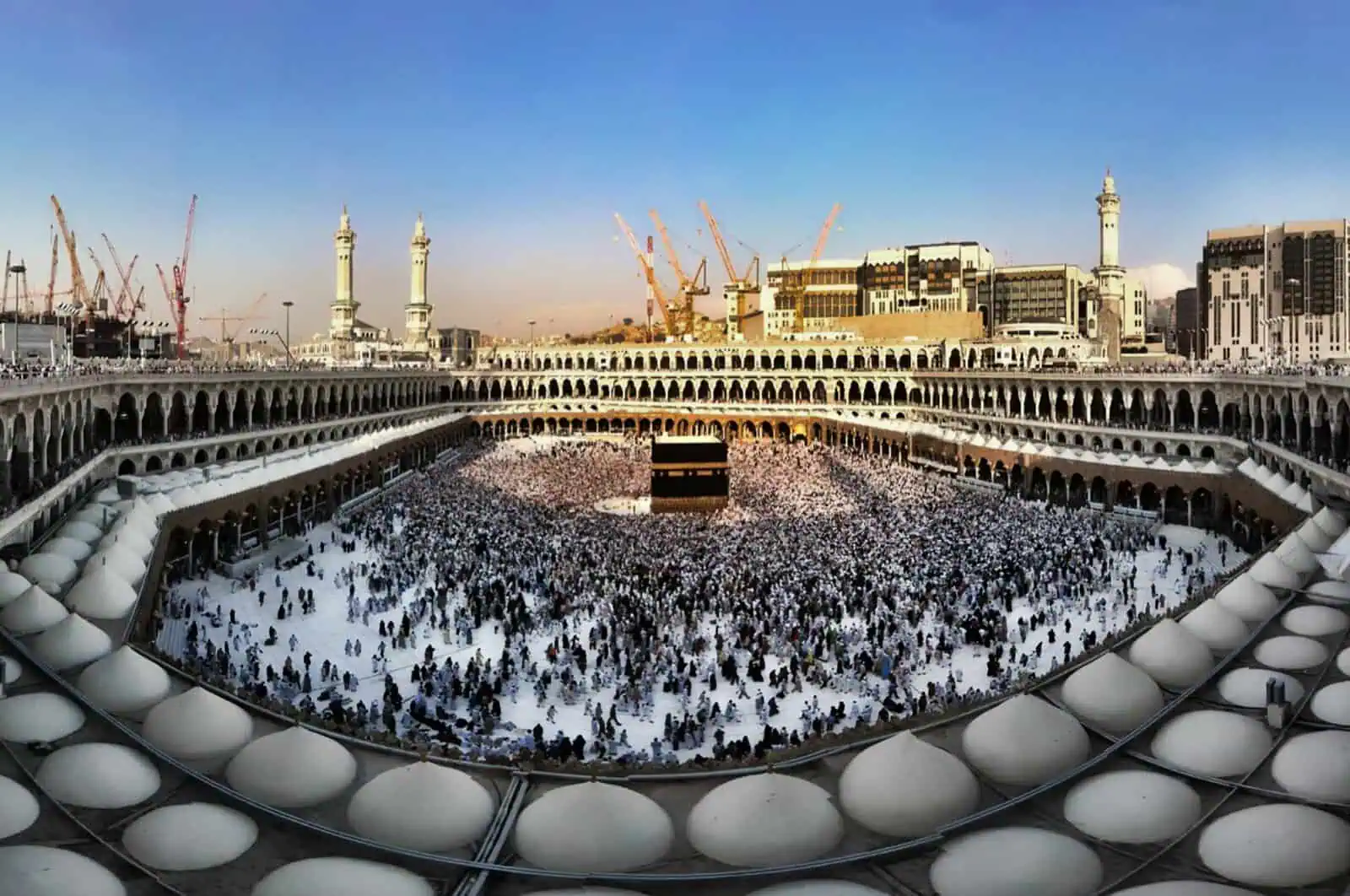
Repentance becomes specific. The vague guilt of years narrows into a list of named sins, in front of the Kaaba, that you genuinely intend to leave behind. Worldly anxieties shrink. Standing in the Mataf surrounded by hundreds of thousands of people from every continent, the things you were anxious about a week ago lose their grip. The heart re-orders. Salah, which used to be one item on a daily list, becomes the spine of the day. These are the patterns pilgrims describe again and again. They are the marks of an accepted Umrah.
Visiting Madinah: Recommended, Not Part of Umrah
A common confusion: visiting the Prophet’s Mosque in Madinah is not part of Umrah. The Umrah is complete once you finish Sa’i and shorten the hair in Makkah. Travelling to Madinah after that to pray in the Prophet’s Mosque ﷺ is a separate, recommended visit, encouraged by the hadith:
“Do not undertake a journey except to three Mosques: this Mosque of mine, the Sacred Mosque, and Al-Aqsa Mosque.”
Sahih Muslim 1397a
Most pilgrims combine the two journeys, which is good practice, but the spiritual reward of Umrah does not depend on it.
Preparing Your Heart Before You Travel
The journey starts at home, not at the airport. The Prophet ﷺ said:
“Actions are by intentions, and every person will have what they intended.”
Sahih al-Bukhari 1
Your Umrah will be exactly as deep as your niyyah. A few things worth doing before you fly:
- Repent specifically. Make a list of recurring sins and resolve to leave them. Generic istighfar at the airport is weaker than naming the things you intend not to return to.
- Reconcile with people. Do not arrive at the Kaaba with a quarrel still open. Apologise, refund, return, or message before you board the plane.
- Settle debts where possible. If you cannot, document them and tell your family.
- Learn the rites. Reading the manasik once or twice before you travel changes you from a pilgrim who follows a guide into a worshipper who knows what they are doing.
Mistakes That Reduce the Reward
A few patterns that pilgrims regret afterwards:
- Rushing Tawaf to “get it done” instead of remembering that each circuit is a private audience with Allah.
- Talking loudly or taking selfies during Sa’i, when the historical weight of the place calls for silence.
- Treating Ihram clothing as a costume and breaking small Ihram restrictions absent-mindedly: perfumes, cutting nails, arguing.
- Spending the trip on the phone calling family back home instead of being present.
- Planning the shopping route before planning the prayer times.
None of these invalidate the Umrah, but some Ihram violations, such as clipping nails, require an expiation (fidya) according to the majority of scholars even when done forgetfully, so ask a scholar if it happens (Dar al-Ifta fatwa 14692). All of them thin its barakah.
Signs Your Umrah Was Accepted
The early scholars used to say that the sign of an accepted act of worship is a better act of worship after it. The night prayer that did not exist in your routine before Umrah, the loose tongue that quietened, the sin you walked away from when you came back home: those are the receipts. The Umrah was not the destination. It was the moment your life turned.
Frequently Asked Questions
Is Umrah obligatory?
According to the Hanafi and Maliki schools, Umrah is recommended (sunnah mu’akkadah). According to the Shafi’i and Hanbali schools it is obligatory once in a lifetime for those who can afford it. Either way, the encouragement to perform it is strong.
Can a woman perform Umrah without a Mahram?
The schools differ here. The Hanafi and Hanbali schools require a husband or mahram for the obligatory pilgrimage, while the Maliki and Shafiʿi schools allow a woman to travel for it with a safe, trustworthy group (islamweb fatwa 536113). Dar al-Ifta al-Misriyyah permits a woman to travel for Hajj and Umrah without a mahram as long as her safety is assured (Dar al-Ifta fatwa 11367). Saudi rules on women travelling for Umrah without a mahram have changed several times, so check the current conditions with the official Nusuk platform or your travel operator before booking. Speak to a knowledgeable scholar in your madhhab for the ruling that applies to you.
How long does Umrah take?
The rites themselves can be completed in three to five hours if the Mosque is not crowded. Most pilgrims spread their stay over several days to pray more, repeat Umrah for deceased family members, and visit Madinah.
Can I perform Umrah on behalf of someone who has died?
Yes. After completing Umrah for yourself, you may perform a second Umrah, this time entering Ihram from the Tan’im or Ji’rana, with the intention that its reward goes to the deceased.
Is Umrah valid if I cry the whole time and forget the duas I prepared?
Yes. Tears in front of the Kaaba are acceptable to Allah. The dua lists are a help, not a condition. What is required are the four rites done in order with niyyah; everything else is between you and your Lord.
A Course That Continues Where Umrah Begins
Many pilgrims return from Umrah wanting to read the Quran better, recite with proper Tajweed, or finally start their hifz. If that is you, our online Quran recitation course and Tajweed course are designed to take that motivation and turn it into a daily habit. If memorization is your next goal, our Hifz programme takes you through it step by step from home.
Whichever of those fits, the start is free: two trial lessons with two Al-Azhar teachers, then you continue with the one whose teaching suits you. Book a free trial lesson.
Related Guides
- Ramadan: Significance in Islam – Spiritual depth of Ramadan, when Umrah carries the reward of a Hajj.
- Umrah Dress Code for Ladies – Shariah guidelines and practical packing advice for women.
- The Importance of Seeking Knowledge in Islam – Why deepening your Quranic understanding is a lifelong duty.
- Islam as a Holistic Way of Life – How worship, character, and daily routine fit together.
Conclusion: A Journey That Changes the Heart Forever
Umrah is more than a pilgrimage. It is a journey of transformation. It purifies the heart, strengthens faith, and renews purpose. Each rite brings the believer closer to Allah, and the lessons of Ihram, Tawaf, Sa’i, and the closing of the act stay with the pilgrim long after the journey ends. May Allah accept the Umrah of every pilgrim, write them among those whose sins are forgiven, and return them home with hearts changed for life.