
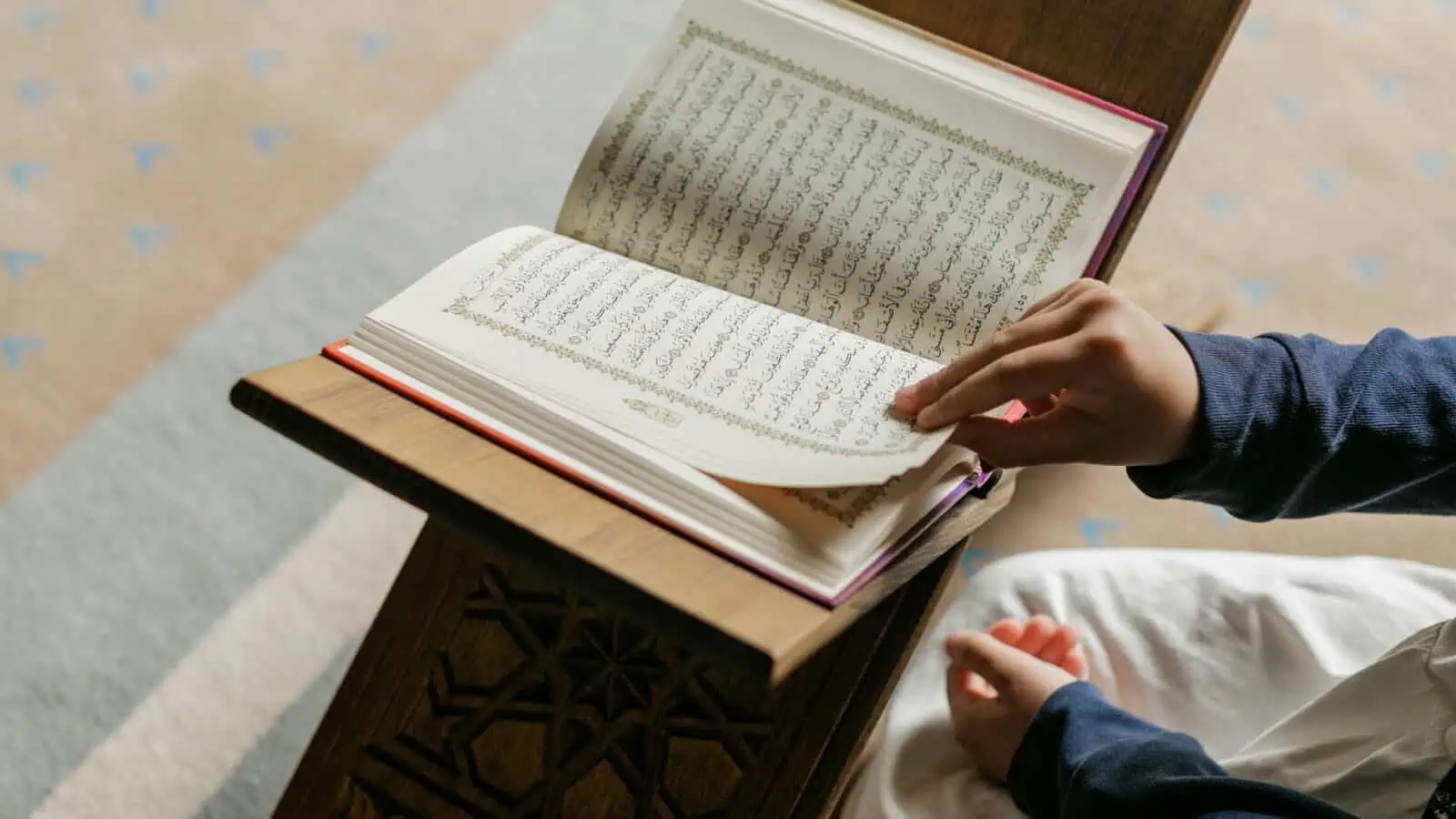
The first time a child reads Bismillāh from a real Mushaf is not a small moment. For many Muslim families, it is the start of a relationship that will outlast school, work, and most other things in life. The question most parents ask is not whether to teach the Quran early; it is how to do it without overwhelming a five-year-old or boring a teenager.
This guide walks through what actually works, by age, with the help of qualified teachers and a quiet, consistent routine. It is shaped by what we see every day at Quranic Mind Academy with families across the UK and beyond.
Why Childhood Matters in Quran Learning
The Prophet ﷺ said: “The best of you are those who learn the Quran and teach it.” (Sahih al-Bukhari 5027). He also said that the one who recites the Quran and stumbles over it, finding it difficult, receives a double reward (Sahih al-Bukhari 4937, Sahih Muslim 798). For a young learner stumbling through the Arabic alphabet, that hadith is a quiet promise that the effort itself is honoured.
Allah addresses the believers about their families in Surah At-Taḥrīm (66:6), trans. Abdel Haleem: “Believers, guard yourselves and your families against a Fire fuelled by people and stones…” Quran education is one of the most concrete ways a parent fulfils that command.
Beyond the spiritual weight, there are practical reasons childhood is the right window:
- Children pick up Arabic phonemes and rhythm faster than adults, especially the sounds Tajweed depends on (ع، ح، ق، ض).
- Daily Quran practice builds focus, patience, and quiet self-discipline that carry into school and home life.
- Recitation memorised young is recalled at speed and tends to stay with the child for life.
- The Quran becomes the family’s emotional language early, and children grow up associating it with calm and connection rather than pressure.
The Three Stages of Quran Learning by Age
There is no single right way to teach the Quran. There is, however, a wrong-fit approach for every age group. A toddler being drilled on Tajweed terms will resent the Mushaf by year two. A teenager being read storybook surahs will quietly disengage. The framework below is what we use with new families to match the method to the child.
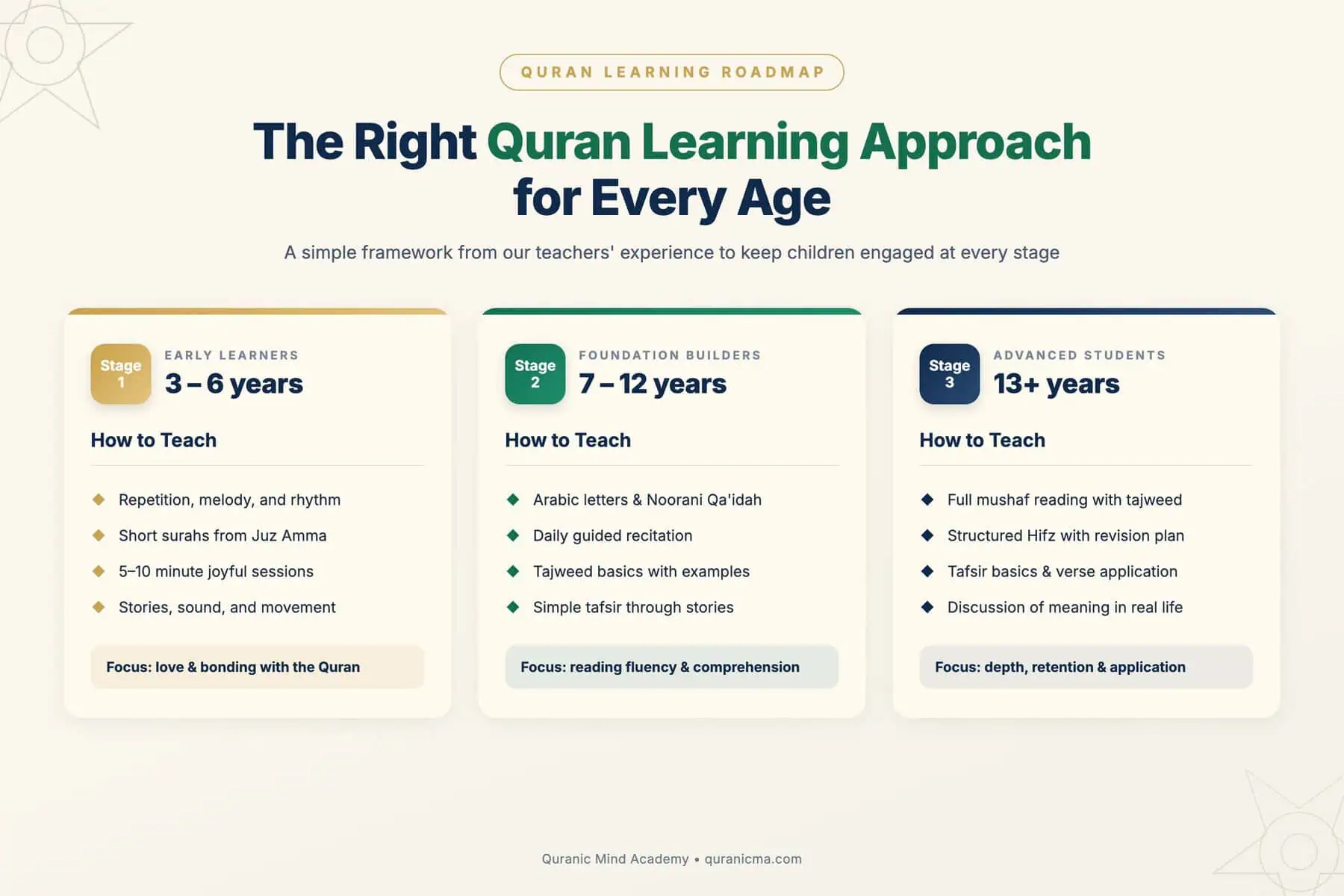
Ages 3 – 6: Love Before Letters
The single goal of this stage is bonding. The child should associate the Quran with warm voices, cuddled stories, and a bit of melody. Trying to teach the alphabet too early creates resistance.
- Sessions of five to ten minutes, no longer. Two short sessions a day beat one long one.
- Repetition of very short surahs from Juz Amma, especially Al-Fātiḥah, Al-Ikhlāṣ, Al-Falaq, and An-Nās.
- Listening together to a slow reciter such as Al-Ḥuṣarī or Al-Minshāwī while doing quiet activities.
- Stories about the Prophet ﷺ as a child, the cave of Hira, and the gentle ones from Surah Yūsuf.
If a four-year-old can recite three short surahs by heart and asks to “read like Mama and Baba,” that is success at this stage.
Ages 7 – 12: Building the Reader
This is the structural stage. The Prophet ﷺ instructed parents to begin teaching prayer at seven (Sunan Abī Dāwūd 495, graded hasan sahih by al-Albani), and Quran reading naturally fits the same window. By the end of this stage, a child should be reading directly from the Mushaf with reasonable fluency and the basics of Tajweed in place.
- Start with Noorani Qā’idah or Noor Al-Bayān to build the alphabet, vowel marks, and combination rules systematically.
- Daily guided recitation, ideally with a teacher who can hear and correct mispronunciations early. Catching errors at seven is much easier than unlearning them at fifteen.
- Tajweed introduced through real verses, not abstract rules. Idghām and ikhfā are easier to feel than to define.
- Tafsir woven in through stories: who Maryam was and why a whole surah is named after her, why Surah Al-Fīl is in the Mushaf, what Lailat al-Qadr is. Meaning sticks where rote does not.
Ages 13+: Depth and Application
By the teenage years, the goal shifts from reading correctly to living the Quran. The verses a teen recites should start to interact with the questions they are actually asking about identity, friendship, anxiety, and purpose.
- Full Mushaf recitation with refined Tajweed, including the more advanced rules of madd and qalqalah.
- Structured Hifz, broken into realistic daily targets with proper revision (murājaʿah) cycles.
- Tafsir at the level of meaning and context, not just translation. Connecting Surah Al-Kahf to peer pressure, or Surah Yūsuf to forgiveness, makes the text alive.
- Discussion. A teenager who can ask hard questions about a verse and receive thoughtful answers stays close to the Quran. A teenager forced to memorise without understanding often drifts.
Does Online Quran Learning Actually Work for Children?
For families who do not have a qualified Quran teacher locally, the honest answer is yes, with the right setup. The format is different from a masjid madrasa, but the outcomes are often better because the child gets undivided attention.
- One-to-one sessions mean the teacher hears every letter the child reads. There is no hiding at the back of a class of fifteen.
- The lesson happens in a familiar room, which lowers anxiety, particularly for younger or shy children.
- Parents can sit nearby, see what is being taught, and reinforce the same words during the week.
- Recordings, progress notes, and weekly feedback give parents a real picture of what the child is learning.
The risk with online learning is the same as with any class: a teacher who is more focused on covering material than on the actual child in front of them. Look for a programme that adjusts pace to the learner, not the other way around.
What a Structured Online Quran Programme Looks Like
A serious programme for kids should include all three of the following, regardless of age. If any are missing, the child’s progress will plateau.
1. A Reading Track
From alif bā tā to fluent Mushaf recitation. This is the spine. At Quranic Mind Academy this starts with our Noorani Qā’idah course for beginners and moves into full Mushaf reading through the Online Quran Recitation Course once the child is ready.
2. A Tajweed Layer
Tajweed is not a separate course for older children only. It is taught from the first verse a child reads, in age-appropriate doses. By 12, a student should know the rules of nūn sākinah, mīm sākinah, and madd in practice.
3. A Memorisation Track (Optional but Recommended)
Even children not aiming for full Hifz benefit from memorising Juz Amma and the most-used surahs. Our Quran memorisation classes use spaced repetition and live revision so verses do not slip away after a month.
Beyond these three, two services round out a real programme: a teacher who is qualified (Al-Azhar graduates trained in pedagogy, not just recitation), and a parent feedback loop so the family is never guessing about progress.
How to Support Your Child at Home (Even If You Don’t Speak Arabic)
Parental involvement makes a real difference to how far a child goes in Quran learning. You do not need to be a ḥāfiẓ. You need to be present.
- Pick a fixed time. Right after Maghrib or right before bed work well because the house is calmer and the child is less likely to argue.
- Sit and listen. You do not have to correct. Just being there, phone away, signals that this matters.
- Celebrate small milestones. The first surah memorised, the first time the child reads a page without tripping, the first correct idghām. Keep a simple chart on the fridge.
- Listen to the Quran together in the car or during meals. The ear learns even when the child is not actively studying.
- Read a short translation together once a week so meaning is part of the routine, not an afterthought.
- Ask the teacher each week what to reinforce at home. Two specific tasks a day are enough.
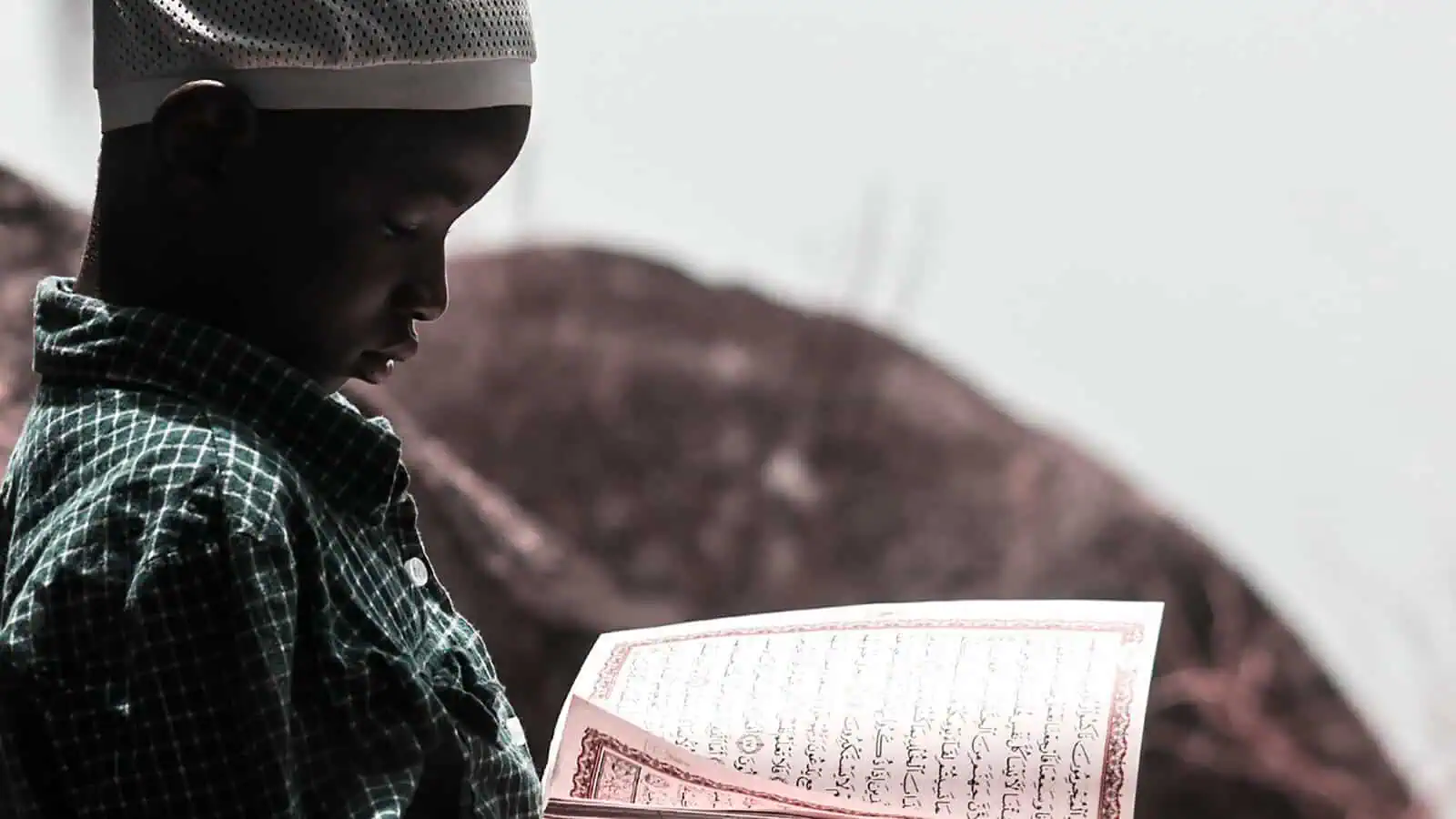
Quran Memorisation (Hifz) for Kids
Many parents wonder when to start Hifz and how to keep it sustainable. The honest answer: start small, start consistent, and never let memorisation outpace the child’s reading fluency. A child who memorises faster than they can read often loses the surahs within months. That is why our online Quran memorisation (Hifz) course sets the pace from the child’s reading level rather than a fixed number of verses.
A practical Hifz routine for a child looks like this:
- New material: three to five verses a day for younger children, one half page for older students. Recite the verse with the teacher, then with the parent, then alone.
- Daily revision: the previous day’s portion plus one earlier surah. Without this, memorisation is wasted.
- Weekly revision: all surahs from the past month, recited start to finish.
- Listening track: the child listens to the same reciter each week to anchor pronunciation. Switching reciters constantly slows memorisation.
The aim is not to finish a juz in six months. The aim is for the surahs to still be there next year, and the year after, and twenty years after that.
Why Families Choose Quranic Mind Academy
Parents who join us usually share the same frustration: they tried local options or a generic online platform and the child stalled. What works for our families is a small set of things, done consistently:
- Every teacher is an Al-Azhar graduate trained in Tajweed and child-focused pedagogy. They are vetted before they ever meet a student.
- Every child is taught one-to-one, with the lesson plan written for them and adjusted weekly.
- Female teachers are available on request for daughters who prefer them.
- Sessions are flexible across UK time zones, evenings and weekends included; the UK timetable is on our online Quran classes in the UK page.
- Two free trial classes are offered before any commitment, so the family can see how the teacher and child connect.
- Parents receive a short progress note after each lesson, with what was covered and what to revise.
If you are weighing options, our full course list covers Quran reading, Tajweed, memorisation, Arabic, and Islamic Studies, and the pricing plans are designed to fit different family budgets.
Related Guides
- Online Quran Classes for Kids — one-to-one lessons for children from age five, with a parent welcome in every lesson.
- Quran Lessons for Beginners — a beginner’s roadmap for first-time readers.
- Quran Memorisation Classes — guided Hifz with structured revision.
- What is Tajweed? — the foundation of correct Quran recitation.
- Complete Guide to Tajweed Rules — every rule explained with examples.
Frequently Asked Questions
How can I help my child learn the Quran if I don’t speak Arabic?
You don’t need to teach the lessons yourself. Your role is to keep the routine. Enrol your child with a qualified teacher, then sit through a few lessons and ask the teacher each week what to revise at home. Listening to the Quran together and showing up consistently has more impact than any worksheet.
What is the best age to start teaching a child the Quran?
Three to five is ideal for listening, melody, and short surahs. Six to seven is the right window to begin formal reading with Noorani Qā’idah. It is never too early or too late, but the child’s enjoyment is the variable that matters most.
Can children really learn the Quran online effectively?
Yes, when the format is one-to-one with a qualified teacher and there is a real lesson plan behind it. Many of our students progress faster online than they did in group classes because the teacher hears every letter and adjusts in real time.
How long does it take a child to read the Quran?
In our teachers’ experience, most children move from the Arabic alphabet to reading short surahs from the Mushaf within four to six months at three lessons a week, and reaching fluent recitation of any page takes 18 to 24 months. Pace depends more on consistency than on the child’s age.
Should my child memorise the Quran while learning to read it?
Light memorisation of short surahs is healthy from the very start. Full Hifz, where the child memorises serious daily portions, should usually wait until they can read the Mushaf with reasonable fluency. Memorising faster than reading creates fragile retention.
How do I find a trustworthy online Quran teacher for my child?
Look for verified Ijāzah or Al-Azhar credentials, experience teaching non-Arabic-speaking children, female teachers available for daughters where preferred, a written lesson plan for your child, and a free trial. If a provider can’t show all of the above, keep looking.
Start Your Child’s Quran Journey
The earliest verses a child learns become part of how they remember being a child. Make those memories warm, slow, and consistent, and the Quran becomes home.
If you’d like to see how it works for your child, book two free trial lessons with one of our Al-Azhar teachers. No commitment, no pressure, just a chance to see whether the fit is right.
Start with 2 Free Trial Lessons →
Have questions? Chat with us on WhatsApp.

2 responses
4 years old wanted to learn the Qur’an
Assalamu Alaikum Aysha,
That’s wonderful! We would love to help your 4-year-old start learning the Qur’an. 🌿✨ To make sure you find the best teacher for your child, we offer two free trial sessions where you can meet different teachers and choose the one that suits your child best.
Feel free to contact us on WhatsApp at +442070976739 to schedule the trial sessions at a time that works for you. Looking forward to hearing from you!
JazakAllah Khair. 😊