Every Hifz student starts with the same question. Not can I memorise the Quran, but how do I make it stick? The Quran is full of memorable lines and the brain is built to memorise. The hard part is the system. Most attempts fail not because the verses are difficult, but because the routine collapses around month two.
This guide is the system. It started as 25 separate techniques, and over the years we have grouped them into six pillars that Hifz students at every level can lean on. Allah Himself promises in Surah Al-Qamar 54:17, trans. Abdel Haleem: “We have made it easy to learn lessons from the Quran: will anyone take heed?” Al-Qurtubi explains that Allah made it easy to memorise and helps whoever sets out to memorise it (Tafsir al-Qurtubi on 54:17). The verse is repeated four times in the same surah. The ease is real. Your job is to show up.
The Status of the Hāfiẓ in Islam
Before the techniques, the motivation. The Prophet ﷺ said:
“The best among you are those who learn the Quran and teach it.” (Sahih al-Bukhari 5027)
And:
“One who was devoted to the Qur’an will be told to recite, ascend and recite carefully as he recited carefully when he was in the world, for he will reach his abode when he comes to the last verse he recites.” (Sunan Abī Dāwūd 1464, graded hasan sahih by al-Albani; Jami at-Tirmidhi 2914, graded hasan sahih by al-Tirmidhi)
Even for those who recite with difficulty, the Prophet ﷺ said the reward is doubled (Sahih al-Bukhari 4937, Sahih Muslim 798). The struggle itself is rewarded. None of the effort is wasted.
The 6 Pillars of Quran Memorisation
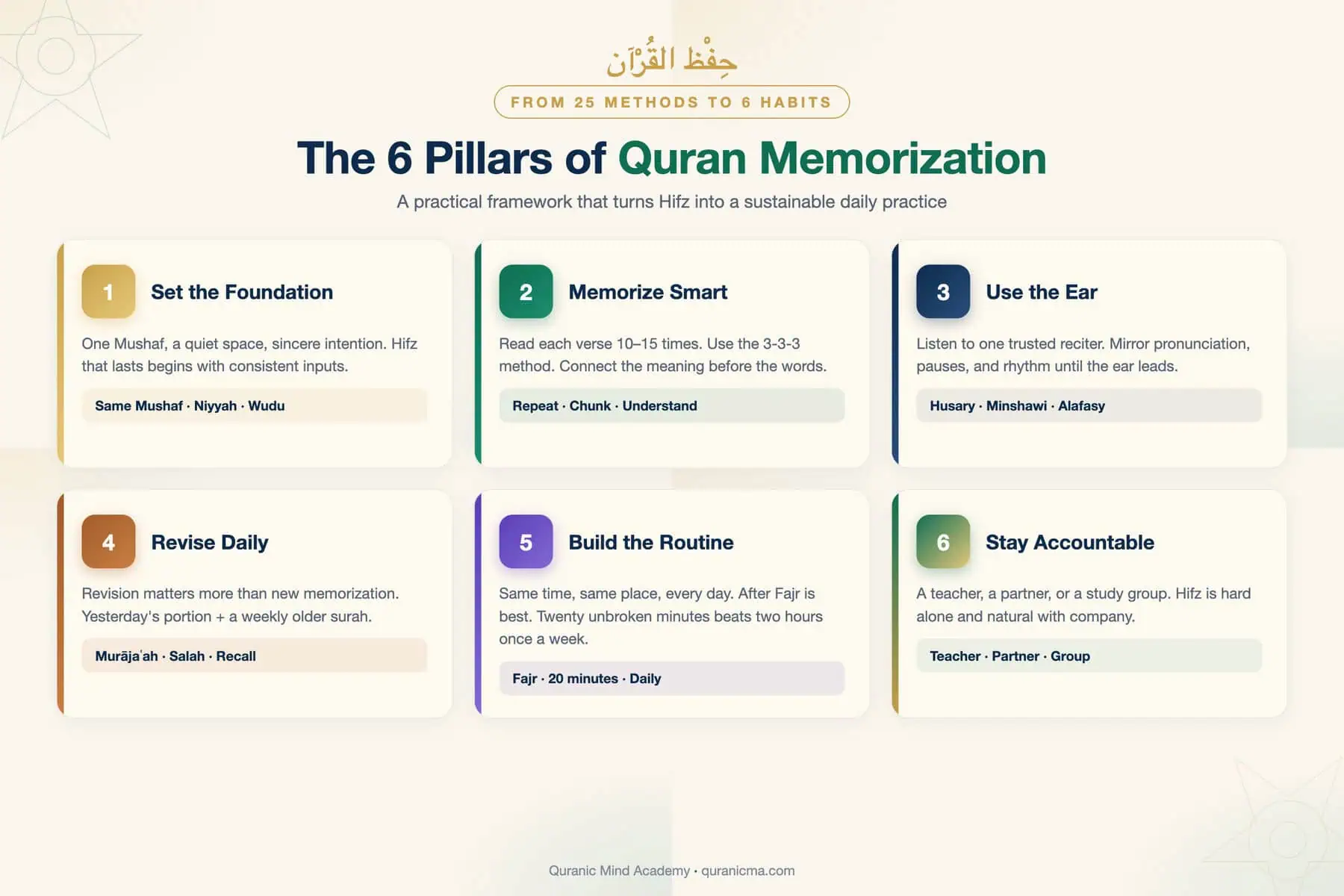
Each pillar below collapses several specific techniques into one habit. Build the six habits and the 25 techniques follow naturally.
Pillar 1: Set the Foundation
Hifz that lasts begins before the first verse is memorised. The foundation has three parts.
Use the Same Mushaf Every Day
Memorisation is partly visual. Your mind anchors verses to where they sit on the page, the colour of the script, the way the page breaks. Switching between Mushafs forces the brain to re-anchor every session, and progress slows. Pick one Madinah-script Mushaf and stay with it for the entire Hifz journey.
Renew the Intention
Hifz is one of the longest spiritual projects a Muslim takes on. The niyyah does not stay fresh on its own. Allah preserves the Quran whether or not we memorise it; the reward is in the act of memorising for His sake. Renew the intention every morning. Two seconds is enough.
Make a Quiet Space
You do not need a special room. You need a corner where you sit at the same time every day with your Mushaf, your notebook, and a phone in airplane mode. The body learns where Hifz happens, and showing up becomes automatic.
Pillar 2: Memorise Smart
The technique itself is where most students plateau. The methods that work are not glamorous. They are slow and repetitive, which is exactly why they work.
The 3-3-3 Method
A simple method that works well for many students. Take three verses. Read each one ten to fifteen times aloud. Recite all three from memory. Repeat the cycle three times in your session, and again at three points in the day (morning, afternoon, before sleep). By day’s end, those three verses are anchored.
One Verse at a Time
Quality beats quantity at every level. Read the verse aloud, slowly. Cover it. Try to recite it. Uncover, correct, repeat. Only when one verse is solid do you move to the next. Two solid verses today are worth more than five fragile verses this week.
Break Long Verses into Phrases
Many beginners stall on verses like Ayat al-Kursī or the long verses of Surah Al-Baqarah. The trick is to break by meaning, not by length. Allāh, lā ilāha illā huwa is one phrase. Al-ḥayyu al-qayyūm is another. Learn each fragment separately, then chain them.
Connect Verses
Verses fall into themes, and the brain remembers chains better than islands. After memorising a verse, ask what is the link to the verse before and after? A surah committed to memory as a chain of meaning is far more durable than the same surah memorised as 50 disconnected lines.
Visualise the Page
Many ḥuffāẓ describe Hifz as photographic. They can see where each verse begins on the page, how the line breaks, which words are red. This emerges naturally from using the same Mushaf every day. Notice it deliberately: which verse starts at the top of the page? Which ones are on the left side?
Pillar 3: Use the Ear
The ear is the original Hifz tool. The Prophet ﷺ memorised by hearing Jibrīl ʿalayhi al-salām, and his companions memorised by hearing him. Modern memorisation that ignores the ear is fighting the tradition.
Pick One Reciter and Stay
Switching between reciters is similar to switching between Mushafs. The ear has to recalibrate every time. Pick one of these slow, clear reciters and listen to them for the entire surah you are memorising:
- Maḥmūd Khalīl Al-Ḥuṣarī for the slowest, most pedagogical recitation.
- Muḥammad Ṣiddīq Al-Minshāwī for clarity and emotional depth.
- Mishary Rāshid Al-ʿAfāsī for a slightly faster modern recitation.
Listen Before, During, and After
Listen to the new portion before you start memorising so the sound enters your ear first. Read along while listening during the session. Replay the surah while doing other things during the day. Three exposures, no extra time.
Mimic Pronunciation and Pauses
Tajweed and Hifz are taught together in QMA’s online Quran memorisation (Hifz) course because they reinforce each other. The places where the reciter pauses are the natural memory chunks. The places where they elongate follow fixed madd rules, so copying their lengths exactly trains your Tajweed at the same time. Imitating both shapes a memorisation that is also tajwīd-correct from day one.
Pillar 4: Revise Daily
Revision (murājaʿah) is the part of Hifz nobody enjoys until they realise it is the only part that actually matters. The Prophet ﷺ warned:
“Commit yourself to the Qur’an, for by Him in whose Hand is my soul, it is surely more prone to break away than a camel in its bind.” (Sahih al-Bukhari 5033)
A practical revision system has three layers.
Daily: Yesterday’s Portion
Before you memorise anything new, recite yesterday’s portion three times. If it is shaky, fix it. If it is solid, move on. Five minutes.
Weekly: One Older Surah
Pick one previously memorised surah each week and recite it from start to finish. This is what stops the early surahs from quietly disappearing while the new ones get all the attention.
Use Salah as Revision
One of the best revision tools a Muslim has is the five daily prayers. Recite the surahs you have memorised in your salah, especially in voluntary prayers and witr. A long night of tahajjud with two pages of Quran is better revision than an hour at a desk.
Pillar 5: Build the Routine
Inconsistency is one of the main reasons Hifz stalls. The fix is structural.
Same Time, Same Place, Every Day
The body and brain learn rituals. If your Hifz session is always after Fajr in the same chair facing the same window, the routine carries you on days you do not feel like it.
Aim for Twenty Minutes Minimum
A common mistake beginners make is targeting an hour and then quitting after a week. Twenty unbroken minutes a day produces more in a year than three random hours a week. After Fajr is the highest-quality twenty minutes you have. The mind is fresh. There is barakah in the early hours.
Set Realistic Targets
For most adults learning at QMA, the realistic pace is three to five new verses a day with full revision. Children and teenagers who have reading fluency can usually do half a page. Aiming higher than this in week one is a common cause of Hifz burnout by week three.
Pillar 6: Stay Accountable
Hifz is hard alone and natural with company. The Prophet ﷺ never memorised the Quran in isolation. He recited to Jibrīl every Ramadan. The companions recited to each other and to him. The unbroken chain of memorisation runs through teachers, not solo learners.
A Teacher
A teacher catches Tajweed errors in real time, hears your weak spots, paces your sessions, and most importantly, hears you recite. The verses you cannot fake to a teacher are the verses that genuinely entered your memory. Our Al-Azhar Hifz teachers do this in one-to-one sessions designed around the student’s life.
A Hifz Partner
If a teacher is not yet accessible, a partner at a similar level works almost as well. Recite to each other once a week. Test each other on previously memorised surahs. Send a quick voice note when you finish a portion.
Make Duʿāʾ for Help
A line that became central in our courses is from Surah Ṭā Hā 20:114, trans. Abdel Haleem: “Lord, increase me in knowledge!” Asking Allah for the memory itself, before each session, is part of the discipline. The Quran is His; permission to carry it is granted by Him.
The Daily Hifz Session: A Worked Example
If you are new to all this, here is what a typical 25-minute morning session looks like once the system is in place:
- 0:00 – 0:30 Wudu, niyyah, two rakʿah of Sunnah if you haven’t prayed Fajr already.
- 0:30 – 5:00 Recite yesterday’s portion three times.
- 5:00 – 7:00 Listen to the new verses on your reciter of choice, while reading along.
- 7:00 – 18:00 Memorise the new verses using the 3-3-3 method.
- 18:00 – 22:00 Recite the entire new portion together with yesterday’s portion.
- 22:00 – 25:00 Recite this week’s older surah (your weekly revision target).
That is one realistic Hifz session. Repeat it five days a week and the verses compound.
Memorising as a Family
Some of the most successful Hifz students at QMA come from families where the parent and child memorise together. The parent does not need to be a ḥāfiẓ themselves. They just need to sit beside the child during the session, listen to recitation, and revise the same surahs at their own pace. How a child’s own lessons run is set out on our online Quran classes for kids page.
If you are a parent, two things help most:
- Read the same surah your child is memorising, even slowly. The shared vocabulary makes correction natural.
- Celebrate every milestone. The first surah memorised, the first juz, the first complete recitation in salah.
For families with younger children, our Learning Quran for Kids guide covers the age-by-age framework we use, and our Interactive Quran Memorisation Classes page describes the structured Hifz programme.
Common Hifz Mistakes (and How to Fix Them)
Five mistakes come up again and again with Hifz students who plateau. Catch them early.
- Memorising too fast. Half a page a day for a year produces more retained Quran than two pages a day for three months.
- Skipping revision. The early juz quietly evaporate. By the time the student notices, six months of work is gone. Daily revision is non-negotiable.
- Memorising without Tajweed. Errors memorised at this stage are very hard to fix later. Learn Tajweed alongside Hifz, not after. See our Tajweed Rules guide.
- Switching reciters or Mushafs. Both are forms of starting over. Pick once, stay.
- Memorising in isolation. Without a teacher or partner, blind spots stay invisible. Even one weekly recitation session with another person makes your memorisation far more secure.
How Long Will Hifz Take?
An honest range, based on what our teachers see at QMA:
- Children 7–12 with daily one-to-one teaching: 2 to 4 years for the full Quran.
- Teenagers 13–18 with daily teaching plus consistent revision: 3 to 5 years.
- Adults with full-time work or family: 5 to 8 years for full Hifz, often starting with focused memorisation of Juz Amma and the surahs used in salah.
Pace varies. Consistency does not. The students who finish Hifz are not the fastest. They are the ones who showed up the most days.
Why Quranic Mind Academy for Hifz
The QMA Hifz programme is built around the six pillars above. Every student gets:
- An Al-Azhar-certified teacher with experience in Hifz pedagogy, not just recitation.
- One-to-one sessions in which every verse is heard and corrected.
- A revision schedule built around the student’s surahs, with monthly checkpoints.
- Female teachers on request for daughters who prefer them.
- Flexible session times across UK time zones, including evenings and weekends, as set out on our online Quran classes in the UK page.
- Two free trial sessions before any commitment.
You can browse the full QMA course list or jump straight to the Hifz programme page.
Related Guides
- Quran Memorization Course: Structured Hifz Program
- Memorise the Quran with Tajweed Online
- Complete Guide to Tajweed Rules
- The Virtues of Reading the Quran Daily
- Learning Quran for Kids: A Parent’s Guide
Frequently Asked Questions
How long does it take to memorise the Quran?
In our teachers’ experience, 2 to 4 years is realistic for children with daily one-to-one teaching. Teens typically take 3 to 5 years. Adults with work and family commitments often take 5 to 8 years for full Hifz. Pace varies. Consistency is the variable that matters.
What is the best age to start memorising the Quran?
In our teachers’ experience, six to ten is a strong window to start, because reading fluency, memory and routine come together at that age. That said, adults memorise successfully at any age with the right system, and our online Quran classes for adults are built for exactly that. Many QMA students started Hifz in their 30s, 40s, and beyond.
Can I memorise the Quran on my own?
Technically yes. In practice, very few people finish Hifz without a teacher. A teacher catches Tajweed errors, paces the schedule, and provides accountability that motivation alone cannot sustain over 3 to 5 years.
How do I stop forgetting what I have memorised?
Daily revision of yesterday’s portion, weekly revision of one older surah, and using your memorised surahs in salah. Without revision, even strong memorisation evaporates. With it, even modest memorisation lasts decades.
Should I memorise with Tajweed from the start?
Yes. Errors memorised early are extremely hard to unlearn later. Learn Tajweed alongside Hifz from day one, not after. Our courses combine both intentionally.
I forget verses I memorised last year. Is that normal?
Completely normal, and reversible. The Prophet ﷺ described the Quran as harder to hold than camels with ropes. Restart structured revision now: a daily five-minute slot for older surahs, plus reciting them in your salah, brings them back faster than expected.
Begin Your Hifz Journey
If you are ready to start, two free trial sessions with one of our Al-Azhar Hifz teachers will give you a clear picture of your current level and a realistic plan for where to go. No commitment, no pressure.
Start with 2 Free Trial Lessons →
Have questions? Chat with us on WhatsApp.