Signing up for a Quran reading course as a complete beginner can feel daunting. Where does a course actually start if you cannot yet read a single Arabic letter? How is a lesson structured? And how do you know a course is built for genuine beginners rather than people who already know the basics? This guide answers those questions and shows what a well-designed beginner course looks like from the inside.
Everything here reflects how beginner teaching is structured at Quranic Mind Academy, where students start exactly where they are, learn one to one with a qualified tutor, and move forward at their own pace.
What a beginner course is really for
A good beginner course has one job: to take someone from not recognising the Arabic script to reading the Mushaf with confidence. It is not a casual set of videos. It is a structured path, taught in order, with a teacher correcting you along the way.
The motivation behind that path is worth keeping in mind from day one. The Prophet ﷺ said: “The best of you are those who learn the Qur’an and teach it” (Sahih al-Bukhari 5027). Every person who can read the Qur’an fluently today began as a beginner who could not. A course simply gives that beginning a clear shape.
And the effort itself is honoured. The Prophet ﷺ said: “One who is proficient in the Qur’an is associated with the noble, upright, recording angels; and he who falters in it, and finds it difficult for him, will have two rewards” (Sahih Muslim 798). The struggle of a beginner is not a weakness in the eyes of Allah. It is rewarded twice.
It is worth remembering, too, that the very first word revealed of the Qur’an was a command to read: “Read! In the name of your Lord who created” (Surah Al-Alaq, 96:1, trans. Abdel Haleem). Learning to read is not a minor task on the side of faith. It is where revelation itself began.
Why a structured course beats teaching yourself
Plenty of beginners try to learn from apps or videos alone, and a few succeed. Most do not, and the reason is almost always the same: there is no one to catch their mistakes. A mispronounced letter practised a hundred times becomes a habit that is far harder to unlearn than it would have been to learn correctly in the first place.
A structured course solves this in two ways. First, it gives you the right order, so you never find yourself stuck on verses before you can join letters. Second, it puts a teacher between you and your mistakes. The command to recite carefully comes straight from the Qur’an: “… recite the Quran slowly and distinctly” (Surah Al-Muzzammil, 73:4, trans. Abdel Haleem). That measured, accurate reading is difficult to reach without someone listening and correcting, which is exactly what a course provides and a video cannot.
What you learn, stage by stage
A structured beginner course moves through a fixed sequence. Skipping ahead is one of the main reasons learners get stuck, so a good tutor holds you to the order even when you feel impatient.
The letters and their sounds
You start with the twenty-eight Arabic letters, learning the correct sound and the point in the mouth or throat from which each one is produced. This is the foundation. A letter learned wrong here will sound wrong in every word it ever appears in, so a beginner course invests real time at this stage.
Vowels and simple combinations
Next come the short vowel marks, then the longer vowel sounds. With these in place you can begin sounding out two and three letter combinations. This is usually where progress suddenly feels fast, because the letters you already know start forming recognisable syllables.
Joining letters into words
Arabic letters change shape depending on their position in a word. Learning these connected forms is the step that turns letter recognition into real reading. Many beginner courses use a structured primer such as the Qaida Noorani to build this skill methodically before opening the Mushaf.
Reading the Mushaf and basic Tajweed
Finally you read directly from the Mushaf, with the most essential rules of Tajweed introduced gradually as you go. This is the stage most people picture when they imagine “reading the Qur’an,” but it is the destination, not the starting line. Reaching it is a genuine milestone.
What actually happens in a single lesson
People often imagine a Quran lesson as simply reading aloud while a teacher listens. A well-run beginner lesson is more deliberate than that. Each session follows a rhythm that reinforces what came before and adds something new, shown below.
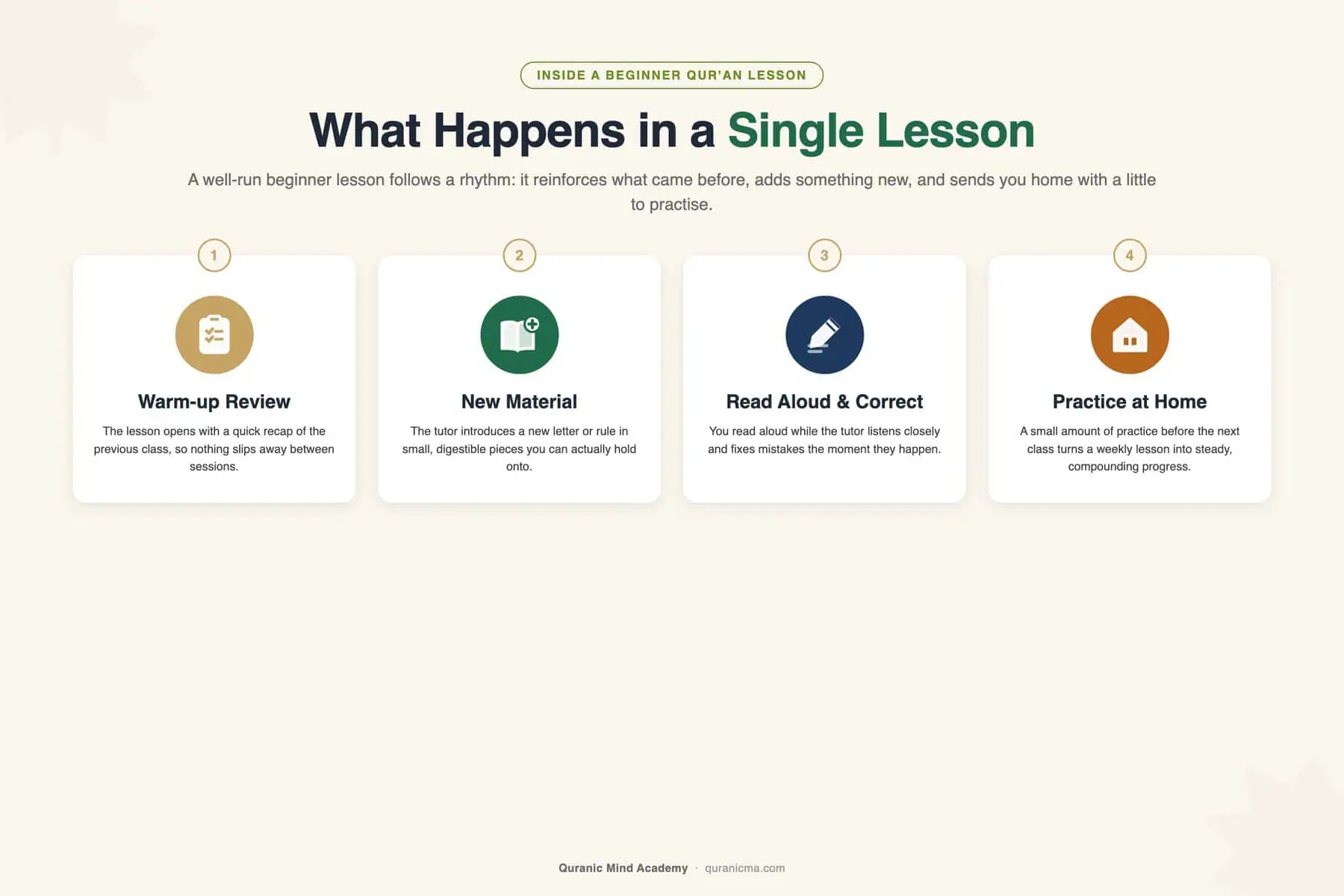
The lesson opens with a short review of the previous class, so nothing slips away between sessions. The tutor then introduces new material in small, digestible pieces. You read aloud while the tutor listens closely and corrects mistakes the moment they happen, before they harden into habits. Finally you are given a small amount of practice to do before the next lesson, which is what turns a weekly class into steady, compounding progress. This loop, repeated patiently, is how beginners become readers.
How to tell a course is genuinely for beginners
Not every “beginner” course is built for someone starting from zero. Before committing, it helps to check a few things.
It starts from the alphabet. A true beginner course assumes no prior knowledge and begins with the letters themselves, not with reading verses.
It is one to one, or close to it. Reading is a spoken skill that needs individual correction. A tutor who can hear only your voice will catch errors a crowded group class would miss.
It moves at your pace. Beginners learn at very different speeds. A good course adjusts to the student rather than pushing everyone through the same fixed timetable.
It corrects gently and consistently. The tone matters. A patient tutor who corrects without making you feel foolish is what keeps a nervous beginner coming back.
Who a beginner course is for
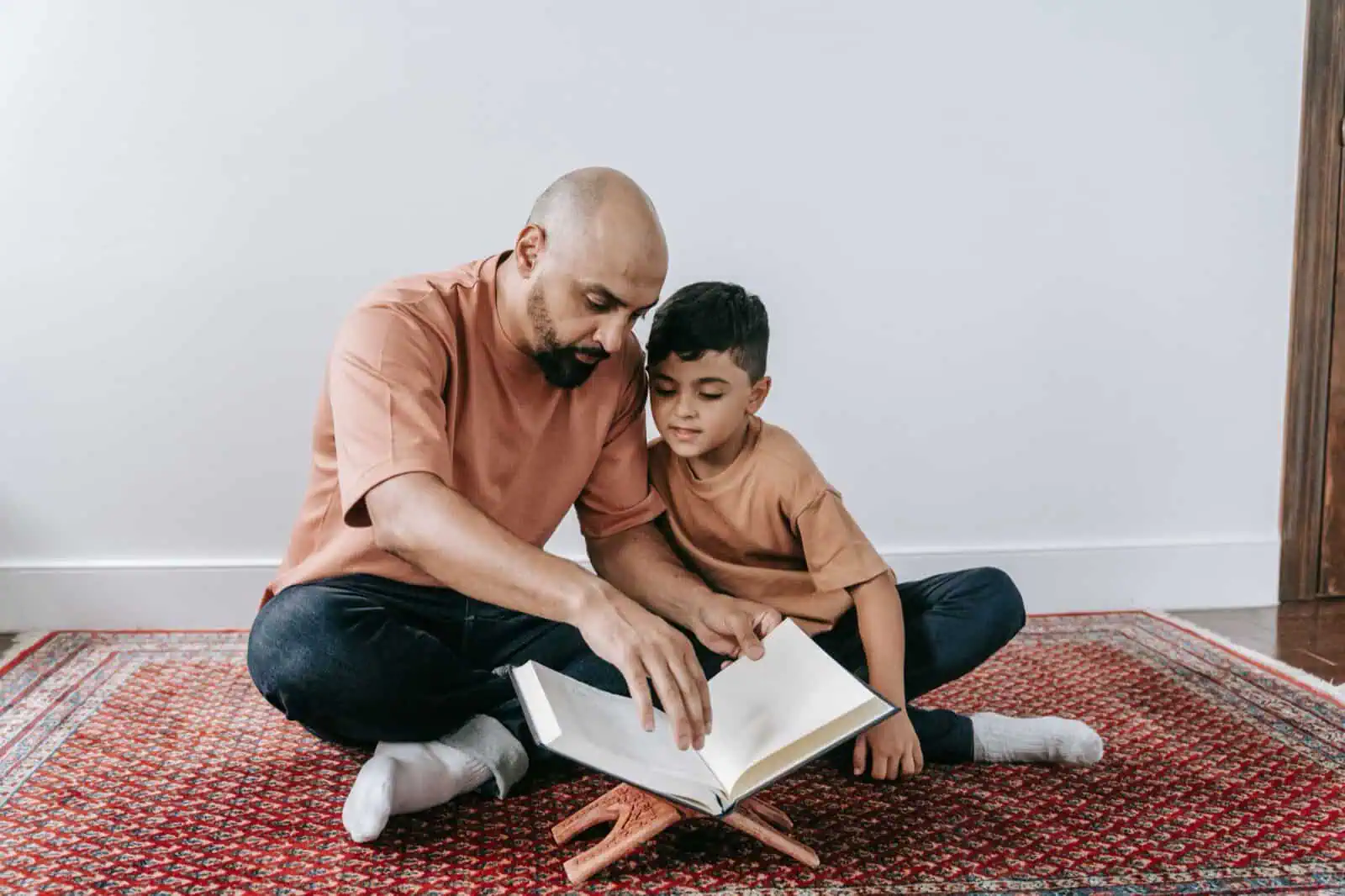
One of the quiet truths about Quran reading is that it has no age limit. Beginner courses serve young children taking their first steps, teenagers who never had the chance to learn, and adults who can pray but were never taught to read. Each group simply needs a slightly different pace and tone; what that looks like for grown-ups is set out on our online Quran classes for adults page.
Children often absorb pronunciation flexibly and benefit from playful, shorter sessions. Adults bring focus and self-motivation, and frequently progress faster than they expect, as we explain in our guide for adult learners. Whole families sometimes learn alongside one another. The reassurance from the Qur’an applies to all of them: “We have made it easy to learn lessons from the Quran: will anyone take heed?” (Surah Al-Qamar, 54:17, trans. Abdel Haleem).
How long does a beginner course take?
There is no single answer, because it depends on your starting point and how consistently you attend. In our teachers’ experience, a committed adult taking two or three lessons a week, starting from zero, can usually read simple Mushaf text within four to six months and read comfortably with basic Tajweed within a year.
The variable that matters most is not talent or age. It is consistency. Three short sessions a week will always beat one long session every fortnight, because the script fades from memory quickly at the start and regular contact keeps it fresh. A good course is built around that reality, which is one reason learning from home, as covered in our guide to reading the Quran online, suits so many beginners.
Flexible scheduling matters more than people expect. A course that lets a working parent or a busy student find a tutor at a workable hour is a course they will actually finish. Our online classes are arranged around the student’s own timetable for this reason, because the best course is the one you keep showing up to.
Frequently asked questions
Do I need to know any Arabic before starting?
No. A genuine beginner course assumes you are starting from nothing and teaches the letters from the very first lesson. Understanding the meaning of Arabic is a separate skill you can pursue later.
Can I take a beginner course entirely online?
Yes. Reading is taught very effectively through live one-to-one video lessons, where the tutor hears your voice clearly and corrects you in real time. Many beginners find this less intimidating than a classroom.
What materials do I need?
Usually just a beginner’s Qaida and a standard Mushaf, both of which a course will guide you to. Many lessons share the page on screen, so you can start your first class with nothing more than a device and an internet connection.
Is it too late for me to start as an adult?
It is never too late. Many adults begin reading the Qur’an in their forties, fifties, and beyond. The double reward for the one who finds recitation difficult is a direct encouragement to anyone who feels they are starting late.
How is progress measured in a beginner course?
Progress is tracked by what you can read unaided. A good tutor will note which letters and rules you have mastered, revisit anything shaky, and only move you on when the foundation is solid. You are not racing a syllabus; you are building a skill that has to hold.
Can children and adults follow the same course?
They follow the same sequence but at a different pace and tone. Younger learners get shorter, more playful sessions, while adults move faster through structured explanation. The underlying path from letters to fluent reading is the same for everyone.
Start your beginner course with confidence
A beginner Quran reading course is not a test you can fail. It is a patient, ordered path that countless beginners have walked successfully, starting from exactly where you are now. With the right teacher, an honest sequence, and steady practice, the script that looks impossible today becomes a page you can read.
If you are ready to begin, you can book a free trial lesson and meet a qualified tutor who will assess your level and map out a course built around your pace. The first step is the only hard one.