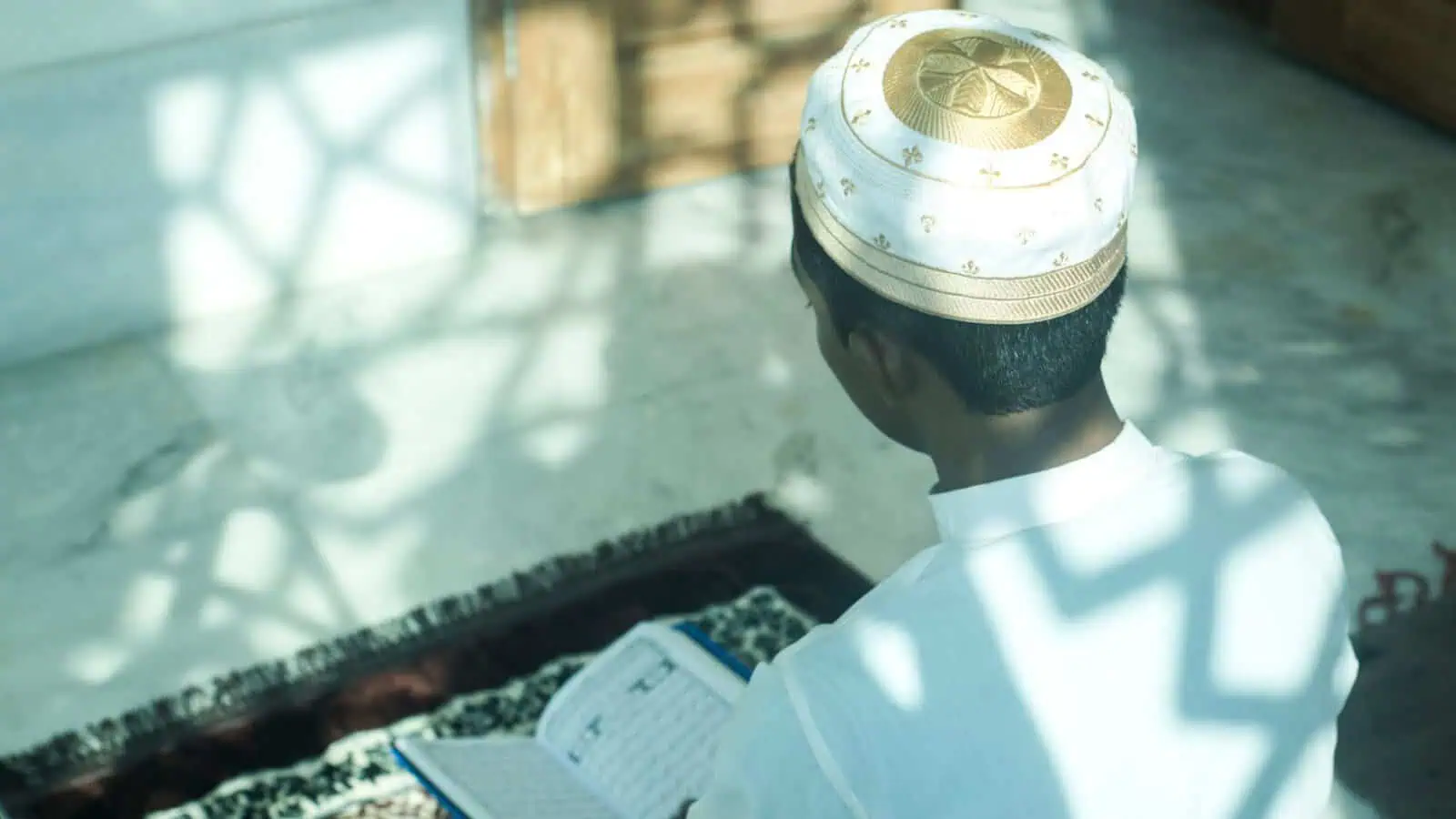
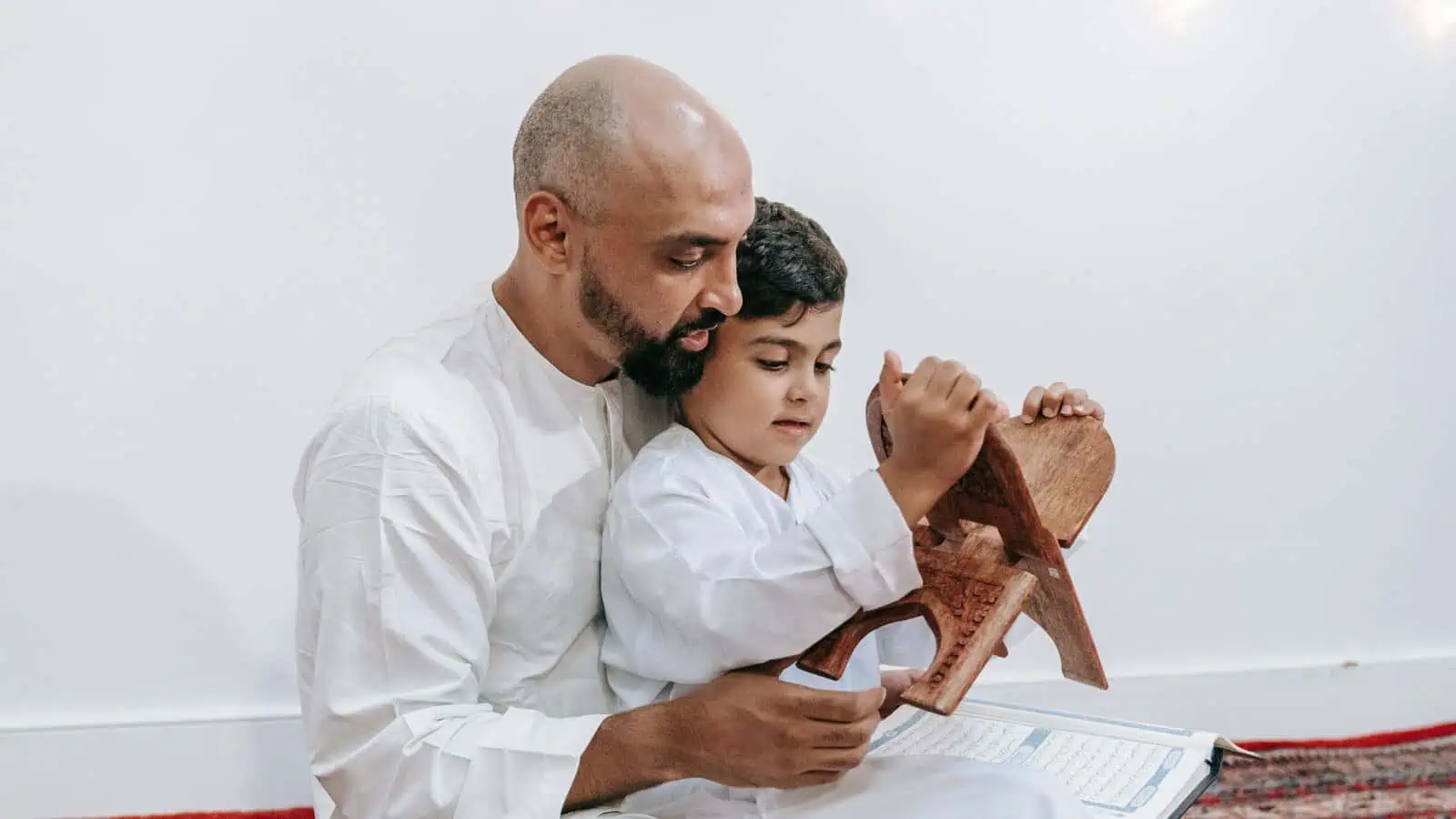
Quran memorization for kids works best when it is small, daily and kind. Most parents who ask us about it are not short of love for the Quran. They are short of a method: how much to give a seven-year-old, which surah comes first, what to do when last week’s verses have vanished, and how to help at all if they cannot read Arabic themselves. This guide answers those questions in order, with the sources behind each point and a printable tracker at the end.
It is written for parents. If you want the wider picture of how children learn to read and recite at each age, start with our guide to learning Quran for kids, then come back here for the memorisation side.
In this guide: what the earliest examples show · is your child ready? · which surahs to start with · method by age · a 15-minute daily routine · your job as a parent · rewards and motivation · revision · common problems · printable tracker · FAQ
Quran Memorization for Kids Began With the Companions
Children memorising the Quran is not a modern programme. Imam al-Bukhari gave a chapter of his Sahih the title “Teaching the Qur’an to the children”, and in it he reports from Ibn Abbas, may Allah be pleased with him: “Allah’s Apostle died when I was a boy of ten years, and I had learnt the Muhkam” (Sahih al-Bukhari 5035). In the next narration his student Sa’id ibn Jubayr asks what the Muhkam is, and Ibn Abbas answers: “The Mufassal” (Sahih al-Bukhari 5036).
The Mufassal is the final section of the Quran, the part made up of shorter surahs. Scholars differ on exactly where it begins. The Islamweb fatwa centre gives the start as Surah Qaf (50), running to Surah An-Nas at the end of the Mushaf (Islamweb fatwa 11819). So the child in this narration did not begin with the long surahs at the front of the Mushaf. He began with the short ones at the back, which is where children still begin today.
A second report shows how a child can learn. Amr ibn Salama, may Allah be pleased with him, grew up beside a road used by caravans. Travellers would recite what had been revealed, and he says: “I used to memorize that (Divine) Talk, and feel as if it was inculcated in my chest.” When his tribe later looked for the person who knew the most Quran, they “found none who knew more Qur’an than I because of the Qur’anic material which I used to learn from the caravans”, and he was “a boy of six or seven years” (Sahih al-Bukhari 4302). He learnt by listening and repeating. Nobody handed him a book.
Two practical points follow from these reports, and the rest of this guide leans on them: start from the short surahs, and let the ear lead.
وَلَقَدۡ يَسَّرۡنَا ٱلۡقُرۡءَانَ لِلذِّكۡرِ فَهَلۡ مِن مُّدَّكِرٖ
“We have made it easy to learn lessons from the Quran: will anyone take heed?” (Surah Al-Qamar, 54:17, Abdel Haleem)
In al-Tafsir al-Wasit, Sheikh Muhammad Sayyid Tantawi explains that the ease in this verse covers both memorising and understanding: the Quran was sent down clear in its wording and meaning, “easy to memorise for whoever wants to memorise it”, and he says the verse is an encouragement to memorise the Quran, take its lessons to heart and act on it. That is a helpful frame for a parent. The aim is a child who knows the words, grows into their meaning and lives by them, and memorising is the first of those three.
Is Your Child Ready to Start Memorising?
There are two kinds of memorising, and they start at different times.
Memorising by ear can begin as soon as a child can copy a short phrase. It needs no reading. The child hears a verse, repeats it and keeps it. This is how most children learn Al-Fatihah and the last few surahs, and it is how Amr ibn Salama learnt.
Memorising from the Mushaf, with a fixed daily portion and a revision plan, is what people usually mean by hifz. It goes far better once the child can read Arabic script without spelling out every word, because the page then becomes a second memory beside the ear. If your child is still on the letters, our Arabic alphabet guide for beginners and the Qaida Noorani course cover that stage.
Signs that a child is ready for a steady daily portion:
- They can sit with one task for ten minutes.
- They can repeat a short verse back correctly after hearing it three or four times.
- They already know a few short surahs from prayer or from hearing them at home.
- They can read, or are learning to read, from the Mushaf.
If only the first three are true, keep going by ear and build the reading alongside. Nothing is lost by that order.
Which Surahs Should Children Memorise First?
Start with Al-Fatihah, because your child will recite it in prayer many times a day, then work backwards from the end of the Mushaf. The last surahs are short, their verses are brief and rhythmic, and a child hears them often in prayer. Below is one common starting order. The verse counts follow the Hafs Mushaf.
| Surah | Number | Verses | Why it is an easy early one |
|---|---|---|---|
| Al-Fatihah | 1 | 7 | Recited in prayer every day, so it is revised without extra effort |
| An-Nas | 114 | 6 | Every verse ends on the same sound |
| Al-Falaq | 113 | 5 | Short verses, usually learnt as a pair with An-Nas |
| Al-Ikhlas | 112 | 4 | Four very short verses |
| Al-Masad | 111 | 5 | Five short verses |
| An-Nasr | 110 | 3 | Only three verses |
| Al-Kafirun | 109 | 6 | Repeated phrases, which also makes it a good first test of care |
| Al-Kawthar | 108 | 3 | Three verses of a few words each |
| Al-Ma’un | 107 | 7 | Seven short verses |
| Quraysh | 106 | 4 | Four verses |
| Al-Fil | 105 | 5 | A short story children remember |
| Al-Humazah | 104 | 9 | Nine short verses with a steady rhythm |
| Al-‘Asr | 103 | 3 | Only three verses |
After these, most children carry on backwards through the thirtieth juz (Juz Amma), from At-Takathur (102) up to An-Naba (78). The tracker at the end of this guide lists every surah in that order. The surahs near the start of the juz are longer, so expect the pace to slow there. That is normal.
Age-Appropriate Strategies: What Changes as Your Child Grows
The principle stays the same at every age: hear it, say it, repeat it, revise it. What changes is the size of the portion, the length of the session and how much the child can run alone. The table below is how our teachers usually pitch it. Treat the figures as starting points and let your child’s teacher adjust them.
| Age | How they learn | New portion a day | Session length | Your job |
|---|---|---|---|---|
| Under 6 | By ear only, copying a voice | One short verse, or part of one | 5 minutes, once or twice a day | Recite with them and keep it light |
| 6 to 9 | Ear first, with a finger on the Mushaf as reading grows | Two to five short verses | 10 to 15 minutes | Listen to them recite every day |
| 10 to 13 | From the Mushaf, checked against a reciter | A few lines, up to half a page | 20 to 30 minutes | Hold the Mushaf and follow while they recite |
| 14 and over | Independently, with a plan agreed with the teacher | Half a page or more, by agreement | 30 minutes or more, often split in two | Protect the time and ask about progress |
Two cautions. A bright child can often take more than the table shows, and it is tempting to let them. Hold some of that energy back for revision, because a fast start with no revision is the usual way children lose whole surahs. And a child who needs less than the table shows is not behind. The Prophet ﷺ said: “the most beloved deed to Allah is the most regular and constant even if it were little” (Sahih al-Bukhari 6464).
A 15-Minute Daily Routine You Can Run at Home
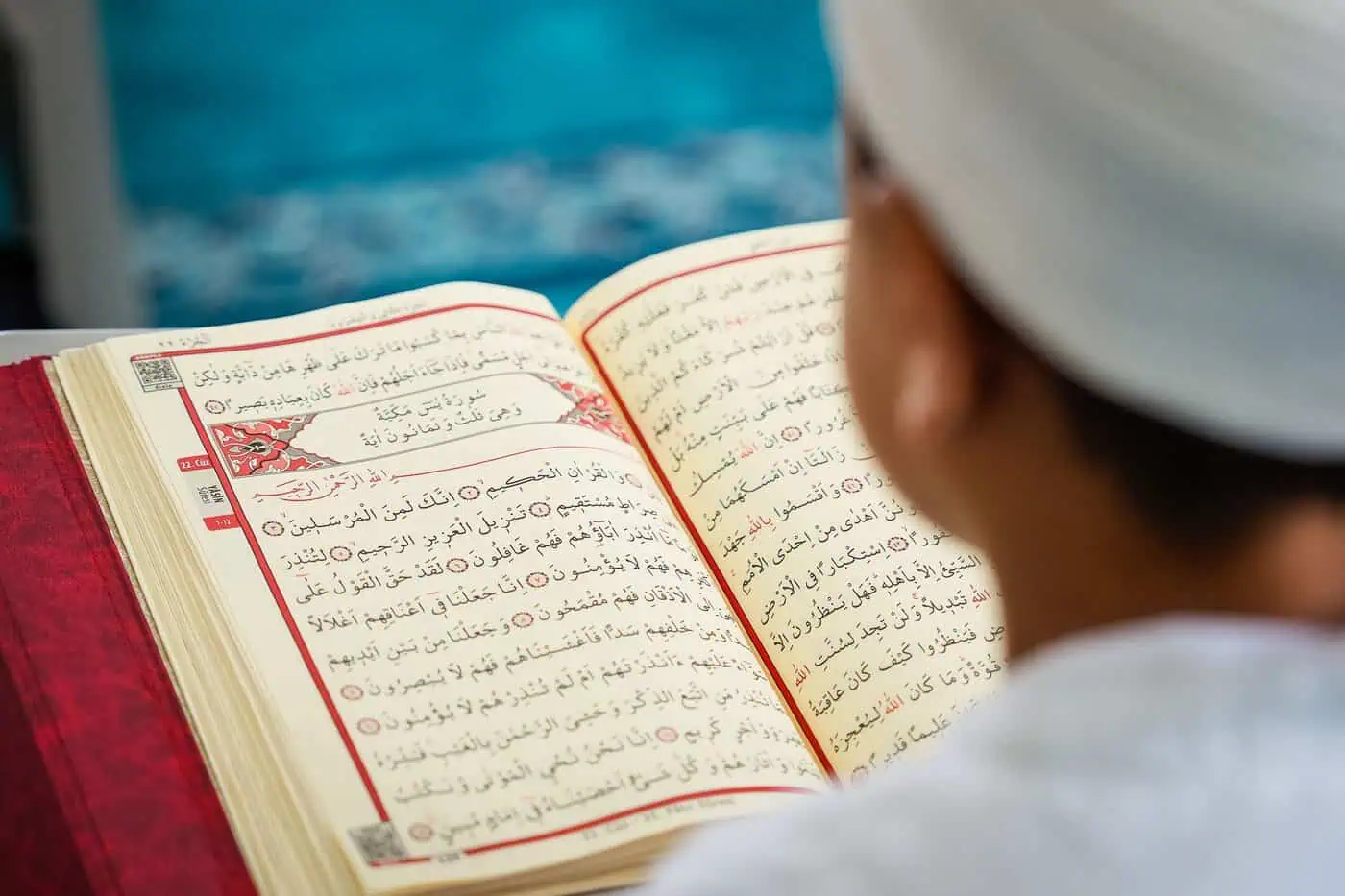
Pick one fixed slot. After Fajr or straight after school both work well, and the same slot every day matters more than which one you choose. Then follow the same four steps each time.
| Step | Minutes | What happens |
|---|---|---|
| 1. Listen | 2 | Play today’s verses three times from one reciter while your child follows with a finger or simply listens |
| 2. Repeat | 5 | Take one verse at a time. Your child says it with the recording, then without it, until it comes out smoothly. Then join it to the verse before |
| 3. Recite | 3 | Your child recites the whole new portion to you from memory, with the Mushaf closed |
| 4. Revise | 5 | Yesterday’s portion, then one older surah. End on something they know well |
For a child under six, cut this to steps 1 and 2 and stop after five minutes. For an older child the same four steps stretch to half an hour. The fuller method behind these steps, including how to link verses and how to use the page layout as a memory aid, is in our guide on how to memorise the Quran.
Keep to one reciter and one Mushaf. A child’s memory holds on to a voice and to where a verse sits on the page, and changing either means starting part of the work again. If you would like an app to loop verses or track progress, we compared the main ones in best Quran memorisation apps.
Your Job as a Parent, Even If You Cannot Read Arabic
You do not need to be a hafiz, or even a confident reader, to carry most of this. A parent has three jobs.
Guard the slot. The session happens at its time, on good days and on tired days. A shorter session still counts. A skipped one teaches the child that the Quran is what we do when nothing else is on.
Be the listener. Children memorise for an audience. Sit with them, look at them while they recite, and let them see that it matters to you. If you can follow the Arabic, follow in the Mushaf. If you cannot, play the reciter quietly alongside and listen for the places where your child’s voice and the recording part ways. Mark those places for the teacher. Leave the correcting of letters and rules to someone trained to do it.
Let them hear you with the Quran. A child who sees a parent open the Mushaf every day learns more from that than from any instruction. If you are learning yourself, say so, and let them hear you struggle and carry on. The Prophet ﷺ said: “One who is proficient in the Qur’an is associated with the noble, upright, recording angels; and he who falters in it, and finds it difficult for him, will have two rewards” (Sahih Muslim 798a). That is as true for the parent sounding out a line as for the child.
Open each session with a short supplication. The Quran itself teaches one that a child can learn in a day:
وَقُل رَّبِّ زِدۡنِي عِلۡمٗا
“…but say, ‘Lord, increase me in knowledge!'” (Surah Ta-Ha, 20:114, Abdel Haleem)
Rewards, Praise and What to Avoid
Children work for encouragement long before they can work for a distant goal. Use that.
- Praise the effort you saw. “You repeated that verse eight times and got it” does more than “clever boy”.
- Mark milestones. A finished surah deserves a moment: reciting it to a grandparent on a call, reciting it to the family after Maghrib, a tick on the tracker.
- Keep material rewards small and occasional. A sticker chart or a favourite meal at the end of a surah is fine. If every verse is paid for, the child starts to bargain.
- Tell them what they are part of. The Prophet ﷺ said: “The best among you (Muslims) are those who learn the Qur’an and teach it” (Sahih al-Bukhari 5027). Children can understand that.
What to avoid is just as important. Never use the Quran as a punishment (“go and memorise a page”). Do not compare siblings or cousins. Do not shout over a mistake. The Prophet ﷺ said: “Kindness is not to be found in anything but that it adds to its beauty and it is not withdrawn from anything but it makes it defective” (Sahih Muslim 2594a), and: “Make things easy for the people, and do not make it difficult for them, and make them calm (with glad tidings) and do not repulse (them)” (Sahih al-Bukhari 6125). When he kissed his grandson al-Hasan and a man remarked that he had never kissed any of his ten children, he replied: “Whoever is not merciful to others will not be treated mercifully” (Sahih al-Bukhari 5997). A child who links the Mushaf with a parent’s warmth will come back to it for life. One who links it with fear may stop as soon as they are able to.
A note on a popular narration. Many articles for parents quote the hadith that the parents of one who recites the Quran and acts on it will be given a crown on the Day of Judgement whose light is better than the sun’s. It is in Sunan Abi Dawud 1453, and al-Albani graded that narration da’if (weak). We mention it so you know where it stands. The reward for learning and teaching the Quran rests on stronger reports, such as the two from al-Bukhari and Muslim quoted above.
Revision: Where Children’s Hifz Is Won or Lost
Children memorise quickly and forget quickly. That is how memory works at their age, and it says nothing about their ability. The Prophet ﷺ described it for every memoriser: “The example of the person who knows the Qur’an by heart is like the owner of tied camels. If he keeps them tied, he will control them, but if he releases them, they will run away” (Sahih al-Bukhari 5031).
For a child, tying the camels means three small habits:
- Yesterday before today. No new verse until yesterday’s portion has been recited from memory.
- One older surah a day. Rotate through everything memorised so that nothing goes more than a week or two unheard.
- Use the prayer. Ask your child to recite their surahs in their own prayers, and recite them yourself when you lead at home. A surah used in prayer rarely leaves.
When the amount memorised grows past a juz, revision needs its own plan. Our Quran revision schedule sets one out, and although it was written for those who have finished, the weekly cycle in it scales down well for a child.
Common Problems and What to Try
| Problem | Likely cause | What to try |
|---|---|---|
| “I don’t want to” every day | The session is too long, too late in the day, or has become a battle | Halve the portion for two weeks, move the slot earlier, and end each session on a surah they know well |
| Forgets last week’s verses | New material is outrunning revision | Stop new verses for a few days and only revise, then restart with a smaller portion |
| Mixes up similar verses | Two passages share wording, as in Al-Kafirun | Recite the two side by side, point to the one word that differs, and have the child say what the difference is |
| Recites fast and blurs letters | Memorised from a fast recording, or racing to finish | Switch to a slower recitation and have the teacher re-check the surah before moving on |
| Stuck on one surah for weeks | The portion is too big, or the surah’s meaning is a blank | Break it into two-verse pieces and tell them in a sentence or two what the surah is about |
| Siblings compete and one gives up | Progress is being compared out loud | Give each child their own tracker and their own time with you, and praise them separately |
Where a Teacher Fits
A parent can run the daily routine. What a parent usually cannot do is hear whether each letter came from the right place and whether a stretch was held for its full length, and a mistake memorised at seven is hard to remove at seventeen. A teacher’s part is to listen to the new portion before it sets, correct it, decide when the child is ready for more, and keep revision honest.
That is how our online Quran classes for kids are arranged: one-to-one lessons with a qualified teacher who sets the portion from your child’s level, and a note after each lesson of what was covered and what to practise at home. Children who are ready for a full programme move on to the Quran memorisation (hifz) course. If you are still deciding what hifz involves as a whole, What is hifz? explains the journey from the first surah to the last.
Printable Juz Amma Tracker
We made a two-page A4 tracker for the fridge door. It lists Al-Fatihah and the 37 surahs of Juz Amma in the order children usually learn them, with the verse count for each and four boxes to tick: listened, memorised, recited to a parent, recited to the teacher.
Download the Juz Amma memorisation tracker (PDF)
Frequently Asked Questions
How many verses a day should a child memorise?
In our teachers’ experience, one short verse a day suits most children under six, two to five short verses suits ages six to nine, and older children can build towards a few lines or half a page. The right amount is whatever your child can still recite correctly the next day without help.
Which surah should my child memorise first?
Al-Fatihah, because your child will recite it in prayer every day. After that, most children learn the short surahs at the end of the Mushaf, starting with An-Nas, Al-Falaq and Al-Ikhlas and working backwards through Juz Amma.
Can my child memorise Quran before learning to read Arabic?
Yes, short surahs can be memorised by ear, by listening and repeating. A fixed daily hifz portion goes better once the child can read from the Mushaf, so teach reading alongside the early surahs.
How can I help my child memorise Quran if I cannot read Arabic?
Keep the daily slot, sit and listen while your child recites, and play one reciter so your child has a correct model to copy. Note the places where your child and the recording differ and pass them to the teacher, who can correct the pronunciation.
Should I reward my child for memorising Quran?
Praise and small, occasional rewards help, especially at milestones such as finishing a surah. Avoid paying for every verse, and never use the Quran as a punishment or compare one child with another.
What should I do when my child keeps forgetting what they memorised?
Pause new verses and spend a few days only revising, then restart with a smaller daily portion. Forgetting is expected, which is why the Prophet ﷺ compared memorised Quran to tied camels that run away when released (Sahih al-Bukhari 5031). Daily revision is the tie.
How long does it take a child to memorise Juz Amma?
It varies widely with age, reading level and how regular the practice is. In our teachers’ experience, a child who memorises a little every day and revises as they go often completes it in roughly one to two years. A steady pace that the child keeps matters more than the finish date.