
Most sisters who look for online Quran classes are not really asking whether online lessons work. They are asking something more specific: will I be taught by a female Quran teacher, will I be comfortable reciting in front of her, and will the lessons survive a week of school runs, work and everything else a household asks of me? This guide answers those questions plainly, including the fiqh question that most academy websites avoid.
It is written for women starting from any point: a mother who never learned to read Arabic as a child, a sister who reads fluently but wants her tajweed checked, a new Muslim, a woman who wants to begin memorising. If you are arranging lessons for a daughter, most of it applies to her too.
What a lesson with a female Quran teacher looks like
An online Quran lesson is a live video call between you and one teacher. There is no class of strangers, no recorded course to work through alone. You read, she listens, stops you where a letter or a rule goes wrong, models the correct sound and has you repeat it. Everything else in the lesson hangs off that loop of recite, correct, repeat.
At Quranic Mind Academy the details are these:
- One teacher, one student. Lessons are one-to-one. You are matched with a teacher before the first lesson and stay with her.
- You choose a male or female teacher when you book. Both are available. Say which you prefer when you book and you are matched accordingly.
- Two free trial lessons, with two different teachers. Each is a real thirty-minute lesson, and no card is needed. Trying two teachers lets you compare how each one explains and corrects before you commit to anyone.
- Who the teachers are. Native Arabic speakers based in Egypt, qualified at Al-Azhar and other recognised Islamic institutions, and fluent in English.
- Times that fit your week. Two to five sessions a week, at times agreed with your teacher.
- Something to show for each lesson. A short summary and homework after every session, and a progress report each month.
What changes when the teacher is a woman is mostly comfort, and comfort matters more than it sounds. Reading aloud badly in front of someone is uncomfortable for any adult beginner. Many women find it easier to stumble, ask a basic question twice, or say “I need to move this week’s lessons” to another woman. A lesson where you are relaxed is a lesson where you actually open your mouth and recite, which is the only way recitation improves.
What does not change is the standard. A female teacher corrects the same makharij, the same rules of noon and meem, the same madd lengths as a male teacher. If you want to know what those rules are before you start, our guide to what tajweed is is a good place to begin.
Can a woman recite the Quran to a male teacher?
This is the question behind a lot of searches for a female teacher, so it deserves a straight answer rather than a hint.
Egypt’s Dar al-Ifta al-Misriyyah holds that a woman’s voice in itself is not ‘awrah. Its fatwa on the question cites the hadith in Bukhari and Muslim in which the Prophet ﷺ addressed a gathering of women directly and a woman answered him aloud. It quotes Abu Zur’a ibn al-‘Iraqi: if a woman’s voice were ‘awrah, the Prophet ﷺ would not have heard it. (Dar al-Ifta, fatwa 6064)
A second fatwa deals with Quran recitation specifically. It says a woman reciting aloud in front of men who are not her mahram is permissible but disliked (makruh), and then adds that this dislike is removed by any genuine need, “such as learning, and reciting to the shaykhs”. Learning the Quran from a qualified teacher is exactly that need. (Dar al-Ifta, fatwa 3247)
What is forbidden in every case is a manner of speaking, not the voice itself. The Quran tells the wives of the Prophet ﷺ, “do not speak too softly in case the sick at heart should lust after you, but speak in an appropriate manner” (Quran 33:32, Abdel Haleem). Tantawi explains this in al-Wasit as a prohibition on softening speech into a yielding, alluring tone, and says they should speak in a natural way instead. A student reading to her teacher in her ordinary voice is nowhere near that line.
Not every jurist took the same view. In the Hanafi school, the author of al-Nawazil, quoted by Ibn al-Humam in Fath al-Qadir, held that “a woman’s tone of voice is ‘awrah”. Dar al-Ifta cites that disagreement as one of its two reasons for calling open recitation disliked rather than simply permitted, and still holds that the dislike falls away for teaching and learning.
So the ruling does not force the choice. A woman may learn from a male teacher, and a woman who would rather learn from a female teacher is making a perfectly sound choice too. That is why you choose your teacher’s gender when you book, rather than having it decided for you.
Women have always learned the Quran, and taught it
Wanting a lesson set aside for women is not new. Abu Sa’id al-Khudri reports that some women asked the Prophet ﷺ to fix a day for them, because the men were taking all of his time, and he promised them a day for religious lessons (Sahih al-Bukhari 101). Aisha, after a woman asked the Prophet ﷺ a very personal question about purification, said: “How good are the women of Ansar that their shyness does not prevent them from learning religion” (Sahih Muslim 332c).
The written collection of the Quran that Zayd ibn Thabit compiled on Abu Bakr’s instruction stayed with Abu Bakr, then with ‘Umar, and then with Hafsa, the daughter of ‘Umar (Sahih al-Bukhari 4986). The Quran’s promise of reward draws no line between the two: “I will not allow the deeds of any one of you to be lost, whether you are male or female, each is like the other [in rewards]” (Quran 3:195, Abdel Haleem).
Egypt has its own history here. The same Dar al-Ifta fatwa on women’s recitation names Egyptian women who recited in public: Sheikha Munira ‘Abduh, who recited on Egypt’s private radio stations and, the fatwa says, began reciting in 1920, and Karima al-‘Adliyya, who read the Quran on the radio up to the Second World War.
The Prophet ﷺ said, “The best among you are those who learn the Qur’an and teach it” (Sahih al-Bukhari 5027). Nothing in that sentence is addressed to men only.
Lessons during your period
Sisters often wonder about this privately and never ask, so it is worth setting out. Whether a woman may recite the Quran during her period is a question on which the schools differ.
The majority of jurists hold that a menstruating woman does not recite the Quran. The Maliki school permits her to recite while the bleeding continues, and Dar al-Ifta al-Misriyyah says that a woman who needs to recite or to handle the Mushaf for memorisation or teaching may follow the Maliki view (Dar al-Ifta, fatwa 2841). On touching the Mushaf itself, the Maliki school allows it for a woman who is learning or teaching, during the lesson (Dar al-Ifta, fatwa 6300).
In practice, a week off does not have to mean a week lost. Tell your teacher, which is one conversation many women find easier to have with another woman. The lessons can then move to what does not depend on your own recitation: listening closely while she recites the passage you are working on, tajweed theory, the Arabic behind the words, or the meaning of what you have been reading. If you are memorising and follow the Maliki view that Dar al-Ifta allows for that need, you can keep reciting.
Where to start, depending on where you are now
The right first course depends on what you can do today, not on your age or how long you have been meaning to start. Your level is checked in the first trial lesson, so you do not need to decide alone.
| Where you are now | Where to start | What the first weeks focus on |
|---|---|---|
| You cannot read the Arabic letters yet | Qaida Noorani or Noor Al-Bayan | Letter shapes and sounds, then joining letters and reading short vowels |
| You can read, but slowly and with mistakes | Quran reading and recitation | Reading directly from the Mushaf with your teacher correcting each line |
| You read fluently but have never studied the rules | Tajweed course | Makharij, the rules of noon and meem, and the lengths of madd |
| You want to memorise | Quran memorisation (Hifz) | A daily plan of new memorisation and revision, recited to your teacher |
| You want to understand what you recite | Arabic language | Vocabulary and grammar drawn from the Quran itself |
If you are a complete beginner as an adult, our guide to learning the Quran as an adult covers the early stages in more detail, and our online Quran classes for adults page explains how the adult lessons are run.
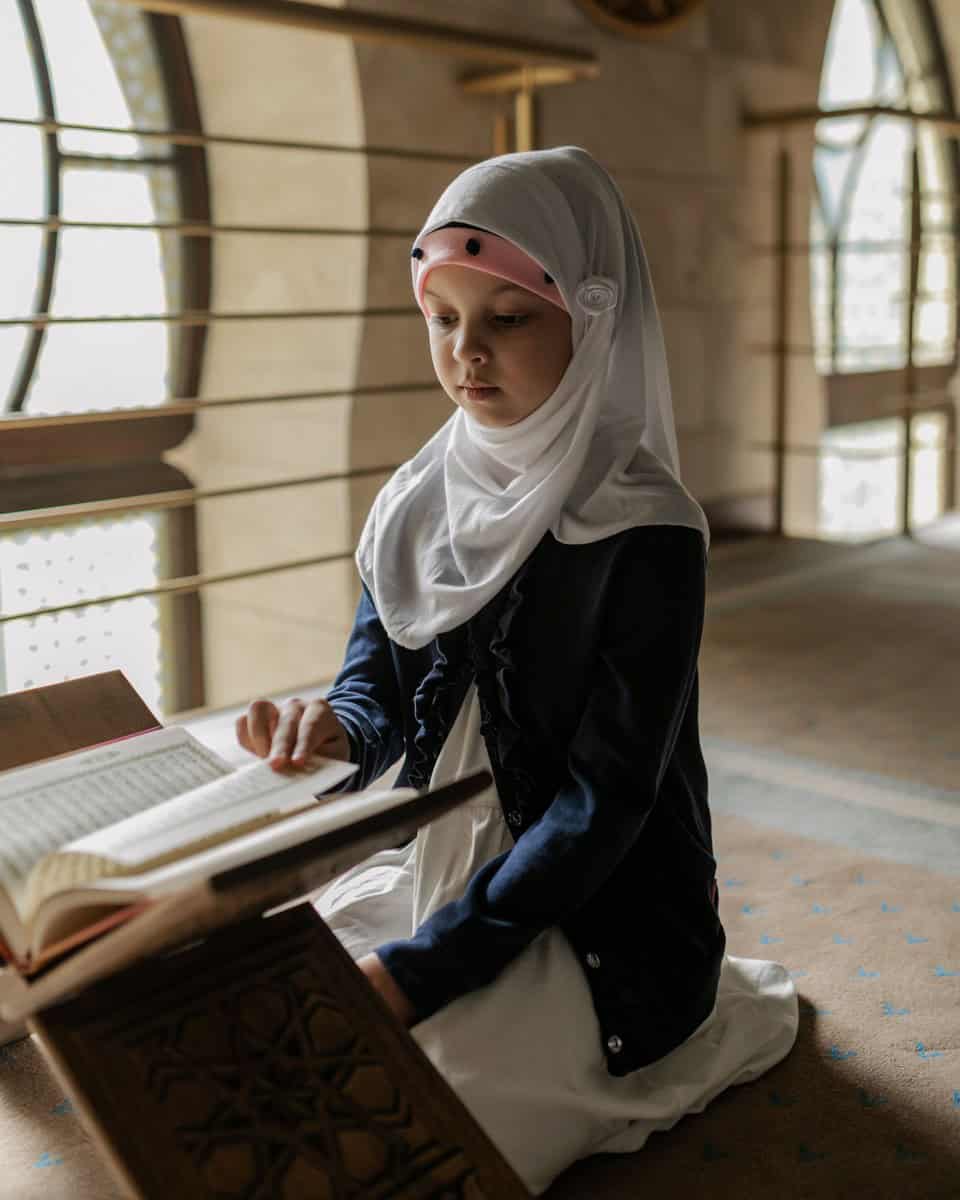
Many mothers start their own lessons and book their daughter’s alongside them.
Fitting lessons around a household
The lessons that last are the ones that fit the week you actually have, not the week you wish you had. A few things help.
Shorter and more often beats long and rare. Two thirty-minute lessons in a week, with ten minutes of practice on the days between, keeps the sounds fresh. One long lesson followed by six days of nothing means the first quarter of every lesson goes on remembering where you were.
Pick a slot you can defend. After the children’s bedtime, before Fajr, a lunch break on a working day: the best time is the one that is least likely to be taken by something else. Agree it with your teacher and treat it like any other appointment.
Learn alongside your daughter. Many mothers book their own lessons and a daughter’s at the same time. Children can learn with a female teacher too, and parents are welcome to sit in on any of their child’s lessons. Our Quran classes for kids explains how those lessons work, and our guide to learning the Quran as a child covers what to expect at each age.
Keep the Mushaf where you will see it. Ten minutes of practice happens far more often when the book is on the table than when it is on a high shelf.
How to check that a female teacher is really available
Almost every academy says it has female teachers. The useful question is narrower: which female teacher is free at the time you need, and will she stay your teacher once you enrol? An academy with female teachers on staff can answer that with a name and a slot. One that intends to “arrange something” will answer with reassurance.
Before you book anywhere, ask:
- Will my trial lesson be with the female teacher I would actually be assigned?
- Does she have availability in my time zone, at the times I have given you?
- Will I keep the same teacher every lesson, or does it rotate?
- What happens if she leaves or her timetable changes?
- What qualification does she hold, and in which recitation?
Our guide to choosing the best online Quran academy goes through these checks and others in detail. If a teacher’s qualification is new territory, what an ijazah in Quran means explains what that licence proves and what it does not.
Start with two free lessons
The quickest way to find out whether online lessons suit you is to take one. Book your two free trial lessons, mention in the comment box that you would prefer a female teacher, and tell us roughly what you can already read and which times suit you. We match you and send times to choose from. No card is needed, and you decide afterwards.
Frequently Asked Questions
Can I request a female Quran teacher online?
Yes. At Quranic Mind Academy you choose a male or female teacher when you book, and you are matched before your first lesson. At any academy, ask which female teacher has availability at the times you need, not just whether female teachers exist.
Is it permissible for a woman to learn the Quran from a male teacher?
Dar al-Ifta al-Misriyyah holds that a woman’s voice in itself is not ‘awrah, and that reciting to a teacher for the sake of learning is a need that removes any dislike of reciting in front of non-mahram men (fatwas 6064 and 3247). In the Hanafi school, the author of al-Nawazil held that a woman’s tone of voice (naghma) is ‘awrah. Many women still prefer a female teacher, and that is a sound choice.
Can I continue Quran lessons during my period?
The majority of jurists hold that a menstruating woman does not recite the Quran, while the Maliki school permits it, and Dar al-Ifta says a woman who needs to recite for memorisation or teaching may follow the Maliki view (fatwa 2841). Either way, lessons can continue with listening, tajweed theory, Arabic or tafseer that week.
Can my daughter have a female Quran teacher too?
Yes. Children can be taught by a female teacher, parents are welcome to sit in on any lesson, and teachers do not message students privately outside lesson time. Many mothers book their own lessons and a daughter’s at the same time.
Can I learn tajweed or memorise the Quran with a female teacher?
Yes. Female teachers teach every stage, from the first letters in Qaida Noorani to tajweed and memorisation. Tell us your goal when you book, and your level is checked in the first trial lesson.
How many lessons a week should I take?
Plans run from two to five sessions a week, at times agreed with your teacher. If you are fitting lessons around children or work, two shorter lessons with a little practice in between is usually easier to keep up than one long lesson.