The Arabic alphabet looks harder than it is. There are 28 letters, written from right to left, with no capital letters, and most of them change shape slightly depending on where they sit in a word. Once you see how the letters group into families, the whole system becomes far smaller than it first appears. This guide to the Arabic alphabet for beginners gives you everything in one place: a chart of all 28 letters and their forms, how the letters join, the pairs that look alike, the vowel marks, and a 30-day plan you can follow in about twenty minutes a day.
Be clear about what 30 days can do. In our teachers’ experience, a beginner who practises daily for a month can recognise every letter in every position, read the vowel marks, and sound out short vowelled words slowly. That is the foundation for reading the Quran, not the finished skill. Fluent reading from the Mushaf, with tajweed, takes longer, and we explain the next steps at the end.
The Arabic Alphabet for Beginners: Key Facts
A few facts make everything else easier to follow:
- 28 letters. They are usually taught in the order shown in the chart below, which begins alif, baa, taa, thaa.
- Right to left. Words and lines run from right to left, and a book opens from what an English reader would call the back.
- No capitals. There is only one case. What changes instead is the shape of a letter according to its position.
- Consonants first. Arabic is an abjad: the letters mostly represent consonants, and the short vowels are shown by small marks above or below them. Everyday printed Arabic often leaves those marks out, but in the Quran every vowel mark is printed, and reading them correctly is part of reading the Quran properly.
- Three letters double as long vowels. Alif, waaw and yaa also stretch the vowel before them into ā, ū and ī. That is why they appear twice in the chart’s Sound column.
Two shapes you will meet early are not counted among the 28. ة (taa marbūṭah) is a form of taa that appears at the end of words, and ى (alif maqṣūrah) is a dotless, yaa-shaped letter that is read as a long ā at the end of a word. The small sign ء is hamza, a catch in the throat like the break in “uh-oh”. In the 28-letter count, hamza shares the alif slot, and it often sits on an alif, a waaw or a yaa as its seat.
Arabic Alphabet Chart: All 28 Letters and Their Forms
Most letters have four forms: isolated (on its own), initial (start of a word), medial (middle of a word) and final (end of a word). The six letters marked “No” in the last column have only two, isolated and final, so their initial and medial cells repeat those shapes. The shape changes with position, but it is still the same letter, which is what makes the system learnable rather than a fresh alphabet at every position.
The Sound column gives the usual English transliteration. Letters with a dot under them (ḥ, ṣ, ḍ, ṭ, ẓ) mark throat or heavy sounds that English does not have, and ʿ, kh, gh and q are new to most English speakers too; all of them are explained in the section after the chart. Scroll the table sideways on a phone.
| Letter | Isolated | Initial | Medial | Final | Sound | Joins forward |
|---|---|---|---|---|---|---|
| Alif | ا | ا | ـا | ـا | ā (long a); ʾ with hamza | No |
| Baa | ب | بـ | ـبـ | ـب | b | Yes |
| Taa | ت | تـ | ـتـ | ـت | t | Yes |
| Thaa | ث | ثـ | ـثـ | ـث | th | Yes |
| Jeem | ج | جـ | ـجـ | ـج | j | Yes |
| Ḥaa | ح | حـ | ـحـ | ـح | ḥ | Yes |
| Khaa | خ | خـ | ـخـ | ـخ | kh | Yes |
| Daal | د | د | ـد | ـد | d | No |
| Dhaal | ذ | ذ | ـذ | ـذ | dh | No |
| Raa | ر | ر | ـر | ـر | r | No |
| Zaay | ز | ز | ـز | ـز | z | No |
| Seen | س | سـ | ـسـ | ـس | s | Yes |
| Sheen | ش | شـ | ـشـ | ـش | sh | Yes |
| Ṣaad | ص | صـ | ـصـ | ـص | ṣ | Yes |
| Ḍaad | ض | ضـ | ـضـ | ـض | ḍ | Yes |
| Ṭaa | ط | طـ | ـطـ | ـط | ṭ | Yes |
| Ẓaa | ظ | ظـ | ـظـ | ـظ | ẓ | Yes |
| ʿAyn | ع | عـ | ـعـ | ـع | ʿ | Yes |
| Ghayn | غ | غـ | ـغـ | ـغ | gh | Yes |
| Faa | ف | فـ | ـفـ | ـف | f | Yes |
| Qaaf | ق | قـ | ـقـ | ـق | q | Yes |
| Kaaf | ك | كـ | ـكـ | ـك | k | Yes |
| Laam | ل | لـ | ـلـ | ـل | l | Yes |
| Meem | م | مـ | ـمـ | ـم | m | Yes |
| Noon | ن | نـ | ـنـ | ـن | n | Yes |
| Haa | ه | هـ | ـهـ | ـه | h | Yes |
| Waaw | و | و | ـو | ـو | w / ū | No |
| Yaa | ي | يـ | ـيـ | ـي | y / ī | Yes |
How Arabic Letters Join
Most Arabic letters connect to the letters before and after them within a word, a bit like joined-up handwriting. A letter’s initial form leads into the next letter, its medial form joins on both sides, and its final form closes the word off.
Six letters break that pattern: ا د ذ ر ز و never connect to the letter that comes after them, even in the middle of a word. That is why a single word can appear to have a gap partway through it: the letter after a non-connector simply starts fresh. Learn these six early. They explain gaps that would otherwise look like word breaks, and they are a common reason beginners misread where one word ends and the next begins.
Here is the same letter, baa, in its four positions, so you can see how little the core shape changes:
| Position | Shape | In a word | Reads |
|---|---|---|---|
| Isolated | ب | بَابٌ | bābun (a door): the final baa follows alif, which does not join forward |
| Initial | بـ | بَيْتٌ | baytun (a house) |
| Medial | ـبـ | عَبْدٌ | ʿabdun (a servant): baa joins on both sides |
| Final | ـب | قَلْبٌ | qalbun (a heart) |
Letters That Look Alike
This is the part that actually trips people up. Several letters share the same base shape and are told apart only by the number and position of dots. ب, ت and ث are one shape: a dot below marks baa, two dots above mark taa, three dots above mark thaa. ج, ح and خ share another shape: a dot below marks jeem, no dot marks ḥaa, and a dot above marks khaa.
Six more pairs work the same way: د and ذ, ر and ز, س and ش, ص and ض, ط and ظ, ع and غ. In each pair, one letter is bare and its partner carries dots. Watch the start and middle of words too: there, ن and ي take the same tooth shape as ب, ت and ث, and ف and ق differ only by one dot or two.
Because the dots are often the only difference, practise these families deliberately rather than hoping they will sort themselves out through general reading. A useful habit: whenever you meet a tooth shape, stop and count the dots before you say the letter. It feels slow for a week, then it becomes automatic.
Sounds English Does Not Have
Most of the alphabet maps onto sounds English speakers already make. Thaa is the “th” in “think”, dhaal is the “th” in “this”, and sheen is “sh”. The rest need new habits, and this is where most beginners need a listening ear:
- Throat letters. ح (ḥaa) is a breathy h pushed from the middle of the throat, with no rasp. ع (ʿayn) comes from the same area with a tightening that has no English equivalent. خ (khaa) is close to the “ch” in Scottish “loch”, and غ (ghayn) is its voiced partner, similar to a French r.
- Qaaf and kaaf. ق is said further back in the mouth than ك. Mixing them changes words: قَلْب (qalb) is a heart, كَلْب (kalb) is a dog.
- The heavy letters. ص, ض, ط and ظ are heavier, fuller versions of s, d, t and a “th” like the one in “this”. The back of the tongue rises, and the vowel after them sounds deeper. Getting these right is what separates س from ص to an Arabic ear.
The exact point in the mouth or throat where each letter is produced is called its makhraj, and learning them precisely is part of tajweed. Our guide to tajweed rules covers the articulation points in detail. At the alphabet stage, aim to hear the difference between each pair and to make a clear attempt at it; a teacher can then refine the sound.
The Vowel Marks (Harakat)
Letters alone give you consonants. The marks tell you which vowel follows each one, or that none does. Learn these with the alphabet, not after it, because you cannot read a single word of the Quran without them.
| Mark | Name | What it does | Example |
|---|---|---|---|
| بَ | Fatḥah | A short “a” after the letter (a small stroke above) | ba |
| بِ | Kasrah | A short “i” (a small stroke below) | bi |
| بُ | Ḍammah | A short “u” (a small waaw-like curl above) | bu |
| مِنْ | Sukūn | No vowel: the letter closes the syllable (a small circle above) | min (from) |
| رَبّ | Shaddah | The letter is doubled: said twice, once closing the syllable and once with its vowel (a small “w” shape above) | rabb (Lord) |
| كِتَابٌ | Tanwīn | A doubled vowel mark at the end of a word adds an “n”: -un, -an or -in | kitābun, kitāban, kitābin |
| بَا بِي بُو | Long vowels | Alif after fatḥah, yaa after kasrah and waaw after ḍammah stretch the vowel to about twice its length | bā, bī, bū |
The difference between a short and a long vowel is not a matter of style. It can change the word, so give long vowels their full length from the first week.
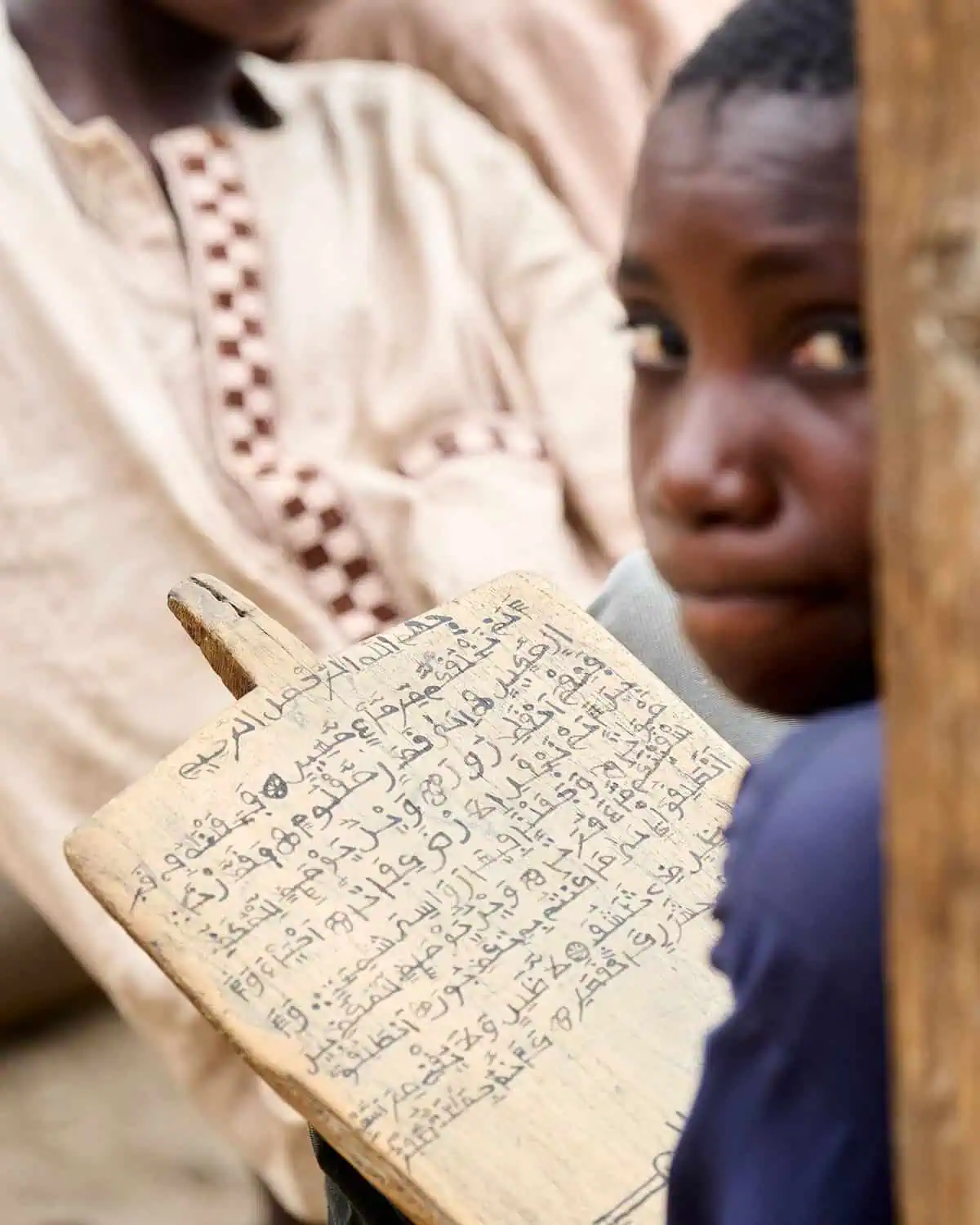
Writing the letters by hand, as on this wooden board, fixes their shapes in the memory faster than reading alone.
A 30-Day Plan to Learn the Arabic Alphabet
This plan assumes about twenty minutes a day, every day. Short daily sessions work better than one long session a week, because recognising letters is a matter of repetition. If you miss a day, carry on from where you stopped rather than trying to catch up twice over.
| Days | Focus | What to do each day | You are ready to move on when |
|---|---|---|---|
| 1 to 7 | The 28 letters in their isolated forms, taught in shape families | Four or five new letters a day. Say each name and sound aloud, write each one ten times, then mix all the letters learned so far and name them at random. | You can name all 28 in a shuffled order without checking the chart |
| 8 to 14 | Positional forms and joining | Copy each letter in its initial, medial and final forms. Join two and three letters into simple shapes. Drill the six non-connectors until you spot them instantly. | You can pick out every letter inside a joined word and say where it starts and stops |
| 15 to 21 | Short and long vowels | Read every letter with fatḥah, kasrah and ḍammah (ba, bi, bu), then with the long vowels (bā, bī, bū). Read two- and three-letter vowelled words aloud. | You can read a short vowelled word without stopping on each letter |
| 22 to 30 | Sukūn, shaddah, tanwīn and real words | Add one mark every two or three days. Finish each session by reading a short list of vowelled words, then a single short verse, slowly, with a recording to check yourself. | You can sound out an unfamiliar vowelled word correctly, even if slowly |
Some practical points make the plan work:
- Learn by shape family, not strict order. Taking ب ت ث together, then ج ح خ, then د ذ and so on lets the dots do the teaching.
- Learn the sound, not just the name. Knowing that a letter is called “jeem” is useful; knowing it says “j” is what lets you read.
- Write as well as read. Copying the letters by hand makes you notice details your eye skips, especially dots and the tails of final forms.
- Listen every day. Hearing a clear reciter or teacher say the letters trains your ear for the sounds English does not have.
- Drop transliteration as early as you can. English letters are a crutch for the first week. After that they slow you down and hide the sounds that matter.
Teaching a child? Try Letter Garden, our free Arabic alphabet game for children aged 5 to 9. Your child hears each letter’s name and taps to find it, and it plays in the browser with nothing to install.
Common Mistakes Beginners Make
Reading left to right out of habit. Especially when a word has a gap after a non-connector, the eye wants to jump. Put a finger under the word and move it right to left until the direction feels natural.
Ignoring the vowel marks. Some learners memorise letter shapes and then guess the vowels. In the Quran every mark is there for a reason, and guessing builds habits that have to be undone later.
Rushing the look-alike families. Many misreadings at this stage are dot errors, not shape errors. Slow down on teeth and bowls and count the dots.
Treating similar sounds as the same. Reading ḥaa as an English h, or qaaf as kaaf, feels like a small shortcut. It changes words, and it is much harder to fix after a year than in the first month.
Studying alone for too long. You can learn the shapes from a chart, but you cannot reliably hear your own mistakes in sounds you have never made before. A few minutes with someone who can listen saves weeks of practising an error.
Why Every Letter Counts
Learning the alphabet can feel like slow, unglamorous work. The Prophet ﷺ put a value on every single letter of the Quran. ʿAbdullah ibn Masʿud reported that he said: “Whoever recites a letter from Allah’s Book, then he receives the reward from it, and the reward of ten the like of it. I do not say that Alif Lam Mim is a letter, but Alif is a letter, Lam is a letter and Mim is a letter” (Jami’ at-Tirmidhi 2910, graded hasan by Darussalam). The same three letters, read by their names, open Surah Al-Baqarah:
الٓمٓ
“Alif Lam Mim” (Quran 2:1, Abdel Haleem). Those are three of the letters in the chart above.
The struggle of a beginner is not wasted either. ʿAishah reported that the Messenger of Allah ﷺ said: “One who is proficient in the Qur’an is associated with the noble, upright, recording angels; and he who falters in it, and finds it difficult for him, will have two rewards” (Sahih Muslim 798a; also Sahih al-Bukhari 4937). Every learner who sounds out a verse slowly, stopping and starting, is the one this hadith describes.
How to Read Arabic Once You Know the Letters
When the 30 days are done, the next stage is joining what you know into smooth reading. Most learners do this with a structured primer such as the Noorani Qaida, which moves from single letters to joined letters, then vowelled words, then the signs used in the Mushaf. Our Noorani Qaida course takes children and adults through it lesson by lesson, and our guide on how to learn to read the Quran online sets out the full path from the alphabet to fluent reading.
From there, reading the Mushaf brings in tajweed, the rules of correct recitation. Our Quran reading course for beginners explains what each stage looks like in practice. If your goal is to understand the Quran as well as read it, the alphabet is also step one of learning Arabic for the Quran, which adds vocabulary and grammar on top.
For children, the same alphabet stage looks different: shorter sessions, more games and more writing. Our guide to learning Quran for kids covers what works at each age.
Learn the Arabic Alphabet With a Teacher
A chart can show you what a letter looks like. It cannot tell you that your ʿayn sounds like an alif, or that your qaaf has drifted forward into a kaaf. At Quranic Mind Academy, lessons are one to one on live video with teachers who are native Arabic speakers in Egypt, with qualifications from Al-Azhar University and other recognised Islamic institutions. From the first lesson, someone is listening to every letter you say. You can change teacher at any time, free of charge, and every paid month is covered by our money-back guarantee.
Start with a free 30-minute trial lesson. The teacher will check which letters you already know and give you a plan for the weeks ahead.
Frequently Asked Questions
How many letters are in the Arabic alphabet?
The Arabic alphabet has 28 letters, written from right to left. Hamza shares the alif slot in that count. Two extra shapes you will see in the Quran, taa marbūṭah (ة) and alif maqṣūrah (ى), are end-of-word forms and are not counted as separate letters.
How long does it take to learn the Arabic alphabet?
In our teachers’ experience, most beginners who practise for about twenty minutes a day can recognise all 28 letters in every position and read the vowel marks within a month. Reading the Quran fluently, with tajweed, takes longer and builds on that foundation.
Is the Arabic alphabet hard to learn for English speakers?
It is different rather than difficult. The right-to-left direction, the joined letters and the dotted letter families take some getting used to, but 28 letters is a comparable load to the 26 of English. The real work is in a handful of sounds English does not have, such as ḥaa, ʿayn and qaaf, which are easiest to learn with someone listening.
Should I learn the letter names or the letter sounds first?
Learn both together, but put the sound first. The name tells you what to call a letter; the sound is what lets you read. A learner who knows that jeem says “j” and baa says “b” can start sounding out vowelled words straight away.
Can I learn the Arabic alphabet on my own?
You can learn the shapes, the joining rules and the vowel marks on your own from a chart and daily practice. The sounds are harder, because you cannot reliably hear your own mistakes in sounds you have never made before. Most learners do best with home practice plus a teacher who listens.
Do I need to learn the Arabic alphabet before reading the Quran?
Yes. The alphabet and the vowel marks are the first step in reading the Quran. After them, most learners work through a structured primer such as the Noorani Qaida, then move on to reading from the Mushaf with tajweed.