Ask a teacher why a student’s recitation sounds wrong and the answer is usually not a missing rule. It is a letter coming from the wrong place. Makharij al-huroof, the articulation points of the Arabic letters, are where tajweed really starts: the throat, tongue, lips and nose each produce particular letters, and a letter made one point too far forward can become a different letter with a different meaning. This guide goes through all 17 makharij one by one, shows you a simple test for finding any letter’s point yourself, and lists the pairs English speakers mix up most, each with a word from the Quran.
If you are new to the subject, our guide to what tajweed is gives the bigger picture first, and our tajweed rules guide has a one-table summary of the five areas. This page is the detailed version.
On this page
- What Makharij al-Huroof Means
- 17, 16 or 14 Makharij? Why the Count Differs
- How to Find a Letter’s Makhraj Yourself
- The 17 Makharij, Letter by Letter
- The Ten Family Names of the Letters
- The Letter Pairs English Speakers Mix Up
- Makharij Are Half the Picture: the Sifat
- If a Letter Will Not Come Out Right
- Frequently Asked Questions
What Makharij al-Huroof Means
Makharij is the plural of makhraj, literally “the place something comes out of”. In tajweed it has a precise meaning. ʿAbd al-Fattah al-Marsafi, in his standard reference work Hidayat al-Qari, defines the makhraj as the place where a letter appears, where the sound of saying it is cut off, so that it is distinguished from every other letter (Hidayat al-Qari, chapter 1).
He then separates two kinds of point. Most letters have a real point, which he calls a makhraj muhaqqaq: the sound rests on a definite part of the throat, tongue or lips. The three madd letters have only an estimated point, a makhraj muqaddar. They rest on nothing; their “point” is the open air inside the throat and mouth, and that is exactly why they can be stretched longer than their natural length.
Scholars put this chapter first for a reason. Near the start of his poem on tajweed, al-Muqaddimah al-Jazariyyah, Ibn al-Jazari tells reciters that before they begin, they must first know the makharij and the attributes of the letters, so that they pronounce the most eloquent of languages correctly:
إذ واجب عليهم محتم … قبل الشروع أولا أن يعلموا
مخارج الحروف والصفات … ليلفظوا بأفصح اللغات
Al-Marsafi quotes those lines and adds that the makharij and the attributes are among the most important chapters of the whole subject, because nearly every other question in tajweed comes back to them.
17, 16 or 14 Makharij? Why the Count Differs
You will see different numbers in different books, and that can look like a contradiction. It is not. Al-Marsafi sets out three positions (Hidayat al-Qari, chapter 1, section 1):
- 17 points: al-Khalil ibn Ahmad, the teacher of Sibawayh, and those who followed him, including Ibn al-Jazari. Al-Marsafi calls this the view of the majority and the one to choose. It is the count Ibn al-Jazari states in the first line of his chapter on the makharij: مَخَارِجُ الحُرُوفِ سَبْعَةَ عَشَرْ.
- 16 points: Sibawayh, followed by al-Shatibi and Ibn Burri. They drop the open-space point and place each madd letter with its relative: alif at the bottom of the throat with the hamza, the madd ya in the middle of the tongue, the madd waw at the lips.
- 14 points: al-Farra, al-Jarmi, Qutrub and Ibn Kaysan. They also give lam, noon and ra a single shared point at the tip of the tongue.
Nobody is adding or removing letters. The 28 letters (29 counting the hamza separately from the alif) are the same in every system. The only question is how finely you divide the space they come from. This guide follows the 17-point count, the majority view and the one Ibn al-Jazari chose. It also keeps lam, noon and ra apart, which helps when you are learning them.
How to Find a Letter’s Makhraj Yourself
Al-Marsafi gives a test that you can do right now. Put a sukoon (or a shaddah) on the letter, then put a hamza with any vowel in front of it, and say it. Where the sound stops is the letter’s point (Hidayat al-Qari).
Try it with a few letters:
- Say أَبْ: the sound stops when your lips close. That is the ba’s point.
- Say أَقْ, then أَكْ: feel the qaf stop at the very back of the tongue and the kaf a little further forward.
- Say أَعْ, then أَهْ: the ayn comes from the middle of the throat, the ha from its deepest point.
- Say أَضْ: the sound stops where the side of your tongue presses along your upper back teeth. That is the ḍad’s point.
Here is how the test sounds. Listen to each one, then say it yourself and feel where the sound stops.
The test does not work for the three madd letters, because they have no point where the sound is cut. Their sound simply ends when your breath ends, which is the open-space idea above.
Practice: the test for every letter
Go down the table one point at a time. Say each syllable slowly and notice where the sound stops. Letters that share a point should stop in the same place; if one of them stops somewhere else, that is the letter to work on. The madd letters (point 1) and the ghunnah (point 17) are not in the drill, because the test does not apply to them.
| Point | Say | Where the sound stops |
|---|---|---|
| 2. Throat: the deepest part | أَهْ | The bottom of the throat. Practise the ha here; the hamza is left out of this drill. |
| 3. Throat: the middle | أَعْ أَحْ | The middle of the throat tightens. |
| 4. Throat: nearest the mouth | أَغْ أَخْ | The top of the throat, the part nearest the mouth. |
| 5 and 6. Tongue: the back | أَقْ أَكْ | Qaf at the very back; kaf a little further forward. |
| 7. Tongue: the middle | أَجْ أَشْ أَيْ | The middle of the tongue rises to the hard palate. |
| 8 and 9. Tongue: the edges | أَضْ أَلْ | Dad on a side edge by the molars; lam on the front of the edges. |
| 10 and 11. Tongue tip on the gum | أَنْ أَرْ | The tip meets the gum behind the upper front teeth. |
| 12. Tip on the roots of the upper teeth | أَطْ أَدْ أَتْ | The tip presses where the upper front teeth meet the gum. |
| 13. Tip just above the lower teeth | أَصْ أَزْ أَسْ | A small gap is left, and the air whistles. |
| 14. Tip on the edges of the upper teeth | أَظْ أَذْ أَثْ | The tip touches the biting edges of the upper front teeth. |
| 15. Inner lower lip and upper teeth | أَفْ | The upper teeth rest on the inside of the lower lip. |
| 16. Both lips | أَوْ أَبْ أَمْ | Closed for ba and meem, rounded for waw. |
The 17 Makharij, Letter by Letter
The 17 points sit in five areas: the open space of the mouth and throat (1 point), the throat (3), the tongue (10), the lips (2) and the nasal passage (1). The table follows the order of Ibn al-Jazari’s poem and al-Marsafi’s explanation of it, from the deepest point to the lips.
| Point | Letters | How it is made |
|---|---|---|
| 1. Al-Jawf: the open space of the mouth and throat | ا و ي | The three madd letters only: alif after a fathah, waw with sukoon after a dammah, ya with sukoon after a kasrah. Nothing touches; the sound runs until the breath ends. |
| 2. Throat: the deepest part | ء ه | The point furthest down, nearest the chest. Hamza first, then ha. |
| 3. Throat: the middle | ع ح | The middle of the throat. Ayn and the heavy-breathed ḥa. |
| 4. Throat: the part nearest the mouth | غ خ | The top of the throat, the part nearest the mouth. Ghayn and kha. |
| 5. Tongue: the very back, against the soft palate | ق | The furthest part of the tongue rises to the roof of the mouth above it. |
| 6. Tongue: the back, a little lower and further forward | ك | Just in front of and below the qaf point. |
| 7. Tongue: the middle, against the hard palate | ج ش ي | Jeem, sheen and the ya that is not a madd letter (a ya with a vowel, or with sukoon after a fathah). |
| 8. Tongue: one side edge, against the upper molars | ض | The edge of the tongue presses along the upper back teeth, on the left side or the right. |
| 9. Tongue: the front of the edges up to the tip | ل | The front part of both edges, with the gum above the upper front teeth. |
| 10. Tongue: the tip, a little below the lam point | ن | The tip meets the gum of the two upper front teeth. |
| 11. Tongue: the tip with a little of its upper surface | ر | Close to the noon point but a touch further back on the tongue. |
| 12. Tongue: the tip against the roots of the upper front teeth | ط د ت | One point for three letters. Only their attributes tell them apart. |
| 13. Tongue: the tip just above the lower front teeth | ص ز س | A small gap is left between the tip and the teeth, which gives the whistle. |
| 14. Tongue: the tip against the edges of the upper front teeth | ظ ذ ث | The tip touches the biting edges of the upper front teeth. |
| 15. Lips: the inner lower lip with the upper front teeth | ف | The tips of the upper front teeth rest on the inside of the lower lip. |
| 16. Lips: both lips together | و ب م | Closed for ba and meem, rounded but not closed for waw (the waw that is not a madd letter). |
| 17. Al-Khayshum: the nasal passage | No letter | Only the ghunnah, the nasal hum of noon and meem. It is a sound that goes with the letter, not a letter of its own. |
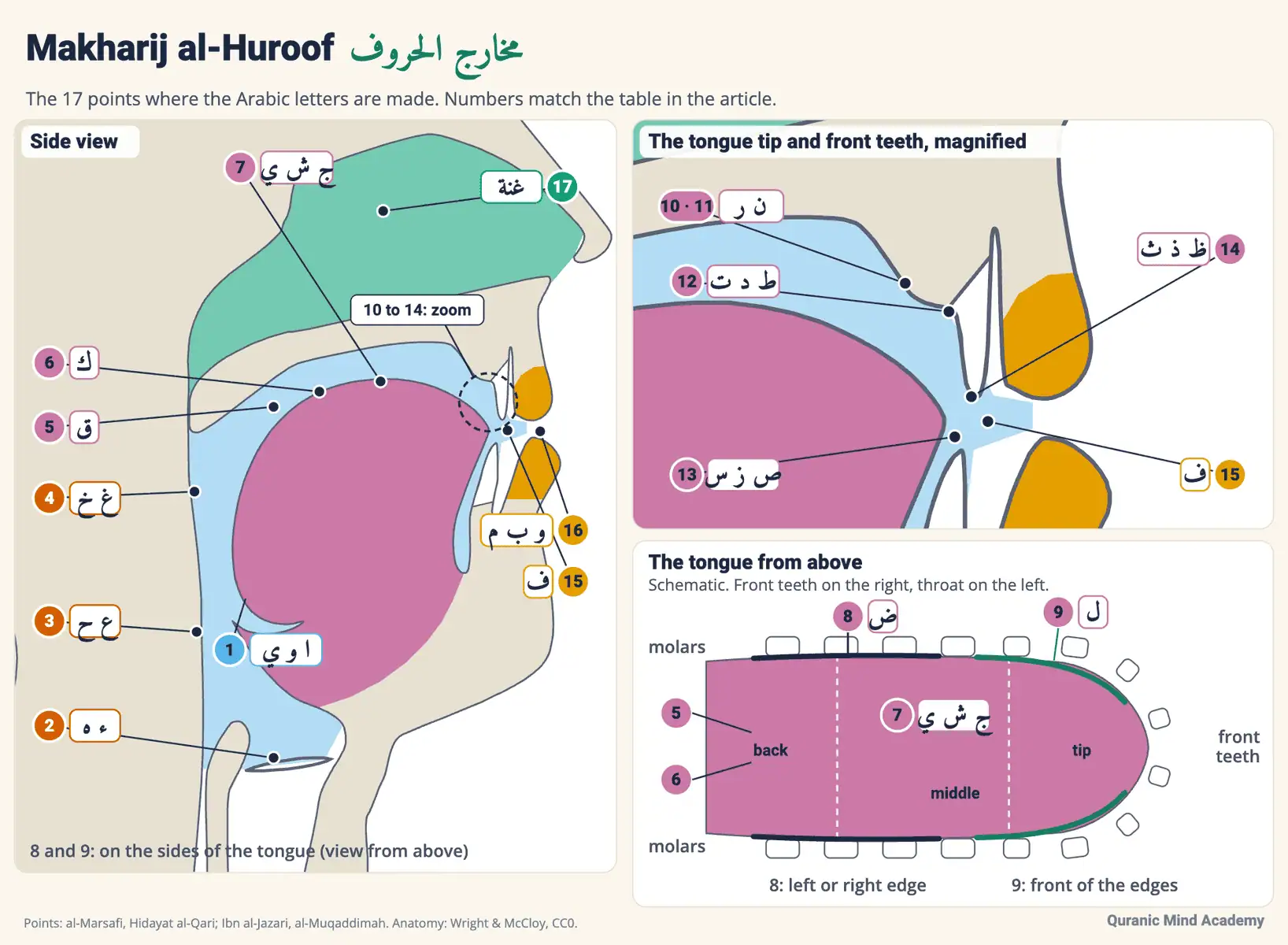
The 17 points, numbered as in the table. Points 8 and 9 sit on the sides of the tongue, so they appear in the view from above.
Prefer paper? Download the printable makharij chart (PDF): the diagram and all 17 points on one A4 page, free to print for home or class.
Two letters appear twice. Waw and ya come from the open space when they are madd letters, and from the lips (waw) or the middle of the tongue (ya) when they carry a vowel or follow a fathah. The hamza is counted separately from the alif, which is why the table covers 29 letters.
The tongue does most of the work
Ten of the 17 points are on the tongue, and al-Marsafi sums them up as four zones: its back, its middle, its edges and its tip. If you can feel those four zones, you can place every tongue letter. The tip alone carries 11 letters across five points, which is why it causes the most trouble: a few millimetres separate ta from tha, and lam from noon.
The ḍad is the letter with no English cousin
The ض is made with the side edge of the tongue pressed along the upper molars, on the left side or the right. No English sound is made like that, so English speakers tend to replace it with a heavy d or with a ظ. Listen for it at the end of Al-Fatihah, where it appears in a word every Muslim says many times a day:
صِرَٰطَ ٱلَّذِينَ أَنۡعَمۡتَ عَلَيۡهِمۡ غَيۡرِ ٱلۡمَغۡضُوبِ عَلَيۡهِمۡ وَلَا ٱلضَّآلِّينَ
“the path of those You have blessed, those who incur no anger and who have not gone astray.” (Quran 1:7, Abdel Haleem)
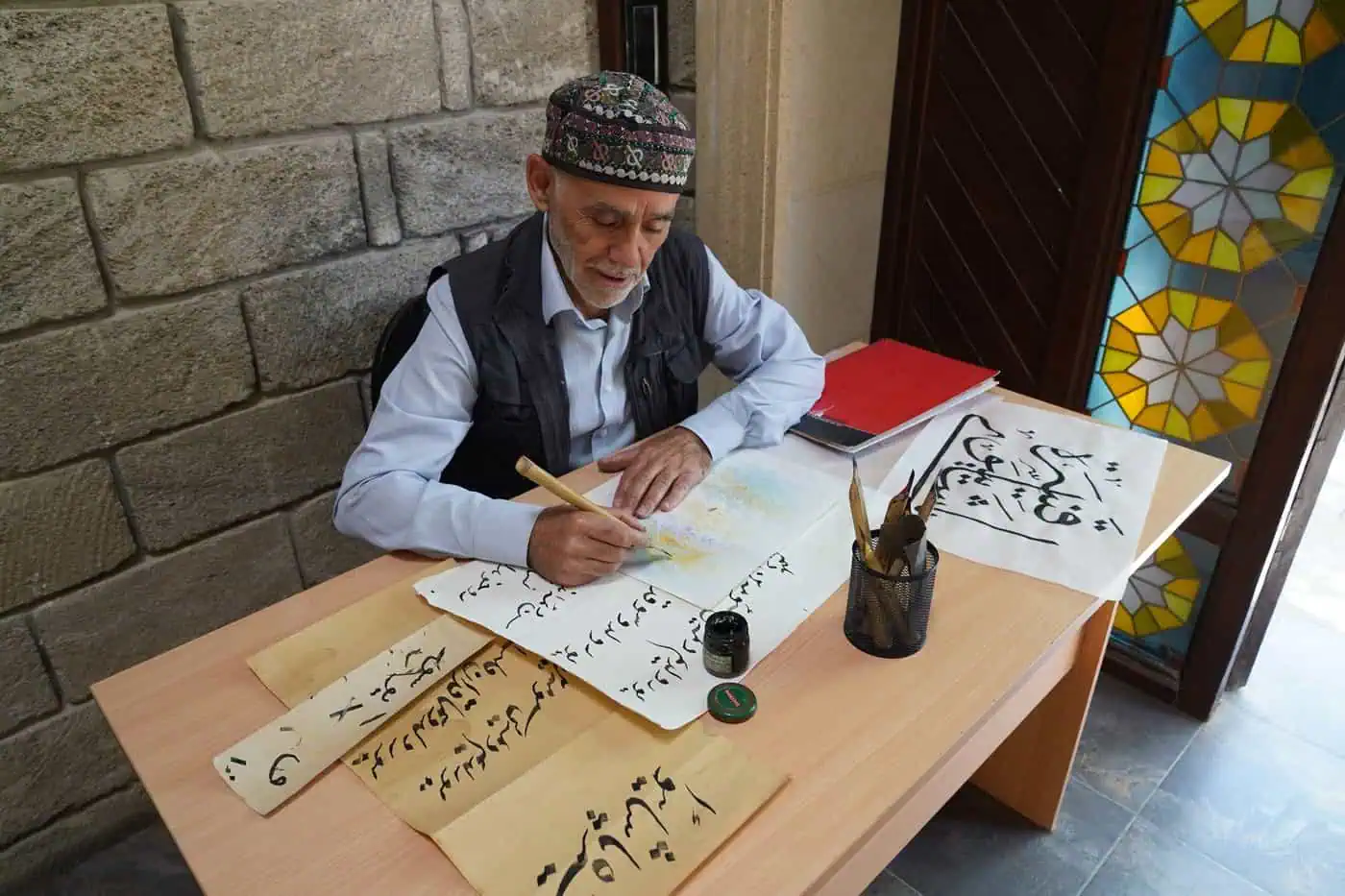
A calligrapher learns each letter’s shape one stroke at a time. A reciter learns its sound the same way, one point at a time.
The Ten Family Names of the Letters
Tajweed books also give the letters family names, taken from the place they come from. Al-Marsafi lists ten, which go back to al-Khalil ibn Ahmad at the start of his dictionary Kitab al-ʿAyn (Hidayat al-Qari, chapter 1, section 3). You will meet these names in any longer tajweed book, so they are worth knowing.
| Name | Letters | Why the name |
|---|---|---|
| Jawfiyya الجوفية | ا و ي | From the jawf, the open space of the throat and mouth (the three madd letters). |
| Halqiyya الحلقية | ء ه ع ح غ خ | From the throat (halq). |
| Lahawiyya اللهوية | ق ك | From near the lahah, the flesh that hangs over the throat (the uvula). |
| Shajriyya الشجرية | ج ش ي | From shajr al-fam, between the middle of the tongue and the palate above it. Some books count ض here too. |
| Dhalaqiyya الذلقية | ل ن ر | From dhalq al-lisan, the tip of the tongue. |
| Nitʿiyya النطعية | ط د ت | From next to the nitʿ, the ridged front of the roof of the mouth. |
| Asaliyya الأسلية | ص ز س | From asalat al-lisan, the tip of the tongue. Also called the whistling letters. |
| Lathawiyya اللثوية | ظ ذ ث | From near the gum (lithah), though not from the gum itself. |
| Shafawiyya الشفوية | ف و ب م | From the lips (shafatan). |
| Hawaʾiyya الهوائية | ا و ي | The same three madd letters, named for their air (hawaʾ), which spreads through the mouth as they are said. |
Books do not all group them the same way. Al-Marsafi notes that Ibn al-Jazari counts jeem, sheen and ya as the shajriyya letters in al-Nashr, but jeem, sheen and dad in al-Tamhid.
The Letter Pairs English Speakers Mix Up
Most mistakes in makharij are not random. They happen where Arabic has two letters and English has one sound, so the ear hears no difference and the tongue makes none. Each pair below changes the meaning of a word when it slips, and each example is a word from the Quran.
| Pair | Where each is made | Example from the Quran |
|---|---|---|
| ح and ه | Middle of the throat against its deepest point. | الْحَمْدُ and لِلَّهِ, side by side in Al-Fatihah 1:2. |
| ع and ء | Middle of the throat against its deepest point. | الْعَلِيمُ (the All Knowing, 2:32) and أَلِيمٌ (agonizing, 2:10). |
| ق and ك | The very back of the tongue against a point slightly forward and lower. | قَلْبٌ (a heart, 50:37) and الْكَلْبِ (the dog, 7:176). |
| ض and د | The side edge of the tongue on the molars against the tip on the roots of the front teeth. | الضَّالِّينَ (those gone astray, 1:7) and دَلَّهُمْ (showed them, 34:14). |
| ط and ت | The same point. The difference is heaviness, an attribute. | طِينٍ (clay, 6:2) and التِّينِ (the fig, 95:1). |
| ظ and ذ | The same point. Again, heaviness separates them. | مَحْظُورًا (restricted, 17:20) and مَحْذُورًا (to be feared, 17:57). |
The last two rows are worth a second look. Ta and ṭa come from exactly the same point, and so do dhal and ẓa. Getting the makhraj right is not enough for these. What separates them is an attribute: the heavy letters are said with the back of the tongue raised, which fills the mouth with sound, and the light ones are not. The same is true of sad and seen, which share point 13. That is where makharij hand over to sifat.
Makharij Are Half the Picture: the Sifat
Tajweed books always teach two chapters together: where a letter is made (makharij) and how it is made (sifat, the attributes). Ibn al-Jazari names both in the same breath in the lines above. The attributes cover things like heaviness or lightness, whether breath escapes with the letter, the whistle of ص, ز and س, and the bounce of qalqalah.
Our article on the science of tajweed explains how these two chapters grew into a formal discipline, and the complete tajweed rules guide covers the attributes you meet first, such as qalqalah and the heavy and light letters. If you are still learning to recognise the letters themselves, start with our Arabic alphabet guide for beginners: it is much easier to place a letter’s sound once its shape is familiar.
If a Letter Will Not Come Out Right
Almost every learner has one letter that refuses to settle: an ʿayn that comes out as a hamza, a qaf that drifts forward into a kaf, a ḍad that keeps turning into a d. That is normal, and it is not a reason to stop reading. ʿAisha reported that the Messenger of Allah ﷺ said: “One who is proficient in the Qur’an is associated with the noble, upright, recording angels; and he who falters in it, and finds it difficult for him, will have two rewards” (Sahih Muslim 798a).
What helps most is someone listening. The difficulty with makharij is that you cannot easily judge your own sound: the voice you hear inside your head is not quite the voice that comes out. You can learn the points from a table and check yourself with the hamza test, and our guide on how to learn tajweed at home is honest about how far that gets you. Correcting a letter that has been wrong for years usually needs a teacher who can hear the slip, show you where the tongue should be, and have you repeat it until it holds. Once the letters are settled, improving your recitation becomes a matter of fluency rather than repair.
That is what our online tajweed course is built around: one-to-one lessons where a teacher who is a native Arabic speaker listens to every letter. Complete beginners often start with our Noorani Qaida course, which teaches the letters and their sounds from the very first lesson.
Your first lesson with one of our qualified teachers is a free 30-minute trial, with no card needed. Every paid month after that is covered by our money-back guarantee, and you can change teacher at any time, free of charge.
Frequently Asked Questions
What are makharij al-huroof?
Makharij al-huroof are the articulation points of the Arabic letters: the exact places in the throat, tongue, lips and nose where each letter is made. The word makharij is the plural of makhraj, the place a sound comes out of. Tajweed books define it as the spot where the sound of a letter stops, which is what separates it from every other letter.
How many makharij are there?
Most scholars of recitation count 17, following al-Khalil ibn Ahmad, and Ibn al-Jazari adopts this count in his famous poem on tajweed. Sibawayh, al-Shatibi and Ibn Burri count 16 because they place the madd letters in other points, and al-Farra and others count 14 because they also give lam, noon and ra one shared point. The letters are the same in every count; only the grouping differs.
Which part of the mouth makes the most letters?
The tongue. Ten of the 17 points are on the tongue, and between them they make 18 letters: qaf, kaf, jeem, sheen, ya, dad, lam, noon, ra, ta, dal, ṭa, sad, zay, seen, ẓa, dhal and tha. The throat makes six, the lips four and the open space the three madd letters.
What is the difference between makharij and tajweed?
Tajweed is the whole discipline of reciting the Quran correctly. Makharij is one chapter of it: where each letter is made. Al-Marsafi opens his tajweed book with it, together with the sifat (the attributes of the letters), before rules such as noon sakinah, meem sakinah and madd.
Should I learn makharij before the other tajweed rules?
Yes, if you can. Near the start of his poem, Ibn al-Jazari says that reciters must first know the makharij and the attributes of the letters before anything else, and al-Marsafi calls these two chapters among the most important in the whole subject. Rules such as idgham or ikhfa only make sense once each letter is coming from the right place.
Which Arabic letters are hardest for English speakers?
The throat letters ع, ح, غ and خ, because English makes almost nothing that deep; ق against ك; ض, which has no English equivalent at all; and the heavy letters ص, ط and ظ, which share a point with lighter letters and differ only in how the tongue is held. Each pair can change the meaning of a word when it slips.
Can I learn makharij on my own?
You can learn where each letter belongs and use the self-test of putting a hamza before the letter with a sukoon on it. What is hard to do alone is judge your own sound, because the voice you hear inside your head is not quite the voice others hear. A teacher who listens and corrects in real time closes that gap far faster than recordings alone.
What is the difference between makharij and sifat?
Makharij tell you where a letter is made. Sifat (the attributes) tell you how it is made: heavy or light, with breath or without, with a whistle, a bounce or a hum. Letters that share a point, such as ط, د and ت, are told apart only by their sifat, so you need both to recite correctly.