
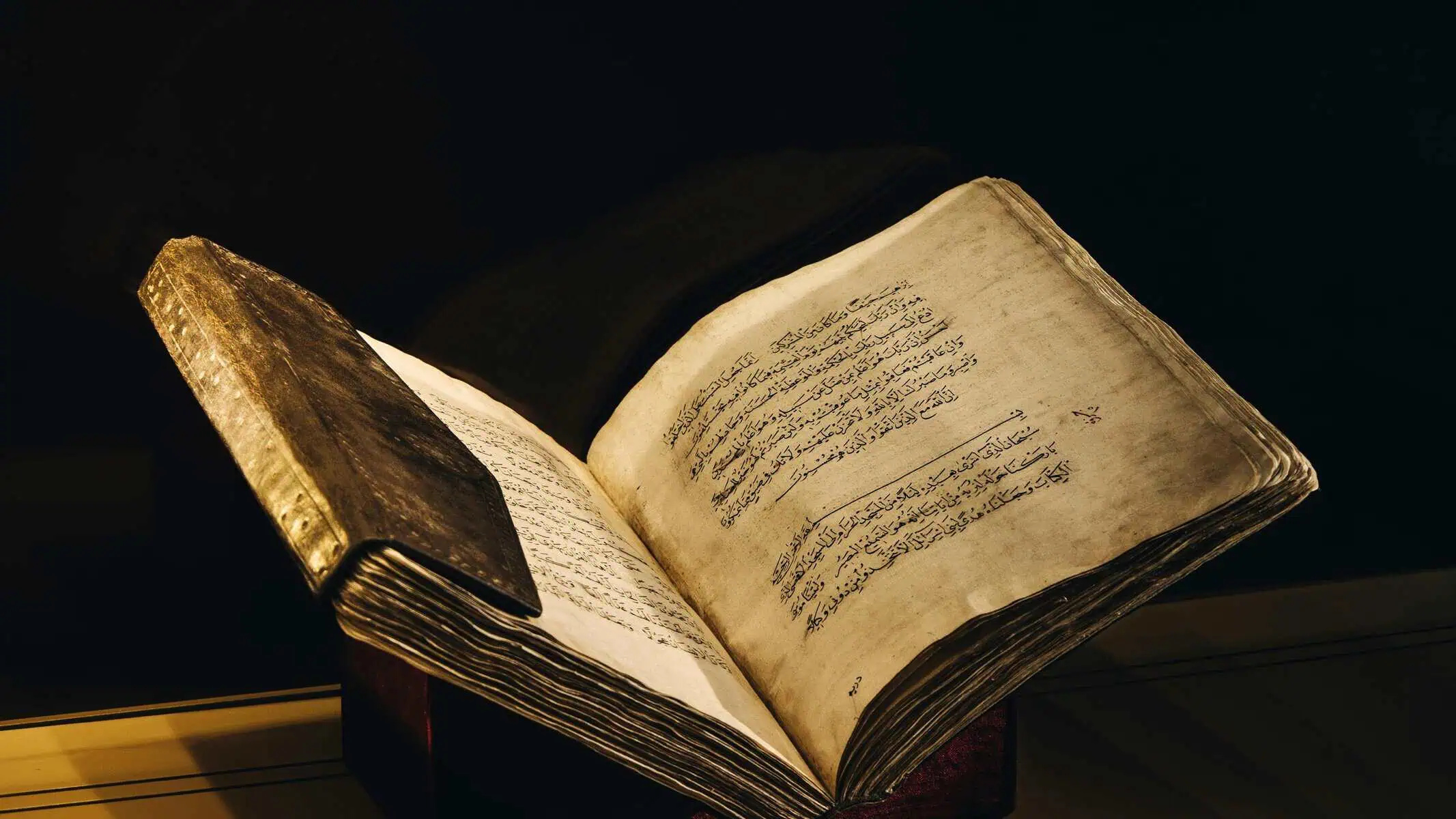
“Tajweed” gets used loosely. For most students, it means the rules of pronunciation: where to elongate, where to nasalise, which letters are heavy, which are light. That is true, but it is only one layer of a much older discipline.
The science of Tajweed (ʿilm al-tajwīd) is the formal academic field that codifies how the Quran is recited the way it was revealed. It includes the practical rules, but it sits on top of a 1,400-year chain of teachers and students that traces, person by person, back to the Prophet Muhammad ﷺ and to Jibrīl ʿalayhi al-salām before him. No other text in human history has been preserved with this much care.
This guide is the umbrella view: the history of Tajweed as a discipline, the scholars who built it, the seven and ten canonical readings, and why every Muslim today benefits from understanding the science even if they only ever read in one style. For the practical rule-by-rule mechanics, see our Complete Guide to Tajweed Rules; for a one-paragraph definition, see What is Tajweed?.
What “Science of Tajweed” Actually Means
The word tajwīd (تجويد) comes from the Arabic root j-w-d, meaning “to make excellent.” Linguistically, it is the act of beautifying or perfecting something. Technically, in Quranic studies, it refers to giving every letter its full right (ḥaqq) and due (mustaḥaqq) during recitation: correct articulation point, correct duration, correct attributes, correct interaction with the letter that follows.
The science layer adds three things on top of the practical rules:
- The transmission (isnād) — the chain of teachers connecting any qualified reciter today to the Prophet ﷺ.
- The qirāʾāt (canonical readings) — the slightly different but all authentic ways the Prophet ﷺ recited the Quran, preserved by named teachers across early Islamic history.
- The theoretical literature — the books and poems that codify the rules in writing, especially the works of Ibn al-Jazarī.
Without the science layer, “rules of pronunciation” is just a list. With it, those rules become part of the most rigorously preserved oral tradition in the world.
The 1,400-Year Chain: How Tajweed Survived
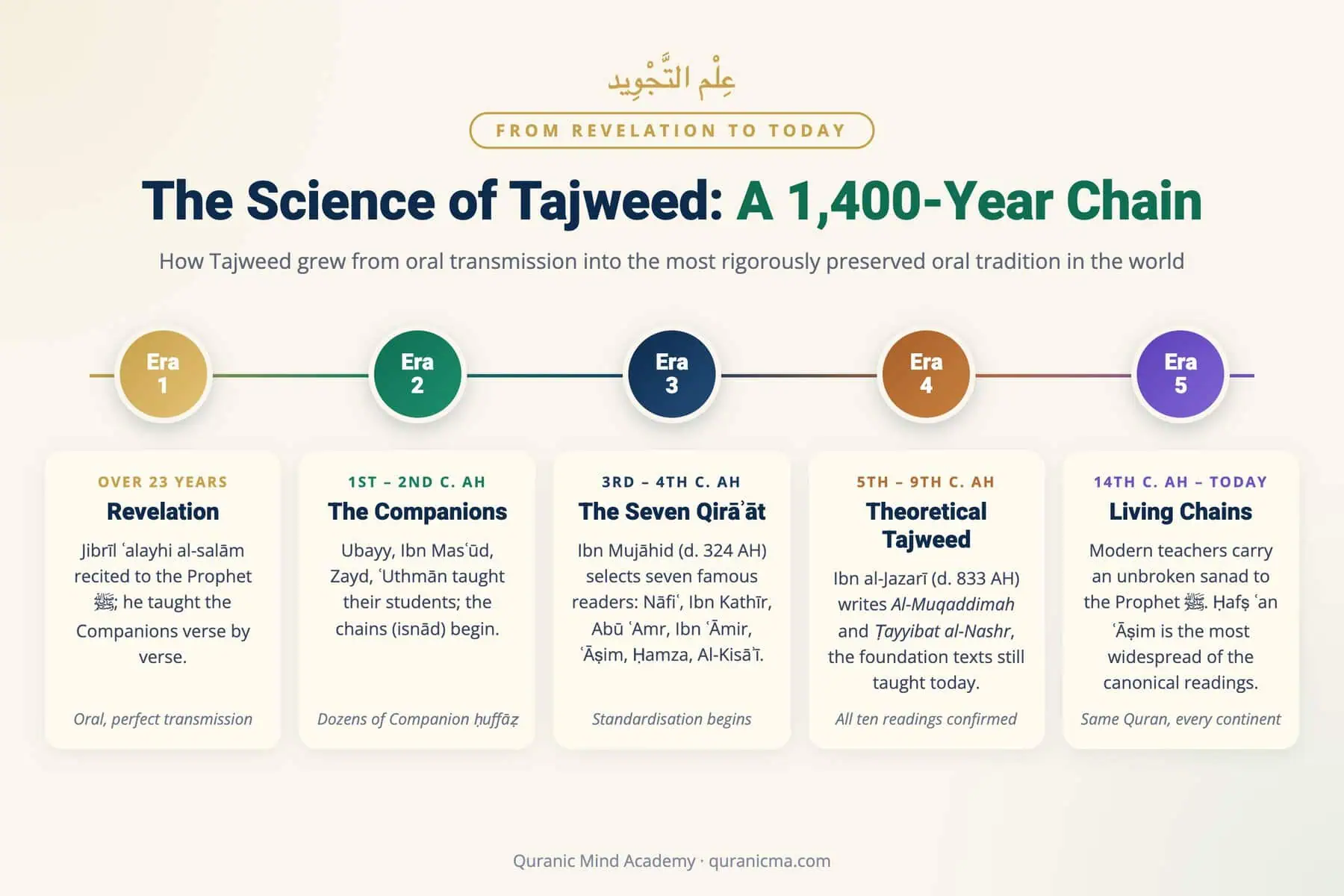
Era 1 — Revelation
The Prophet ﷺ received the Quran from Jibrīl ʿalayhi al-salām verse by verse over twenty-three years. Allah Himself describes the manner in Surah Al-Qiyāmah 75:16-18, trans. Abdel Haleem: “[Prophet], do not rush your tongue in an attempt to hasten [your memorization of] the Revelation: We shall make sure of its safe collection and recitation. When We have recited it, repeat the recitation”. The Prophet ﷺ recited each verse as he received it; the Companions memorised it from his lips. Recitation was oral, perfect, and witnessed.
The Prophet ﷺ also presented the Quran back to Jibrīl every Ramadan, and twice in the final year of his life, ensuring the entire text was reviewed and confirmed. Jibrīl’s nightly study with him in Ramadan is documented in Sahih al-Bukhari 6, and the double review in his final year in Sahih al-Bukhari 4998.
Era 2 — The Companions and Tabiʿīn (1st–2nd century AH)
By the time of the Prophet’s death ﷺ, dozens of Companions had memorised the entire Quran. The most famous reciters among them were Ubayy ibn Kaʿb, ʿAbdullāh ibn Masʿūd, Zayd ibn Thābit, ʿUthmān ibn ʿAffān, and ʿAlī ibn Abī Ṭālib. Each of them taught circles of students, and the chains began.
The Prophet ﷺ specifically named four primary teachers:
“Take the Quran from four: from ʿAbdullāh ibn Masʿūd, Sālim mawlā Abī Ḥudhayfah, Muʿādh ibn Jabal, and Ubayy ibn Kaʿb.” (Sahih al-Bukhari 3808)
Their students became the Tabiʿīn, who passed the recitation forward. The science was still entirely oral, but each chain was named and traceable.
Era 3 — The Seven Qirāʾāt (3rd–4th century AH)
By the time the chains had multiplied across the Muslim world, slight regional differences emerged in pronunciation that were all genuine recitations of the Prophet ﷺ but came through different teaching lineages. The early scholars worried about confusion and began the work of codification.
Imām Ibn Mujāhid (d. 324 AH) is the central figure here. In his book Kitāb al-Sabʿah fī al-Qirāʾāt, he selected seven famous readers from the great cities, each widely agreed to be precise and reliable (islamweb fatwa 425158). Scholars such as Makkī, al-Dānī and later Ibn al-Jazarī set out the three conditions every authentic reading must meet: a sound chain back to the Prophet ﷺ, agreement with the ʿUthmānic Mushaf, and agreement with Arabic grammar (Ibn al-Jazarī, al-Nashr). The seven became the canonical qirāʾāt:
- Nāfiʿ al-Madanī (transmitted today through Warsh and Qālūn)
- Ibn Kathīr al-Makkī
- Abū ʿAmr al-Baṣrī (transmitted through Al-Dūrī and Al-Sūsī)
- Ibn ʿĀmir al-Shāmī
- ʿĀṣim al-Kūfī (transmitted through Ḥafṣ and Shuʿbah)
- Ḥamza al-Kūfī
- Al-Kisāʾī al-Kūfī
Three more readings, those of Abū Jaʿfar, Yaʿqūb and Khalaf, complete the famous ten. Works on the ten existed long before Ibn al-Jazarī (d. 833 AH), such as Ibn Mihrān’s (d. 381 AH) al-Ghāya fī al-Qirāʾāt al-ʿAshr; Ibn al-Jazarī confirmed that all ten are mutawātir (islamweb fatwa 134670). These are also fully canonical and used in different parts of the world today.
Era 4 — Theoretical Tajweed (5th–9th century AH)
The earlier generations transmitted the rules through practice. From the 5th century onwards, scholars began writing systematic treatises so the rules could be taught at scale.
The towering figure of this era is Imām Ibn al-Jazarī (d. 833 AH). His two foundational works are still memorised by serious Tajweed students today:
- Al-Muqaddimah al-Jazariyyah — a poem of just over a hundred lines covering the essentials of Tajweed (makhārij, ṣifāt, the rules of nūn sākinah, mīm sākinah, madd, and waqf).
- Ṭayyibat al-Nashr fī al-Qirāʾāt al-ʿAshr — a 1,000-line poem covering the ten canonical readings in detail.
Other major works include the Ḥirz al-Amānī (Shāṭibiyyah) by Imām Al-Shāṭibī (d. 590 AH), still the standard text for the seven readings. These books did not invent new rules; they encoded what had already been transmitted orally for centuries, so it could not be lost.
Era 5 — Living Chains (Today)
Walk into a serious Tajweed class today, in Cairo, Karachi, Birmingham, or São Paulo, and you are sitting at the end of a chain that has not been broken in over fourteen centuries. Most reciters in the modern world recite via Ḥafṣ ʿan ʿĀṣim, the most widespread of the canonical readings. Other regions preserve Warsh ʿan Nāfiʿ (much of North Africa), Qālūn ʿan Nāfiʿ (parts of Libya), and others.
A qualified teacher today can usually recite their sanad: the names of the teachers between them and the Prophet ﷺ. At Quranic Mind Academy, all our Tajweed teachers are Al-Azhar graduates.
Why Tajweed Is a Religious Obligation
Most Sunni scholars classify the application of Tajweed as farḍ ʿayn — personally obligatory on every Muslim — at the level of avoiding mistakes that change the meaning of the Quran (laḥn jalī). At the finer level (laḥn khafī: errors such as a short madd or a missing ghunnah), scholars differ, as explained below.
The basis is in the Quran itself:
“…recite the Quran slowly and distinctly” (Surah Al-Muzzammil 73:4, trans. Abdel Haleem)
Tartīl means reciting in a measured, clear and unhurried way. Scholars differ on how much this verse requires. Every reciter must avoid errors that change the words (laḥn jalī). Ibn al-Jazarī and the Tajweed scholars cite this verse and hold that applying the full rules is also obligatory; in his Muqaddimah he calls taking up Tajweed “a binding duty”. Dar al-Ifta al-Misriyyah holds that the finer rules, such as madd and ghunnah, are recommended rather than individually binding (Dar al-Ifta research 103).
The Prophet ﷺ also said:
“The one who is skilled in reciting the Quran will be with the noble, righteous scribes (the angels). And the one who recites the Quran with difficulty, stumbling over it, will receive a double reward.” (Sahih al-Bukhari 4937, Sahih Muslim 798)
Two encouragements at once: skilled reciters earn the company of angels, and struggling learners earn double reward. Both groups are honoured. There is no losing position for someone trying.
The Two Levels of Mistakes
The science of Tajweed classifies recitation errors into two clear categories:
Major Mistakes (al-laḥn al-jalī)
These change the meaning of the Quran or the structure of the verse:
- Mispronouncing a letter so it becomes a different letter (e.g., reading qāf as kāf, turning qalb “heart” into kalb “dog”).
- Changing a vowel (ḥaraka) so the word becomes grammatically wrong.
- Adding or omitting letters.
- Deliberately stopping at a point that makes the verse say something wrong, when there is no need such as running out of breath (islamweb fatwa 68659).
Avoiding major mistakes is unanimously obligatory.
Minor Mistakes (al-laḥn al-khafī)
These do not change meaning but reduce the beauty and precision of recitation:
- Insufficient elongation of madd.
- Missing the nasalisation (ghunnah) on nūn and mīm sākinah.
- Slight imprecision in articulation point.
Dar al-Ifta al-Misriyyah treats avoiding these mistakes as recommended (Dar al-Ifta research 103); Ibn al-Jazarī and the earlier Tajweed scholars hold that it is obligatory as well (islamweb fatwa 253360). Either way, it is the goal of advanced Tajweed study.
The Three Pillars of Tajweed Study
A complete Tajweed curriculum sits on three pillars. Skipping any one of them produces an incomplete reciter.
1. Makhārij al-Ḥurūf (Articulation Points)
Where each Arabic letter is produced in the mouth, throat, and lips. Classical scholars identify 17 articulation points distributed across five regions: the empty space (jawf), the throat (ḥalq), the tongue (lisān), the lips (shafatān), and the nasal cavity (khayshūm). Mastering makhārij is the foundation. Without it, the ع (ʿayn) sounds like ا (alif), the ق (qāf) sounds like ك (kāf), and the recitation drifts away from how it was revealed.
2. Ṣifāt al-Ḥurūf (Attributes of Letters)
Each letter has fixed attributes that must be observed: raised vs lowered tongue (istiʿlāʾ vs istifāl), which makes a letter heavy (tafkhīm) or light (tarqīq), whisper vs voice (hams vs jahr), strength vs softness (shiddah vs rakhāwah), and several others. The attributes are what give the Quran its distinctive sound. The same letter pronounced with the wrong attributes is technically still that letter, but it sounds wrong, and at the edges, it crosses into a different letter entirely.
3. Aḥkām al-Tilāwah (Rules of Recitation)
This is what most people mean when they say “Tajweed rules”: the rules governing what happens when specific letters meet, when to elongate, when to nasalise, when to stop, when to continue. The major rule families include:
- Rules of Nūn Sākinah and Tanwīn: Iẓhār, Idghām, Iqlāb, Ikhfāʾ.
- Rules of Mīm Sākinah: Iẓhār Shafawī, Idghām Shafawī, Ikhfāʾ Shafawī.
- Rules of Madd (elongation): Natural madd (two counts), connected (muttaṣil) and separated (munfaṣil) madd (four or five counts in Ḥafṣ ʿan ʿĀṣim via al-Shāṭibiyyah; a connected madd whose hamza ends the word may also take six when you stop on it, islamweb fatwa 66313), required (six counts).
- Rules of Waqf and Ibtidāʾ: Where it is permitted, recommended, or forbidden to stop and start.
For the practical rule-by-rule breakdown with audio examples, work through our Complete Guide to Tajweed Rules.
The Spiritual Function of Tajweed
Tajweed is not a technical exercise that runs alongside worship. It is part of the worship itself. Three things change when a Muslim recites with proper Tajweed:
- Meaning is preserved. A single mispronounced letter can change a verse from praise to insult, from negation to affirmation. Tajweed protects the message.
- Khushūʿ deepens. The slow, deliberate pace of tartīl forces the heart to slow down with the tongue. Recitation stops being mechanical and starts being prayer.
- The chain is honoured. When you recite with the same rules taught by Ibn al-Jazarī, who learned from his teachers, going back to the Companions and the Prophet ﷺ, you are joining a continuous act of worship that has not paused for fourteen hundred years.
Common Mistakes for Non-Arabic Speakers
Common stumbling points for English-speaking learners include:
- The throat letters (ء، ه، ع، ح، غ، خ) and the deep-tongue letter qāf (ق): English does not have these articulation points, so the muscles need training. Daily slow practice is the only fix.
- Heavy vs light rāʾ: The same letter is heavy in some positions and light in others. Many learners default to one and never switch.
- The ḍād (ض): Often called the most distinctive letter in Arabic; the language is sometimes called lughat al-ḍād. It is rarely pronounced correctly without a teacher.
- Nasalisation (ghunnah): Held for two counts on nūn and mīm with shaddah. Most beginners cut it short.
- Madd (elongation): Counted in ḥarakāt, not seconds. Rushing past two-count madd is a very common minor error.
None of these are unfixable. Each one yields to consistent practice with someone who can hear and correct it.
How to Begin Studying the Science of Tajweed
Three honest paths, depending on where you are:
- Complete beginner who cannot read Arabic. Start with Noorani Qāʿidah. In our teachers’ experience, most beginners need six to eight weeks of daily practice, ideally with a teacher. By the end, you can read short surahs from Juz Amma and you have absorbed the basics of makhārij without realising it.
- Can read Arabic but never learned Tajweed. Many adult learners start here. In our teachers’ experience, a focused Tajweed course covering the rules of nūn sākinah, mīm sākinah, and madd over three to four months fixes most recitation errors.
- Can recite with basic Tajweed and want depth. The path forward is the matn tradition. Memorise Al-Muqaddimah al-Jazariyyah and study it line by line with a teacher. Then move to the Shāṭibiyyah for the seven readings if your teacher recommends it.
For most students, our Online Quran Recitation Course covers the first two paths. Tajweed is taught from the first session, not as an afterthought, with Al-Azhar teachers in one-to-one classes.
What You Should Read Next
- What is Tajweed? Definition, Importance, and How to Start Learning — the single-paragraph definition.
- Complete Guide to Tajweed Rules — every rule explained with examples and audio.
- Beginner’s Guide to Reciting the Holy Quran — how to start, what to expect, and how to stay consistent.
- Sciences of the Quran — the broader academic disciplines that surround the Mushaf.
- Memorise the Quran with Tajweed Online — combining Hifz with correct recitation from day one.
Frequently Asked Questions
What is the difference between Tajweed and Qirāʾāt?
Tajweed is the set of rules governing pronunciation in any single recitation. Qirāʾāt are the named recitation styles, each with its own teacher chain back to the Prophet ﷺ. Tajweed is the how; qirāʾāt are the which. Most Muslims today recite via Ḥafṣ ʿan ʿĀṣim and apply Tajweed within that style.
How many qirāʾāt are there?
Seven canonical readings were codified by Ibn Mujāhid (the Sabʿah). Ibn al-Jazarī confirmed three more as mutawātir, giving the ten (the ʿAshr). All ten are mutawātir, meaning their transmission is so widespread it cannot be doubted.
Is learning Tajweed obligatory?
The majority view is that applying Tajweed at the level of avoiding meaning-changing mistakes is farḍ ʿayn on every Muslim. Learning the theoretical rules in detail (farḍ kifāyah) is a community obligation but a recommended individual pursuit for serious students.
Can I learn Tajweed without speaking Arabic?
Yes. Tajweed is taught successfully to non-Arabic speakers every day around the world. The articulation points and rules are universal phonetic concepts that any tongue can learn with enough practice. A teacher who has experience with non-Arabic speakers makes the process much faster.
How long does it take to master Tajweed?
In our teachers’ experience, basic Tajweed (avoiding major mistakes) takes most adults three to six months at three sessions a week in one-to-one online Quran classes for adults. Refined Tajweed (mastering all rules and minor refinements) takes one to two years. Ijāzah-level mastery (with a documented chain) takes several years and requires a dedicated teacher.
What is an ijāzah and do I need one?
An ijāzah is a formal certification from a qualified teacher that you can recite the Quran with proper Tajweed and have completed it under their supervision. It comes with a documented sanad, the chain of teachers back to the Prophet ﷺ. You do not need an ijāzah to recite well, but it is the highest level of recognition in the discipline.
Step Into the Chain
The science of Tajweed is not a museum exhibit. It is a living discipline that anyone with patience and a good teacher can join. Two free trial sessions with one of our Al-Azhar teachers will give you a clear picture of where you are and the most direct path forward.
Start with 2 Free Trial Lessons →
Have questions? Chat with us on WhatsApp.

One Response