

Across the UK, more Muslim families are choosing online Qur’an classes over local circles for one reason: a properly run one-to-one online lesson with an Al-Azhar-trained teacher beats most options that exist within a half-hour drive. The teacher hears every letter you recite, corrects every mistake in the moment, and tracks your progress against a written plan. The Prophet ﷺ said:
“The best of you are those who learn the Qur’an and teach it.” (Bukhari 5027)
This guide explains how online Qur’an classes work in 2026, what to look for in a teacher, what the five most common courses actually cover, and what your first lesson should feel like.
Why UK Muslims Are Moving to Online Qur’an Classes
The local masjid Qur’an class served generations. It still does. But it has practical limits in a UK context that online learning solves cleanly.
- One-to-one attention. Most masjid halaqahs have one teacher to twenty children. An online class is one teacher to one student, the entire lesson.
- No commute. A 30-minute drive each way in evening traffic, twice a week, is two hours of family time. Online classes recover that completely.
- Flexible timing. Adults working in finance, healthcare, or shift patterns can book lessons at 6am, 10pm, or weekends. The fixed Tuesday-7pm slot at the masjid does not fit every working life.
- Specialist teachers. A masjid teacher does what they can with what they have. An online platform lets you choose a teacher specifically certified in Tajweed, in Hifz, in Qira’at, or in teaching children, based on the goal you actually have.
- Progress you can see. Written lesson plans, recorded sessions, and weekly reports make it possible to know exactly where the student is and what comes next. That visibility is rare in informal classes.
The shift is not about replacing community. It is about making sure the time you spend learning the Qur’an actually moves you forward.
What an Online Qur’an Class Actually Looks Like in 2026
If you have not seen one, the format may sound abstract. In practice, a typical lesson is straightforward.
You log in to a video platform (we use Zoom or Google Meet, whichever the family prefers) at the scheduled time. The teacher is already there, with their own copy of the Mushaf open on screen-share. You open your Mushaf on your end or share your screen if you read from a tablet. The lesson runs for 30 to 60 minutes depending on the package.
The teacher asks you to recite the section assigned from the previous class. They listen closely. They stop you when there is a Tajweed error, explain the rule, demonstrate the correct pronunciation, and have you repeat. By the end of the lesson, you have a new portion to prepare, a corrected version of what you read today, and a note in the lesson log about what to focus on next time.
Most students take two to four lessons per week. Children typically have shorter, more frequent sessions (30 minutes, three times a week). Adults often prefer longer, less frequent ones (60 minutes, twice a week). Both work.
Our Five Courses for UK Students
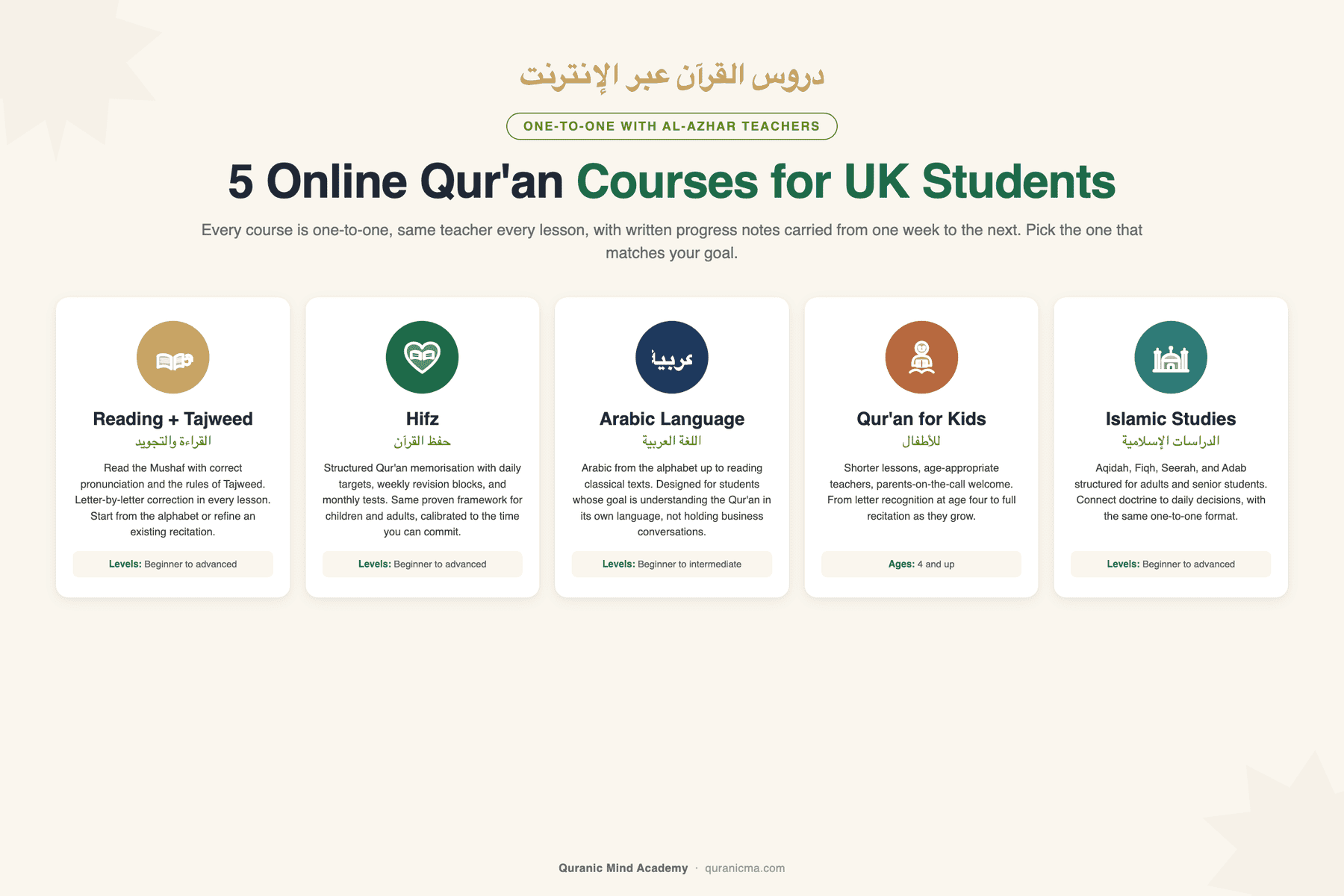
At Quranic Mind Academy we run five core programmes. Each is structured around a specific outcome.
Qur’an Reading and Tajweed
The foundation. Students learn to read the Mushaf with correct pronunciation and the rules of Tajweed (the science of how letters should sound, where to pause, when to elongate). The Qur’an itself instructs:
“And recite the Qur’an with measured recitation.” (Qur’an 73:4)
Full curriculum is covered on the Tajweed Course page and the underlying rules on Tajweed Rules. Suitable for absolute beginners through advanced reciters refining their letters.
Qur’an Memorisation (Hifz)
Structured Hifz with daily targets (the new portion), weekly revision blocks (recently memorised material), and monthly tests (older revision). Children and adults follow the same framework, calibrated to the time they can realistically commit. Full programme on the Quran Memorisation page.
Arabic Language
Arabic from the alphabet up to reading classical texts. Designed specifically for students whose goal is to understand the Qur’an in its original language rather than to hold business conversations in Arabic. Course detail on the Learn Arabic page.
Qur’an for Kids
Shorter lessons, age-appropriate teachers, parents-on-the-call welcome. We start as young as four for letter recognition and progress to full recitation. Dedicated programme on the Online Quran Classes for Kids page.
Islamic Studies
Aqidah (creed), Fiqh (jurisprudence), Seerah (the Prophet’s biography), and Adab (manners and ethics), structured for adult learners and senior students. Full detail on the Islamic Studies page.
How a Typical Lesson Runs
For a 45-minute Tajweed lesson with an adult student at intermediate level, the structure looks like this:
- Minutes 0 to 5: Greeting, recap of last week, du’a before starting.
- Minutes 5 to 20: Student recites the homework portion. Teacher corrects in real time.
- Minutes 20 to 30: Teacher explains one or two Tajweed rules that came up, with examples from elsewhere in the Mushaf.
- Minutes 30 to 40: Teacher recites the next portion. Student repeats, line by line, until pronunciation is set.
- Minutes 40 to 45: Homework assigned, lesson notes shared, brief du’a to close.
Children’s lessons follow the same shape but compressed into 30 minutes with games and visual aids built in. Hifz lessons replace the Tajweed-rule explanation with new memorisation and old revision.

Choosing the Right Online Qur’an Academy: 7 Filters That Matter
There are dozens of online Qur’an services serving the UK market. Most are competent. A few are not. These are the questions that separate them.
- Teacher certification. Look for Ijazah (a written chain of transmission going back to the Prophet ﷺ) and graduation from a recognised institution such as Al-Azhar. Ask to see proof, not just claims.
- One-to-one, not one-to-many. Group classes are cheaper but the correction quality collapses. Confirm the lessons are truly one student per teacher.
- Same teacher every lesson. Rotating teachers means no one knows your specific habits and weaknesses. Choose a service that assigns you a single teacher you stay with.
- Written progress tracking. Ask whether the teacher keeps notes, what is recorded each lesson, and how progress is reported to you (or to the parent for children’s lessons).
- Free trial that is actually a real lesson. Some “free trials” are five-minute sales calls. A real trial should be a full 30-minute teaching session so you can judge the teacher.
- UK-appropriate scheduling. Confirm the academy offers slots that fit UK working hours and school timetables, not only Egypt or Pakistan time.
- Female teachers available for female students. Many sisters prefer or require a female teacher. The academy should have qualified female teachers on staff, not as an afterthought.
Quranic Mind Academy meets every one of these. The free trial is a genuine 30-minute teaching session with the teacher you would actually study with.
Common Concerns Parents and Adults Ask About
“Will my child stay engaged on a screen for 30 minutes?” The first lesson tells you. Good children’s Qur’an teachers use games, rewards, and visual aids that hold attention better than a passive classroom. We have students as young as five who request extra lessons.
“What if the internet drops mid-lesson?” The teacher pauses, you both reconnect, and the lesson resumes from where it stopped. If a full session is lost, it is rescheduled at no charge.
“Is online safe for children?” Yes, when done properly. Parents are welcome to sit in. Lessons are conducted through standard platforms (Zoom, Google Meet) with the same safeguards as any educational service. No private messaging outside lesson time.
“What equipment do I need?” A laptop, tablet, or smartphone, a stable internet connection, headphones (recommended for clear audio), and a physical or digital Mushaf. Nothing more.
“What if I cannot read Arabic at all yet?” Most adult students start there. The first eight to ten lessons cover the Arabic alphabet, the short vowels, and the basics of joining letters. You will read your first word from the Mushaf within the first month.
Pricing, Payment, and What the Free Trial Includes
Lesson packages are priced per month and scale with the number of weekly lessons. The full breakdown is on the Pricing Plans page, and the academy accepts payment by card or bank transfer in GBP.
The free trial includes a full 30-minute teaching session with one of our certified teachers. There is no card required to book it. After the trial, you receive a recommendation on which course suits your level, a suggested teacher to continue with, and a suggested lesson frequency. If you choose not to continue, there is no follow-up pressure.
Getting Started in Three Steps
- Book the free trial. Tell us your level (or your child’s age and current ability), your preferred timing, and whether you want a male or female teacher.
- Take the trial lesson. Meet the teacher, recite or read what you can, and ask any questions about how the academy works.
- Choose your package. Lessons begin the following week, with your assigned teacher, at the times you set.
The whole onboarding takes less than a week from first enquiry to first paid lesson.
Related Guides
- Quran lessons for beginners: where to start if you have never read the Mushaf before.
- Learn Quran for adults: how the courses are paced for adult learners with jobs and families.
- Online Quran classes for kids in the UK: the children’s programme in detail.
- Learn Quran from home: a wider guide to building a home-study routine.
- Tajweed rules: the underlying science covered in the recitation course.
Frequently Asked Questions
Can complete beginners join online Qur’an classes?
Yes. Roughly half of our adult students cannot read the Arabic alphabet at the start. The first course (Qur’an Reading and Tajweed) begins with letter recognition and short vowels before moving to joined-letter words and then full ayat. You should expect to read short verses by the end of your second month.
Are the teachers certified?
All of our teachers hold Ijazah in recitation and graduated from Al-Azhar University or an equivalent recognised institution. Certification is verified before a teacher joins the academy.
Can I learn the Qur’an with Tajweed online or do I need an in-person teacher?
Online works extremely well for Tajweed because the teacher can hear every letter at the same fidelity they would in a room. What you cannot replicate online is the physical community of a halaqah, which is a real loss; that is why we recommend keeping some link with your local masjid even while you do the lesson work online.
Do you teach both adults and children?
Yes. Adult and children’s classes use different teachers, different pacing, and different lesson structures. Most teachers specialise in one or the other.
What do I actually need to start?
A device (laptop, tablet, or phone) with a camera and microphone, a stable internet connection of at least 5 Mbps, headphones, and a Mushaf (physical or digital). No installed software beyond the standard video-call app.
How flexible are the schedules?
We offer morning, afternoon, evening, and weekend slots in UK time zones. The most popular slots for working adults are 6 to 8am and 8 to 10pm. The most popular slots for children are 4 to 6pm after school. Booking is per-week, so you can adjust as commitments change.
What makes Quranic Mind Academy different from other online Qur’an services?
Three things, in order. First, every teacher is Al-Azhar-trained and Ijazah-holding, with proof on file. Second, every student gets the same teacher every lesson, with written notes carried forward week to week. Third, the free trial is a real 30-minute lesson, not a sales call, so you judge the teacher before you pay anything. The combination is harder to find than any one of them alone.
Book your free trial when you are ready.

One Response