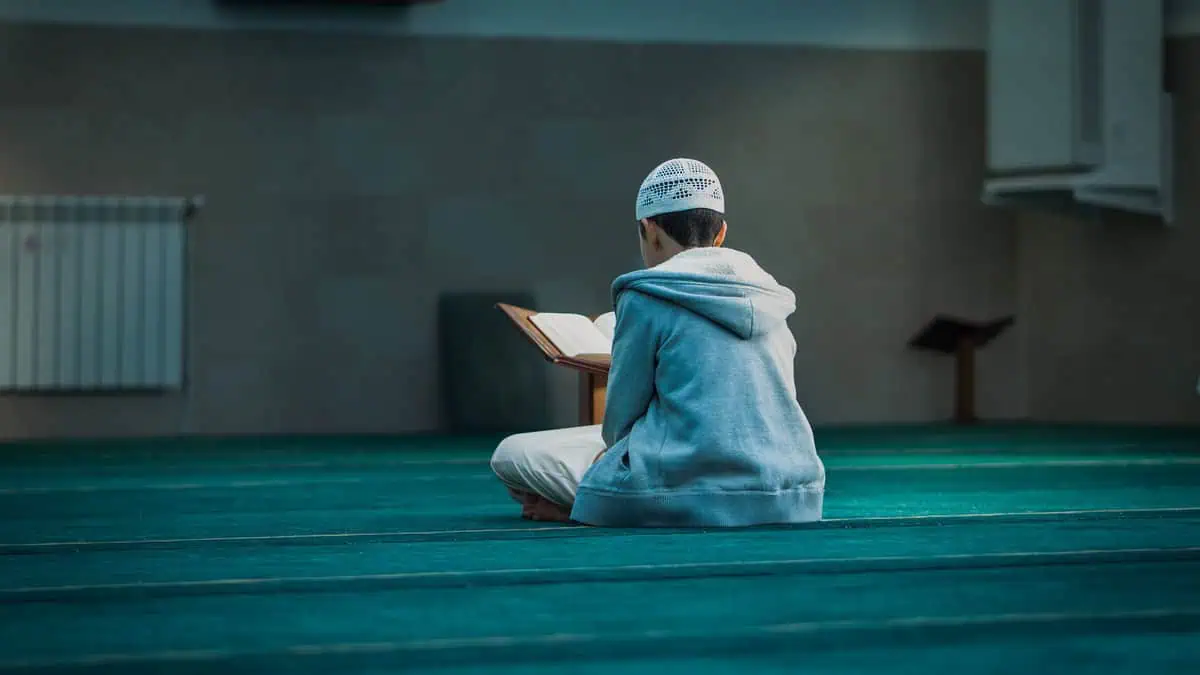
Most people first hear the word hifz in a mosque or a family conversation, usually attached to a child who is memorizing the Quran. The picture that comes to mind is a young student rocking gently over an open mushaf, repeating a line until it sticks. That picture is real, but it is only a small part of what hifz actually is.
Hifz is one of the oldest and most respected acts of worship in Islam, and it is open to far more people than most families assume. This guide explains what hifz means, why it carries so much weight, whether it is obligatory, what the journey really involves, and how to take a sensible first step, whether the student is six or sixty.
What Is Hifz? A Clear Definition
Hifz (حفظ) is the memorization of the Quran by heart, so that it can be recited accurately from memory without looking at the text. A person who completes the memorization of the entire Quran, all 114 surahs and roughly 6,236 verses, is given the honorary title hafiz (for a man) or hafiza (for a woman).
In everyday use, “hifz” can describe two things. It can mean the complete memorization of the whole Quran, which is the goal of a full hifz programme. It can also describe the ongoing practice of committing portions to memory, which every Muslim does to some degree when they learn Surah Al-Fatiha and a handful of short surahs for their daily prayers. Both are hifz. The difference is scale and intention.
One point worth clearing up early: hifz is memorization, not translation or interpretation. A hafiz holds the exact Arabic words in their heart. Understanding the meaning is a separate and equally valuable pursuit, and the best programmes weave the two together, but the act of hifz itself is the precise preservation of the revealed text.
The Meaning of Hifz: A Word That Means “To Guard”
The Arabic root of hifz is the three letters ha, fa, za (ح-ف-ظ). It carries the meaning of guarding, protecting, and preserving something so that nothing is lost from it. A night watchman, a person who keeps a promise, and someone who looks after a trust all draw on this same root.
That is why a person who memorizes the Quran is called a hafiz, which literally means “one who guards” or “a guardian.” They are not simply someone with a good memory. In the language of the Quran itself, they are a keeper of something precious.
This becomes striking when you look at how Allah describes His own relationship to the Quran. In Surah Al-Hijr, Allah says: “We have sent down the Quran Ourself, and We Ourself will guard it” (Surah Al-Hijr, 15:9, trans. Abdel Haleem). The word translated as “guard” here is la-hafizun (لَحَافِظُونَ), an active participle built from that same root ح-ف-ظ. The one who does hifz, then, becomes a carrier of the very words that Allah has promised to protect. The preservation of the Quran is guaranteed by Allah, and the hafiz is one of the human vessels through which that guarantee has been kept alive, generation after generation, for over fourteen centuries.
Why Hifz Matters: The Weight the Quran Gives It
Memorizing the Quran has always held a special place in Islam, and the reasons run deeper than tradition. The Prophet Muhammad (peace be upon him) tied the highest praise to those who take up the Quran and pass it on. He said: “The best among you are those who learn the Quran and teach it” (Sahih al-Bukhari 5027).
The reward described for a hafiz is not limited to this life. In a hadith reported by Abdullah ibn Amr, the Prophet (peace be upon him) said that the one devoted to the Quran will be told on the Day of Judgement: “Recite, ascend and recite carefully as you recited carefully when you were in the world, for your rank will be at the last verse you recite” (Sunan Abi Dawud 1464, graded hasan sahih by Al-Albani). The more a person carries, the higher they are invited to rise.
There is also honour in the company a hafiz keeps. Aisha reported that the Prophet (peace be upon him) said: “Such a person as recites the Qur’an and masters it by heart, will be with the noble righteous scribes (in Heaven). And such a person exerts himself to learn the Qur’an by heart, and recites it with great difficulty, will have a double reward” (Sahih al-Bukhari 4937). That second half matters. The student who wrestles with every line is not falling behind in the sight of Allah. Their struggle is counted twice.
Is Memorizing the Whole Quran Obligatory?
This is one of the most common questions families ask, and the answer has two parts.
Memorizing the entire Quran is what scholars call fard kifayah, a communal obligation. This means the Muslim community as a whole is required to have people who preserve the complete Quran by heart. As long as enough people carry that responsibility in every generation, the obligation is fulfilled on behalf of everyone. If a whole community were to abandon it, all of them would share the blame. This is one of the ways the chain of memorized transmission has never broken.
On an individual level, every Muslim is required to memorize at least Surah Al-Fatiha, because the daily prayer cannot be performed correctly without it. Most scholars treat reciting a further surah after it as a sunnah (islamweb fatwa 124147), while the Hanafi school holds that reciting a surah with al-Fatiha in the first two rak’ahs is wajib (islamweb fatwa 62272), so in practice most Muslims also learn a few short surahs. So while becoming a full hafiz is not obligatory on each person, a small amount of hifz is part of every Muslim’s practice, whether they think of it that way or not.
The encouraging takeaway is that hifz is not an all-or-nothing pursuit. Memorizing five surahs is a genuine and rewarded act of hifz. There is no failure in memorizing part of the Quran; there is only the presence or absence of a next step.
What the Hifz Journey Actually Looks Like
Behind the title of hafiz sits a structured routine that has been refined for centuries. Most sound hifz programmes move through four interlocking activities rather than simply “learning new pages until you finish.” Understanding these four parts explains why hifz takes patience, and why revision is the real engine of memorization.
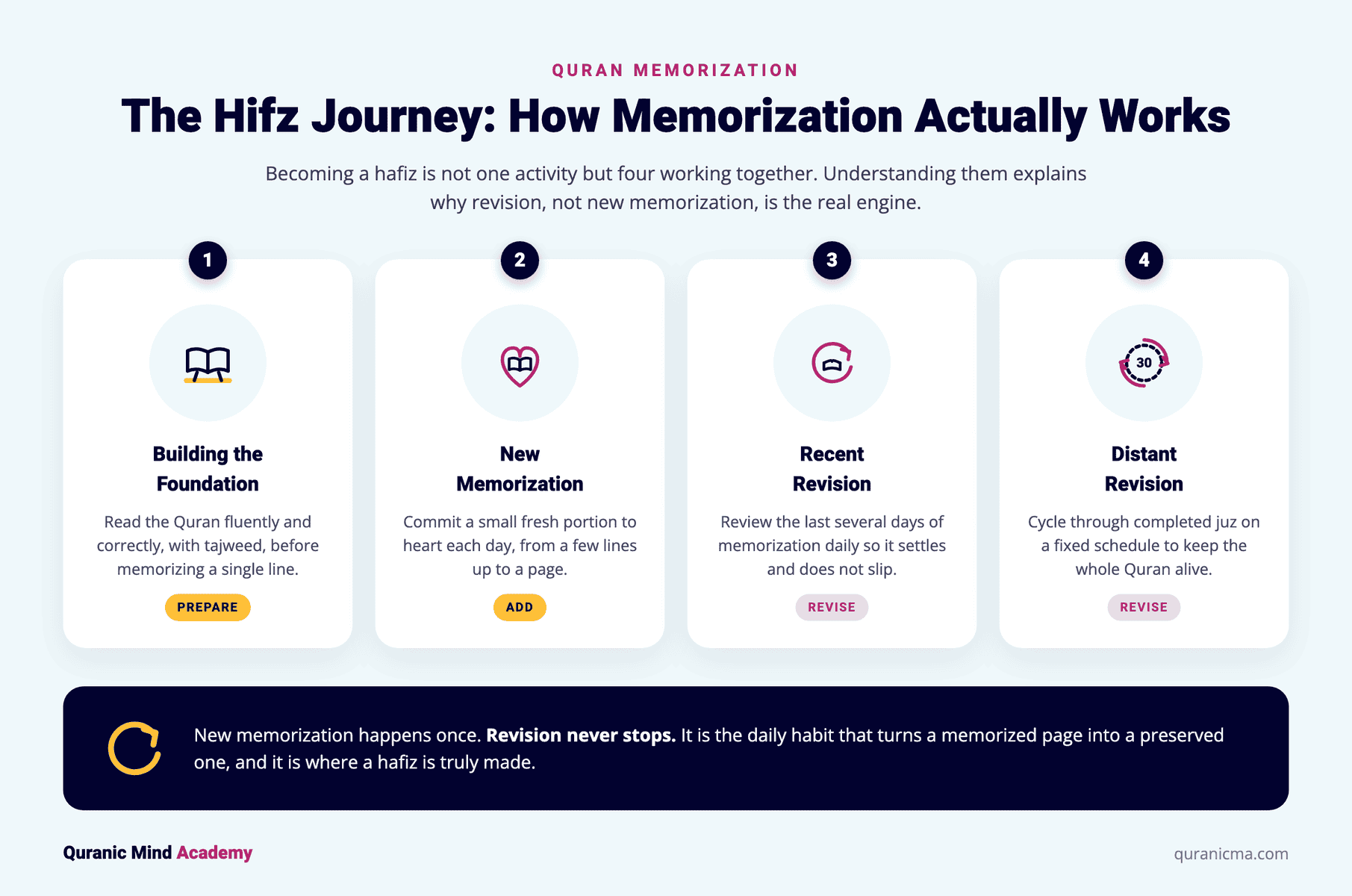
The four activities of a Hifz routine. Revision, not new memorization, is the engine that keeps the whole Quran preserved.
| Stage | What it means | Daily focus |
|---|---|---|
| Building the foundation | Reading the Quran fluently and correctly, with tajweed, before memorizing anything | Accurate reading from the mushaf, letter articulation, pronunciation |
| New memorization | The fresh portion committed to memory each day, from a few lines up to a page | Repeating the new passage until it is firm and can be recited without looking |
| Recent revision | Reviewing what was memorized over the past days and weeks so it does not slip | Reciting the most recent pages daily while they are still settling |
| Distant revision | Keeping older, well-established portions alive across the whole Quran | Cycling through completed juz on a fixed weekly or monthly schedule |
Notice how much of this is revision rather than new memorization. This is one of the most misunderstood parts of hifz. New memorization happens once, but revision never stops, and in practice it fills most of a serious student’s day. New memorization is the easy part. Holding on to what you have already memorized, sometimes years later, is where a hafiz is truly made. A strong foundation in reading and tajweed before starting also prevents a common problem, where a student memorizes mistakes that are then very hard to unlearn.
How Long Does Hifz Take?
There is no single honest answer, because the timeline depends on age, starting level, daily time, consistency, and the quality of teaching. In our teachers’ experience, a full-time young student in a dedicated programme often completes hifz in two to four years. A working adult memorizing part-time, perhaps half a page a day with steady revision, might take considerably longer, and that is completely normal.
What matters far more than speed is consistency. Fifteen focused minutes every single day will carry a student further over a year than a three-hour session once a week. If you want a practical breakdown of techniques that make memorization stick, our guide to the most effective methods to memorize the Quran walks through the routines teachers actually use.
Can Adults Become Huffaz, or Is It Only for Children?
The belief that hifz belongs to childhood is one of the biggest obstacles standing between adults and the Quran, and it is simply not true. Children often memorize quickly because their schedules are open and their minds absorb sound easily. Adults bring something children cannot: understanding, discipline, and a chosen, deliberate love for what they are doing. Many people begin their hifz in their thirties, forties, and beyond, and complete it, and our online Quran classes for adults are built for exactly that.
Allah Himself frames the Quran as approachable. He says: “We have made it easy to learn lessons from the Quran: will anyone take heed?” (Surah Al-Qamar, 54:17, trans. Abdel Haleem). The ease is promised in the text itself. And for any adult who feels the words come slowly, the earlier hadith is worth remembering: the one who finds recitation difficult and perseveres is given a double reward. Difficulty is not a sign that hifz is not for you. It is the very thing being rewarded.
5 Common Misconceptions About Hifz
A few myths quietly discourage people from ever starting. Here are the ones worth putting to rest.
- “You have to be a child.” Adults memorize successfully every day. The method matters more than the age.
- “You must be an Arab or fluent in Arabic first.” Hifz is memorization of sound and text. Many huffaz around the world are non-Arabs who do not speak Arabic conversationally. Learning the meaning is encouraged, but it is not a prerequisite for beginning.
- “It is just mindless repetition.” Good hifz is a skill built on correct reading, listening to a skilled reciter, structured revision, and understanding. Repetition is one tool among several, not the whole craft.
- “If you forget a verse, you have committed a sin.” Forgetting despite regular effort is not sinful. What scholars warn against is letting what you have learned slip away through laziness or neglect, and some, such as al-Nawawi and al-Suyuti, count that a major sin (islamweb fatwa 19564). Revision is care, not fear.
- “There is no point unless you memorize all thirty juz.” Every portion memorized is rewarded and useful in prayer. Partial hifz is real hifz.
How to Start Your Hifz Journey This Week
You do not need to enrol in a two-year programme to begin. You need a first step that you can actually repeat tomorrow. Here is a realistic starting point for a complete beginner.
- Fix your reading first. If you cannot yet read the Arabic script fluently, start there. Solid, accurate Quran reading and recitation is the ground that all memorization stands on.
- Choose a small, fixed daily portion. Two or three lines a day is plenty at the start. Consistency beats intensity every time.
- Listen before you memorize. Hearing a skilled reciter repeat your portion trains correct pronunciation and rhythm before the words ever leave your own lips. A good Quran memorization app can make this easy to do on a commute.
- Revise yesterday before you add today. Always recite the previous day’s portion from memory before touching anything new.
- Pair hifz with tajweed. Memorizing with correct rules from the start saves you from relearning later. Combining the two in a structured course, such as our approach to memorizing the Quran with tajweed online, keeps quality and quantity moving together.
- Get a teacher to listen to you. Self-study can start the habit, but a qualified teacher catches the errors you cannot hear yourself making. In our teachers’ experience, this does more than anything else to speed up a student’s progress.
Frequently Asked Questions About Hifz
What does hifz mean in Islam?
Hifz means memorizing the Quran by heart so it can be recited accurately from memory. The word comes from an Arabic root meaning to guard or preserve. Someone who memorizes the entire Quran is called a hafiz or hafiza.
How many verses are in the Quran to memorize?
The Quran has 114 surahs and roughly 6,236 verses, arranged into 30 sections called juz. Full hifz means memorizing all of them, but memorizing any portion is a valid and rewarded act of hifz.
Can I do hifz as an adult?
Yes. Adults regularly complete hifz. Progress may feel slower than it does for children, but adults benefit from discipline, understanding, and motivation. The Quran describes itself as made easy to remember, and the one who perseveres despite difficulty earns a double reward.
Do I need to know Arabic to memorize the Quran?
No. Many huffaz are not native Arabic speakers. Hifz is the memorization of the Quran’s text and sound. Learning the meaning alongside it is strongly encouraged and deepens the experience, but it is not required to begin.
Is it a sin to forget the Quran after memorizing it?
Forgetting despite sincere effort is not sinful. Many scholars warn that forgetting through neglect, by leaving recitation and revision, is blameworthy, and some, such as al-Nawawi and al-Suyuti, count it a major sin (islamweb fatwa 19564). This is why consistent revision is treated as the heart of hifz, not an optional extra.
How long does it take to become a hafiz?
It varies widely. In our teachers’ experience, a dedicated full-time young student may finish in two to four years, while a part-time adult may take longer. Daily consistency has a far bigger effect on the outcome than raw speed or talent.
Your Next Step
Hifz is not reserved for a gifted few or for one age group. It is a structured, teachable journey that has kept the Quran perfectly preserved for fourteen hundred years, and it has room for you or your child in it. The first step is not memorizing a whole juz. It is starting one small portion, correctly, with someone qualified to guide you.
At Quranic Mind Academy, our online Quran memorization (Hifz) programme pairs each student with a specialised teacher who builds a plan around their age, level, and available time, with revision structured in from day one. If you would like to see how it works before committing, you can book a free trial class and meet a teacher first.
Related reading: